TaxCure WP

Search results for: “profiles”

  • How & Why Get Featured on TaxCure and Boost Your Visibility

    Get Featured on TaxCure: Share Your Expertise & Stand Out Nationwide

    Your real-world experience can help taxpayers—and help you grow your reputation.

    We’re inviting TaxCure Pro Members to contribute real-world insights by answering select open questions. These responses will be reviewed and, if selected, featured in relevant TaxCure content including blog posts, resource pages, and FAQs that get national traffic.

    🚀 Why Contribute?

    • Boost Your Profile Visibility on TaxCure
      We’ll credit you by name and link directly to your TaxCure profile—making it easier for taxpayers to find and contact you.
    • Attract More Leads from High-Traffic Pages
      TaxCure’s content reaches thousands of taxpayers each month. Being featured on national topic pages (not just your local listing) gets you in front of a broader audience.
    • Build Your Brand as a Trusted Authority
      Publishing educational content with your name shows both taxpayers and search engines that you’re an expert in your field.
    • Improve Your SEO Footprint
      When you’re quoted or featured on TaxCure, those mentions and links can send trust signals to search engines—enhancing the visibility of your TaxCure profile and possibly your own website too.
    • Share What You Know—Only What You Know
      Only answer questions where you have real, first-hand experience. If nothing this month fits your expertise, that’s okay—we update questions monthly to cover a variety of topics.

    💬 What Does “Getting Featured” Look Like?

    Here’s a real example of how we’ve started integrating expert contributions:

    You’ll see:

    • Direct quotes
    • Real-world case studies
    • Embedded links to TaxCure Pro Member Profiles. 

    This type of national visibility is powerful. Not only does it help taxpayers better understand tax resolution from trusted pros—it helps you stand out in a sea of generic content and sales-driven firms.

    📬 How to Get Started

    1. Visit our Get Featured page here:
      👉 https://taxcure.com/member/professionals/pro-member-content/get-featured
    2. Review the current open questions. These are updated monthly.
    3. Click the “Submit Your Answer” button next to any question that fits your experience.
    4. Complete the short form with your answer and basic info.

    That’s it! We’ll review all submissions monthly and integrate the strongest insights into our content. If your answer is selected, we’ll credit you and link to your profile.

    🔁 New Questions Every Month

    We rotate questions each month to cover a broad range of IRS and state tax issues. If this month’s questions don’t fit your area of expertise, no worries—check back next month or watch your inbox for updates.

    👉 If you’re not receiving the monthly “Open Questions” email from TaxCure, let us know at support@taxcure.com so we can add you to the list.

    🎯 Final Thoughts

    This initiative is part of TaxCure’s ongoing mission to connect taxpayers with licensed professionals who bring real, hands-on expertise to the table.

    By contributing your experience, you help educate the public, improve your visibility, and grow your brand as a tax resolution expert.

    If you’re ready to stand out nationally—not just in your zip code—start answering questions today:

    👉 Visit the Get Featured Page »

  • How to Set Up Your TaxCure Profile for Maximum Visibility

    How to Set Up Your TaxCure Profile for Maximum Visibility

    Why Completing Your Profile Matters

    Your TaxCure profile is your online presence for potential clients seeking tax resolution services. To appear in search results, you must complete at least 70% of your profile. Profiles below this threshold will not be visible to taxpayers searching for help. We suggest getting as close to 100% as possible for maximum visibility and taxpayer engagement. 

    A well-optimized profile will:

    • Improve your visibility on TaxCure
    • Help match you with the right clients based on your expertise
    • Increase inquiries and conversions
    • Establish trust and credibility through detailed information and reviews

    Let’s go step-by-step through each section of your profile to ensure you meet or exceed the 70%+ completion threshold.

    Table of Contents

    Profile Percentage Meter

    Why This Matters

    The profile percentage meter tracks your completion progress and highlights what needs improvement.

    • Found on your dashboard when logged into TaxCure
    • The profile percentage meter is shown in blue. As you complete items, they will be removed from the list. Some may stay longer, like customer and peer reviews, since you can continuously add to them. While the system suggests obtaining at least 5 customer reviews, adding more reviews provides significant benefits, so don't stop there!
    • Each section you fill out increases your profile percentage
    • Once you hit 70%+, your profile becomes visible in search results
    • Below 70%? Your profile will not appear in search results until it meets the minimum threshold.
    • Once you exceed 70%, Google will index your profile, helping with branded search rankings.
    • TaxCure prioritizes completed profiles to ensure the best user experience for taxpayers.

    About Section

    Why This Matters

    The About section is your introduction to potential clients. It should clearly highlight your experience, qualifications, and most importantly, how you can help clients resolve their tax issues.

    Requirements & Best Practices

    • Must be between 50 and 500 words
    • No links, phone numbers, or AI-generated content
    • Should be 100% unique (do not copy from your website or other profiles)

    What to Include

    Your background (years of experience, credentials, and key achievements)
    Types of tax problems you help with (IRS, state, personal, business tax resolution)
    Your approach to tax resolution (how you work with clients to solve issues)
    Call to action (e.g., "If you need tax relief solutions, I can help.")

    📌 Example:

    As an Enrolled Agent with over 10 years of experience, I specialize in helping individuals and businesses resolve IRS and state tax problems. I have successfully negotiated installment agreements, offers in compromise, and tax penalty abatements. My goal is to provide personalized tax solutions to help clients regain financial stability. If you are struggling with tax debt, I can help find the right resolution for you.

    To Edit this section, simply click the + button as seen below:

    Adding Tax Agencies, Problems & Solutions

    Why This Matters

    Selecting the right tax agencies, problems, and solutions ensures you show up in the correct searches when taxpayers are looking for help. Adding tax agencies first is required, as the problems and solutions sections related to the agencies you select will populate after you select the agencies.

    How to Add Tax Agencies

    1. Click "Edit Profile" from your dashboard
    2. Scroll to the Tax Agencies Servicced section
    3. Click “+ in this section” and select the IRS and/or state tax agencies you work with
    4. You can select as a basic member up to 5 tax agencies, including the IRS
    5. Click Save

    Adding Tax Problems & Solutions

    1. After adding an agency, select the tax problems you have experience with each agency you selected
    2. Then select the solutions you provide for each agency you have selected
    3. Click Save

    📌 Watch this video tutorial: How to Add Tax Agencies, Problems & Solutions


    Adding Tax Types & Taxpayer Types

    Why This Matters

    This section helps specify the types of taxpayers you assist and the tax matters you handle.

    How to Add Tax Types & Taxpayer Types

    1. Go to the "Tax Types" section in your profile settings
    2. Select all the tax types you have experience with (e.g., individual tax, business tax, payroll tax)
    3. Next, choose the taxpayer types you work with (e.g., individuals, businesses, self-employed)
    4. Click Save

    📌 Watch this video tutorial: Adding Tax Types & Taxpayer Types

    Professional Licenses & Designations

    Why This Matters

    Your professional licenses and designations add credibility and showcase your qualifications to potential clients.

    How to Add Your Licenses & Designations

    • Your primary professional license (EA, CPA, or Attorney) is automatically listed based on your registration.
    • If you have additional licenses or certifications, you can manually add them.
    • In this section, you can also include designations such as:
    • CTRS (Certified Tax Resolution Specialist)
    • NTPI Fellow (National Tax Practice Institute Fellow)
    • USTCP (United States Tax Court Practitioner)
    • CTRC (Certified Tax Representation Consultant)
    • And more!
    • If a designation is missing but is relevant to tax resolution, email admin@taxcure.com, and we will add it.

    Related Work Experience

    Why This Matters

    Your work experience section allows you to showcase your professional background, adding credibility to your profile.

    How to Add Your Work Experience

    • Go to the "Related Work Experience" section in your profile settings.
    • Click the “+” icon to add a new position.
    • Enter the following details:
    • Job Title (e.g., Enrolled Agent, Tax Attorney, CPA)
    • Company Name
    • Location (City, State)
    • Work Duration (Start Date – End Date)
    • If you are currently at this position, check the box to set it as "Present."
    • If you want this job title to appear in your profile summary (e.g., "EA at Trusted Tax Relief Company"), check the box that says "Show in Profile Summary."
    • Click Save to update your profile.

    Education Section

    Why This Matters

    Adding your education helps establish credibility and showcases your background in tax law, accounting, or finance.

    How to Add Your Education

    • Go to the "Education" section in your profile settings.
    • Click the “+” icon to add your prior education.
    • Enter your school name, degree, and field of study.
    • Click Save to update your profile.

    Associations & Memberships

    Why This Matters

    Adding your professional associations and memberships helps build trust and credibility with potential clients.

    How to Add Your Associations & Memberships

    • Go to the "Associations & Memberships" section in your profile settings.
    • Click the “+” icon to add relevant memberships.
    • Enter the association name (e.g., National Association of Enrolled Agents, American Bar Association, ASTPS, etc.).
    • Click Save to update your profile.

    Updating Contact Information

    Why This Matters

    Your contact information determines how taxpayers and TaxCure communicate with you. A complete and accurate contact section ensures proper lead generation and notifications.

    How to Update Contact Information

    • Go to the "Contact Information" section in your profile settings.
    • Define your address:
    • This is important because it helps TaxCure determine your visibility in search results.
    • You can enter a full address or just a city if you prefer privacy (exact street address is optional).
    • Enter your phone number:
    • This is the number that will be displayed only if you upgrade to TaxCure Pro.
    • Taxpayers will use this number to contact you directly.
    • Add website, social links, and booking link:
    • These fields are available but will only be visible to taxpayers if you upgrade to TaxCure Pro.
    • Set your preferences:
    • Indicate whether you accept office visits.
    • Enter your email for notifications:
    • This is the email where you will receive important updates, including:
    • Messages sent by taxpayers
    • Reviews approved
    • Other profile-related actions
    • If you upgrade to TaxCure Pro, you will also receive:
    • Phone call click notifications
    • Website click notifications
    • Additional insights on profile engagement

    Pricing, Offers & Payment Methods

    Why This Matters

    Defining your pricing structure and payment methods helps potential clients understand how you operate and what payment options are available to them.

    How to Add Your Pricing, Offers & Payment Methods

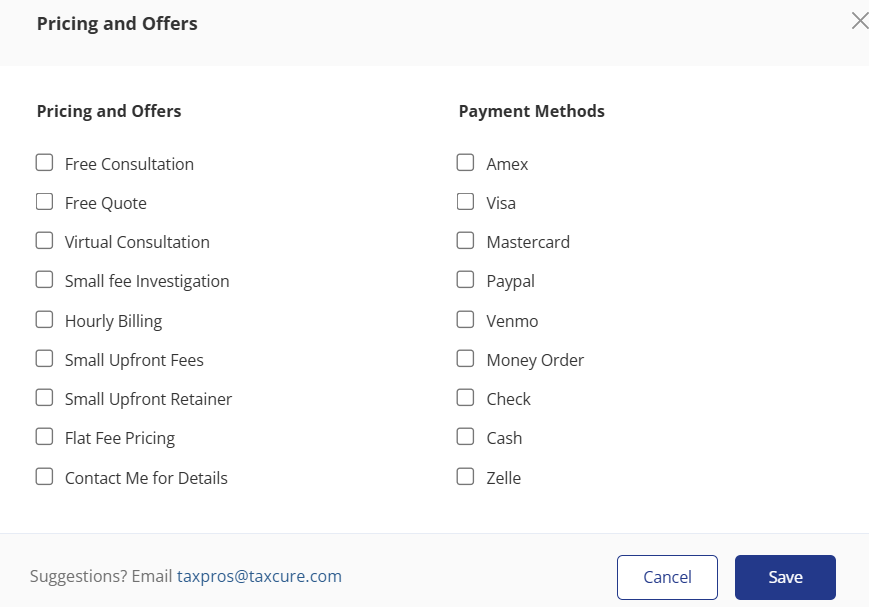
    • Go to the "Pricing & Offers" section in your profile settings.
    • Select the pricing methods that apply to your services, such as:
    • Free Consultation
    • Free Quote
    • Virtual Consultation
    • Small Fee Investigation
    • Hourly Billing
    • Small Upfront Fees
    • Small Upfront Retainer
    • Flat Fee Pricing
    • Contact Me for Details
    • Select your accepted payment methods, including:
    • Amex, Visa, Mastercard
    • PayPal, Venmo, Zelle
    • Money Order, Check, Cash
    • Click Save to update your profile.

    Publications

    Why This Matters

    Listing publications and speaking engagements helps establish your authority and credibility in the tax industry.

    How to Add Your Publications

    • Go to the "Publications" section in your profile settings.
    • Click the “+” icon to add a new publication.
    • Enter the following details:
    • Publication Type (Book, Web Article, Blog Post, Magazine, Journal, Podcast, Speaking Engagement, etc.)
    • Publication Name (e.g., Forbes, Wall Street Journal, Accounting Today)
    • Title of the publication
    • Link to the publication (if available)
    • Click Save to update your profile.

    Videos & Photos

    Why This Matters

    Adding videos and photos helps personalize your profile and make a stronger impression on potential clients.

    How to Add Your Videos & Photos

    • Go to the "Videos & Photos" section in your profile settings.
    • Click the “+” icon to upload media.
    • You can upload up to 5 combined videos and photos.
    • Recommended uploads include:
    • Photos of your team, office, or any professional branding materials.
    • Videos introducing your services, explaining tax resolution strategies, or showcasing client testimonials.
    • Embedded YouTube videos related to your tax business.
    • Click Save to update your profile.

    📌 Supported Video Formats: .mp4, .avi, .mov (suggested, include youtube embed)
    📌 Supported Image Formats: .png, .jpg, .jpeg, .gif, .webp
    📌 Max File Size: 300MB
    📌 Need Help? If you need assistance editing a photo or video, or have trouble uploading, email taxpros@taxcure.com.

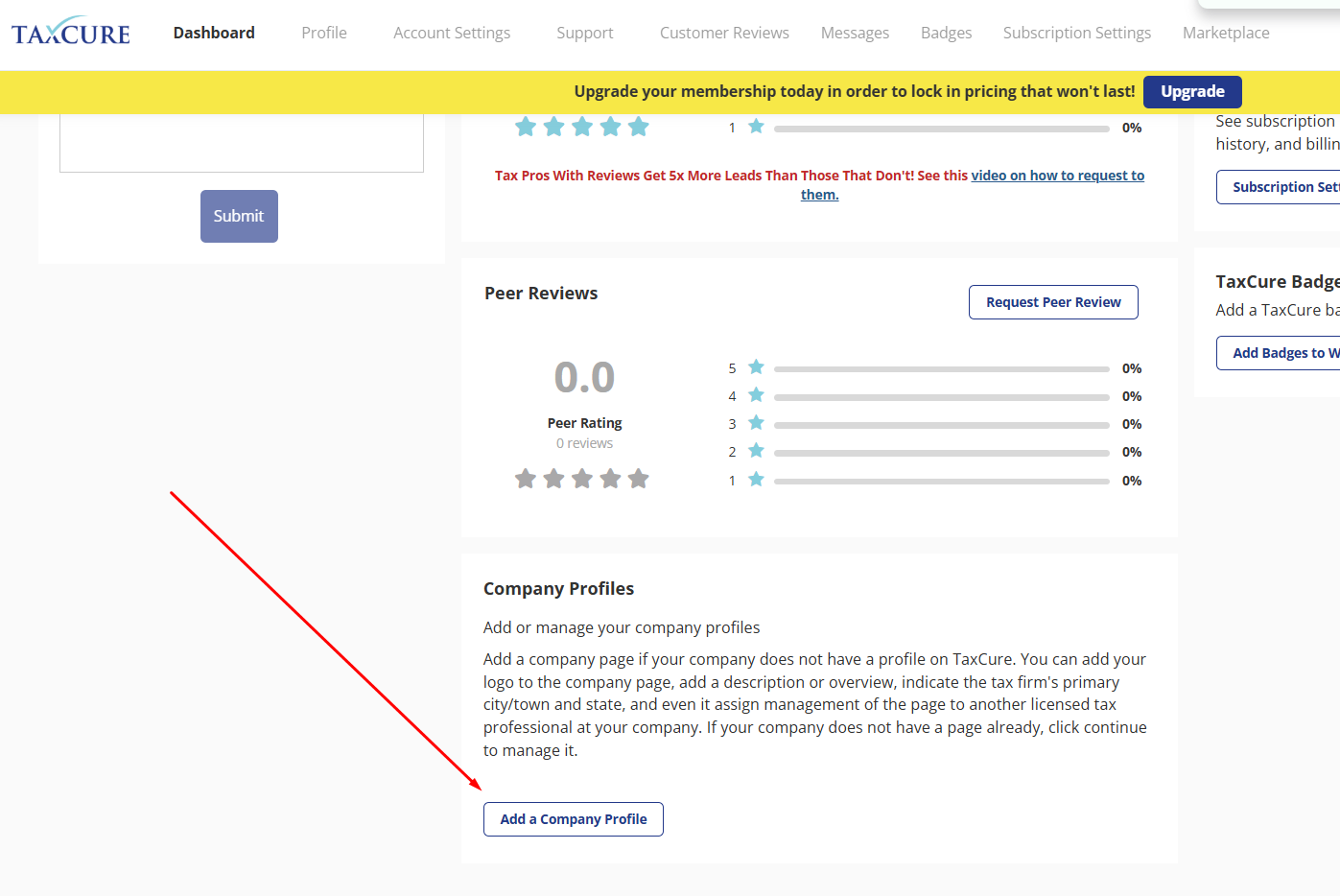
    Setting Up Your Company Profile (If Applicable)

    If you have a tax firm, creating a company profile increases your credibility and visibility.

    📌 Watch this tutorial: How to Create a Company Profile Page

    Requesting Reviews (Client & Peer)

    Reviews help establish trust and increase profile visibility.

    How to Request Client Reviews

    1. Go to your profile dashboard
    2. Click “Request Review”
    3. Send the link to past clients

    📌 Watch this tutorial: How to Request Client Reviews

    How to Request Peer Reviews

    1. Go to your profile dashboard
    2. Click “Request Peer Review”
    3. Send requests to colleagues

    📌 Watch this tutorial: How to Request Peer Reviews

    This request will send the email from the TaxCure platform. Be sure to have the carbon copy option selected, as this request may go into spam for them. We suggest that you then forward it to them and let them know that you send this request and their feedback would be much appreciated. 

    Final Steps: Profile Completion

    Once all sections are complete: ✅ Ensure your profile percentage is above 70%
    ✅ Your profile will now appear in TaxCure search results
    ✅ Google will index your page, helping with branded search rankings

    🎯 Next Steps:

    • Start requesting reviews to further boost your profile
    • Check out other tutorials to improve your visibility
    • Want to maximize your presence? Stay tuned for more optimization tips!

    By following this guide, your TaxCure profile will be fully optimized and ready to attract new clients. Need help? Reach out to support for assistance!

  • Use TaxCure to Find a Tax Resolution Professional

    How to Find a Tax Relief Professional on TaxCure

    Using Taxcure

    Looking for a tax professional to help with IRS or state tax problems? Then, use TaxCure to find a trustworthy, experienced, licensed pro today. TaxCure's mission is to help taxpayers connect with professionals who can resolve their tax problems. 

    The search process is simple – 

    • Start the search by selecting IRS, state agency, or both. 
    • Enter your zip code if desired.
    • Select up to three IRS tax problems and three state tax problems. 
    • Review the list of pros and choose the right fit for your needs.
    • Contact the pro for a consultation.

    TaxCure is absolutely free for taxpayers. We do not solicit information from taxpayers, and all messages sent through TaxCure go straight to the pros. Tax pro members pay for a listing on the site, but they do not pay for leads or connections. TaxCure does not get a commission or a fee when you connect with a tax pro. 

    TaxCure Purpose and Mission

    We created TaxCure to help taxpayers find quality help for their specific tax problems. TaxCure connects taxpayers to experienced professionals with verified reviews, who specialize in resolving tax problems.

    Many national tax relief firms prioritize sales over solutions, often leading to poor outcomes and wasted money for taxpayers. These companies have extensive marketing budgets designed to build name recognition, and they regularly appear on the lists of the best tax relief firms. 

    This restricts taxpayers' ability to find experienced professionals who can help with their problems and creates an environment where it's very difficult for taxpayers to find high-quality alternatives to the big nationwide firms. TaxCure's goal is to disrupt the tax relief industry and help taxpayers find trustworthy help directly from a tax pro.

    Step-by-Step Guide to Using TaxCure

    Follow these steps to find a tax pro on TaxCure.

    1. Choose the tax agency

    Select "Find a Local Tax Pro" on the top of the page or start your search in the widgets located throughout the site. Select IRS, IRS, and state, or just a state agency. Then, enter your zip code. If you don't, the site will use your IP address to find pros near you.

    2. Identify your tax problem

    On the next screen, select up to three problems you're having with the IRS and up to three problems with the state – for instance, audits, wage garnishments, or collection notices. Or if you have unfiled returns and unclaimed refunds, select "unfiled returns" or "refunds". The site will filter the search results to make sure you only see tax pros with relevant experience. 

    3. Refine results with advanced filtering

    Now you will see a list of tax pros, and you can narrow down the results even further with the site's advanced filtering which includes tax agencies, more tax problems, solution experience, state location, tax or taxpayer types, review ratings, professional licenses, and language spoken.

    4. Review professional profiles

    Each profile features the pros years of experience, areas of expertise, verified client reviews, licenses and certifications, and contact info. Review multiple profiles to find the right match for your needs.

    5. Contact your chosen professional

    Use the contact form on the profile to request a consultation or ask questions. You can call the pro directly or call them through the site. If the pro has scheduling set up through TaxCure, you can also schedule an initial consultation. Reach out to as many pros as desired until you find the best fit for your situation.

    How to Use TaxCure to Find a Tax Pro

    This step-by-step guide shows you exactly how to find a licensed tax professional for your specific IRS or state issue:

    Step Action Purpose
    1 Choose Tax Agency Pick IRS, state, or both to match your situation
    2 Enter Zip Code Filters for pros in your area (optional)
    3 Select Tax Problems System shows pros with matching experience
    4 Use Advanced Filters Filter by pro type, reviews, tax type, desired solution & more
    5 View Profiles See licenses, reviews, and expertise
    6 Contact a Pro Call or message directly to request help or consultation

    Key Features of TaxCure

    TaxCure provides real help to taxpayers in an industry that's often marked by aggressive marketing, predatory sales tactics, and a focus on profits over service. TaxCure offers taxpayers the following:

    • Transparent reviews: Real feedback from past clients to help you make informed decisions. You don't have to worry about pay-to-play advertising or manipulated reviews that only look at a handful of firms with no acknowledgment of the thousands of local pros focused on resolution work.
    • Comprehensive filtering: Find professionals who meet your exact needs based on the problem you're having and the solution you want. You don't have to call multiple firms to find the right experience. Instead, just use the filters to ensure the pros you see have the experience you need.
    • Local experienced pros: Connect with professionals near you with the right expertise. Don't get lost in the shuffle of a nationwide firm that lacks state-specific experience. Instead, find a local pro who can provide personalized help to your unique problem.
     

    TaxCure – the Best Choice for Finding Tax Relief Professionals

    Why is TaxCure the best choice for taxpayers looking for tax relief assistance? Because it's the only website with a verified directory of local tax pros – we personally verify the credentials of every pro listed on our site. All TaxCure members focus on tax resolution and have dedicated experience with this part of the tax code.

    TaxCure offers a transparent search process that stands out in an industry that's long been marked by deceptive practices. We don't use coercive sales tactics – instead, we focus on creating tailored searches that make it easy for taxpayers to find help. 

    By using TaxCure, you can find local, trustworthy help from a small firm. You don't have to rely on the big profit-mongering firms. Instead, you can work directly with a tax professional who prioritizes your satisfaction. Learn more about why to use TaxCure if you have a tax problem.

    Ready to find the right help for your tax problems? Start your search on TaxCure today and connect with trusted tax professionals who can resolve your issues with confidence. 

    Related Resources

    To learn more about the tax resolution industry and why you should consider a local pro over a big firm, check out these resources. 

    If you have a tax problem, there are three professionals who can represent you in front of the IRS and help with state tax problems. Learn more about each of these pros in the following resources.

    Alternative Ways to Search for Tax Pros on TaxCure

    In lieu of the above, you can also use the following strategies to search for tax pros on TaxCure:

    • Content pages – While reading content on this site, you will see a list of the pros who deal with that problem on the right side of the page. For example, if you're reading about wage garnishments in Wisconsin, you will see pros who have experience helping clients with wage garnishments. Hit "view profile" to see more details about each pro. 
    • Google search – When you search for a resolution pro by name in Google, you will generally see their TaxCure profile near the top of the search engine results. Then, you can click on the profile to learn more about the pro, or you can explore other resources about them such as their own website.
    • Professional directory – On TaxCure's professional directory page, you will see a list of links that lead to pros based on their agency experience, location, and/or credentials. Select IRS or a state agency from the list and then see the pros who work with those agencies. Or scroll further down the page to see a list of locations and start your search there.

    Don't wait. Use TaxCure to find and assess local tax pros today – whether you need help with the IRS or the state, you can find an experienced pro on this site today.

  • IRS Dispute? How and When to Petition the U.S. Tax Court

    Petitioning the U.S. Tax Court: A Guide for Taxpayers

    Tax Court Petition

    If you disagree with certain IRS decisions, you may need to take your case to the U.S. Tax Court. The Tax Court is a federal court independent of the IRS that hears civil cases between taxpayers and the IRS. The process starts with filing a petition.

    This post outlines the basics of how and when to file a Tax Court petition. Then, it looks at alternatives to going to Tax Court. Although you can represent yourself in front of the Tax Court, you should strongly consider working with a tax professional – use TaxCure to find a tax pro experienced with the US Tax Court today.

    Table of Contents

    What Is a Tax Court Petition?

    A petition is a formal request for a court order. When you petition the Tax Court, you are asking them to make a decision about a dispute you are having with the IRS. 

    For example, if you apply for innocent spouse relief and the IRS denies your request, you can petition the U.S. Tax Court. Then, the court will review your case and decide whether to uphold or change the IRS's original decision. 

    When Can You Petition the Tax Court?

    You can petition the Tax Court if you receive an IRS notice saying you have the right to petition, or if a certain amount of time has passed since you have requested innocent spouse relief or interest abatement. Generally, people petition the court when they disagree with a tax assessed against them, the IRS has threatened a collection action, or the IRS has told the State Department to take away their passports.

    However, that is simply a layman's overview. There are very strict rules on when you can petition the courts. You may petition the Tax Court for the following types of determinations, deficiencies, and certifications:

    IRS Notices That Allow You to Petition the U.S. Tax Court

    Here’s a quick reference table of common IRS notices and the deadlines to petition the Tax Court:

    Notice Type What It Means Petition Deadline
    Notice of Deficiency (CP3219N or 3219A) IRS proposes tax after audit or substitute return 90 days (150 if abroad)
    Collection Due Process Determination IRS plans levy or lien; you requested a CDP hearing 30 days
    Innocent Spouse Relief Determination IRS denied or ignored your request for relief 90 days or after 6 months of no response
    Interest Abatement Denial IRS denied your request or didn’t respond in 180 days After 180 days of no response
    Seriously Delinquent Certification IRS certified your debt to revoke your passport 90 days
    Whistleblower Determination IRS denied or reduced award for reported tax evasion 30 days
    • Notice of Deficiency – You may receive a notice of deficiency, such as a 3219N or 3219A, if the IRS makes changes to your return after an audit or after receiving additional information from other entities. You may also receive a notice of deficiency if you didn't file a return and the IRS assessed tax against you.
    • Notice of Determination on a Collection Case – For example, the IRS files a tax lien or proposes a levy on your assets.
    • Notice of Determination on a Request for Innocent Spouse Relief – You may petition the Tax Court if the IRS denies your claim for innocent spouse relief or if the IRS doesn't respond to your request within six months. Note the petition forms generally refer to this as a determination for a request for relief from joint and several liability. 
    • Notice of Determination on Worker Classification – If you disagree with the IRS's determination of your contractor as an employee, you can take the case to Tax Court.
    • Final Determination for Disallowances of Interest Abatement Claim – If the IRS denied your claim for interest abatement or hasn't responded to a request you made over 180 days ago.
    • Notice of Certification of Seriously Delinquent Debt – This is when the IRS certifies your tax debt as seriously delinquent, and then the State Department revokes or denies your passport.
    • Notice of Determination concerning Whistleblower Action – If you disagree with the IRS's decision about an award after you submit a whistleblower report.

    You may also want to file a petition if you receive a notice of determination or deficiency on a matter that you thought was already settled. Filing a petition stops the IRS from moving forward with assessments or collection actions, protecting you financially. In these cases, however, you should also contact the IRS directly.

    When is the Deadline for Filing a Petition with the U.S. Tax Court?

    The notice you receive should note the number of days you have to file a petition. For example, if you receive a notice of deficiency, you have 90 days from the date the notice was mailed to file a petition or 150 days if the notice was sent to you out of the country. In contrast, with most collection actions, you only have 30 days from the date the notice was mailed.

    These deadlines are very strict, and you will not be able to extend them. If you're unsure about the deadline, contact the IRS or reach out to a tax attorney for guidance as soon as possible. If you're dealing with a 30-day deadline, you have very limited time to start this process. 

    What if you miss the Tax Court petition deadline?

    If you miss the deadline, you will not be able to take your case to Tax Court, but you may have limited options, such as paying the tax and suing for a refund in district court.

    Steps to Prepare the Petition

    The petition requires your full name and spouse's name if filing a joint petition, the reason for the petition, the mailing date of the notice you received, the tax year related to the notice, and whether you want to use regular or small case procedures. 

    You also must note the type of case you are filing by ticking a box on the first line of the petition form. The options include notice of deficiency, determination, or certification, which are explained in more detail above.

    On line five of the petition, you outline the errors the IRS made and why you disagree. Make sure to list each item separately. For example, if the IRS disallowed your dependents, which in turn led to a disallowance of your head of household status and your earned income tax credit, you may note something like the following:

    1. I disagree with the IRS's disallowance of my dependents because each of the individuals claimed meets the tests for dependency. 
    2. I disagree with the IRS's disallowance of my head of household filing status because I meet the requirements to claim that status.
    3. I disagree with the IRS's disallowance of the earned income tax credit because it was correctly calculated on my return.

    Or, if you're replying to a collection determination, you may want to say something such as the following:

    I disagree with the IRS's decision to garnish my wages because:

    1. The wage garnishment would create financial hardship for me.
    2. I have proposed an alternative payment plan for the tax liability. 

    On line six, you should outline the facts that support your case. List each statement so that it correlates with the statements made on line five. To continue with the above examples, if you were contesting a determination about your filing status, dependents, and credits, you would outline why the individuals qualify to be claimed as dependents on line A, why you are entitled to the head of household filing status on line B, and why you qualify for the EITC on line C. 

    If contesting a wage garnishment, you would note on line 1 how the garnishment affects you financially and on line 2 how you propose to make payments. 

    Finally, sign your name, and if filing a joint petition, make sure that both you and your spouse sign. There is a $60 fee to file. If filing by mail, include a check or money order for your payment. If e-filing, you can pay online or note that you are mailing a check.

    Should you choose small case or regular procedures?

    If your dispute involves less than $50,000, you can opt to choose small case procedures. This option provides you with a faster and less formal process, but you will not be able to appeal the judge's decision if you disagree.

    Which documents should you include with your petition?

    Do not send any other documents or evidence with your petition, other than the items listed on the form. 

    Attach or upload the notice of deficiency, determination, or certification and any explanations of adjustments or appeals reports that came with the notice. Make sure to redact (black-out) your Social Security Number if it is on the notice, and also include a Statement of Taxpayer Identification Number. 

    Complete the Request for Place of Trial to note which city you'd like your trial to be in. For small cases, you can choose any of the listed cities, but for regular trials, you cannot choose any city that has an asterisk.

    If you prefer a remote trial, include a Motion to Proceed Remotely. You can make this request up to 31 days before the first day of the trial session. If the judge approves your request, they will send you info on the date, time, and Zoom details for the trial. 

    What if I forget to include information on my petition?

    If you forget to include information on the petition, file a motion asking the Tax Court if you can file an amended petition. If you're allowed to do so, make sure you include everything on the amended form.


    How to File a Petition in U.S. Tax Court

    You can e-file a petition on the Tax Court's website. Go to the Court's DAWSON system, create an account, and then follow the prompts to file a petition. You can answer questions and let the system create a petition for you. You can complete a PDF of the petition form and upload it to the system, or you can write your own petition. 

    If you prefer to file by paper, you can obtain a petition form from the Tax Court's website, which you can print and fill out or fill out online and then print. You can hand deliver paper petitions to the court or mail them to the following address:

    United States Tax Court
    400 Second Street, N.W.
    Washington, D.C. 20217-0002

    You cannot email or fax the petition.

    What Happens After Filing Your Petition?

    If you e-file the petition, the DAWSON system will provide you with your docket number when you're done filing. If you mail or hand deliver the petition, the Tax Court will acknowledge receipt by mail and send you a docket number. 

    The IRS will respond to your petition by either agreeing with or disputing your claims. If both you and the IRS agree on the facts of the case, you can opt to submit a fully stipulated case. That simply means that you send a list of the facts and documents to the court, and you indicate that both you and the IRS agree. Then, the judge reviews the case and makes a decision. You may not even need to go to trial.

    If you don't have a fully stipulated case or if the judge doesn't make a decision quickly, you will get a notice about the time and location of the trial session. The first day of the session is the calendar call, and that is when you learn your trial date and time. At this point, you and the IRS may still be able to settle without going to trial. If not, you will go to the scheduled trial, and you will be able to present your side of the story. 

    The judge may issue a decision from the bench or issue the decision after the trial. If the latter, you will get the decision by mail, and it will also be available on the Court's website. If you disagree, you can take the case to the federal court of appeals, unless you opted for the small cases procedures.

    Examples of Situations Requiring You to Petition the Tax Court

    Here are some sample scenarios of when taxpayers may need to petition the Tax Court. 

    Example one: Tax deficiency after an audit

    Say the IRS audits your tax return and disallows $10,000 in charitable deductions. You receive a notice of deficiency showing the tax owed due to the disallowed deductions, and you petition the Tax Court, arguing that you provided ample documentation to substantiate the deductions. The Tax Court reviews your claims and the IRS's claims and makes a decision.

    Example two: Interest abatement request

    You request an abatement of interest due to incorrect IRS advice. The IRS has not responded to you within 180 days. Even though you have not received a notice, you petition the Tax Court. The Tax Court reviews your information and makes a determination on whether or not to abate the interest.

    Example three: Innocent spouse relief denial

    You discover that your former spouse failed to report income without your knowledge, and now, you owe tax on a jointly filed return. You file for innocent spouse relief, but the IRS denies your claim. When you receive the determination letter, you petition the Tax Court for an independent review.

    Alternatives to Filing a Tax Court Petition

    Often, you have the right to request an administrative appeal before you have the right to petition the Tax Court. Whenever possible, you should start with an administrative appeal, as the process is easier to navigate.

    For example, if you disagree with an audit decision, you have the right to request an administrative appeal. But if you don't appeal, the IRS will send you a notice of deficiency, and at that point, you can petition the Tax Court.

    You may also appeal the following types of IRS decisions as well as some others:

    • Audit determinations
    • Denial of penalty abatement request
    • Denial of innocent spouse relief request
    • Offer in compromise rejection
    • Determination that you owe a penalty
    • Determination of tax-exempt status. 
    • Determination affecting qualification of a retirement plan. 

    With some of the above issues, if you don't appeal, the IRS's decision will stand. For example, if the IRS rejects your offer in compromise and you don't appeal within 30 days, the IRS can start involuntary collections against you. 

    With others, in contrast, you have the right to petition the Tax Court even if you miss the window for the collection appeals process. For example, if the IRS does not approve your request for innocent spouse relief and you miss the appeal window, you can petition the Tax Court.

    In other situations, you have other appeal rights. To give you an example, say that you miss the appeals window on a denial of a claim for refund. After you receive the notice of claim disallowance, you may file suit with the US. District Court or the U.S. Court of Federal Claims but not with the U.S. Tax Court.

    If you do not have the right to petition the Tax Court, you may be able to take your case to the U.S. District Court of Federal Claims or the U.S. Court of Federal Claims. However, with both of these courts, you generally must pay the amount due and then request a refund. You only have two years from the notice of claim disallowance to file a refund suit. 

    Because the rules are so specific, you should strongly consider working with a tax professional. Fortunately, TaxCure makes the process of finding an experienced pro easier than ever before. Simply start the search, select "Tax Court" as your tax problem, and then review tax pro profiles.

    Tax Court FAQs

    What happens if I miss the petition filing deadline?

    You cannot extend the filing deadline for Tax Court petitions. If you miss the deadline, you cannot take your case to Tax Court, but you may be able to pay the tax and request a refund in another court.

    Can I represent myself in Tax Court?

    Yes, you have the right to file your own petition and represent yourself in Tax Court. However, the process is very complex, and you may want to hire someone to represent you.

    Check out these guides to learn more:

    How much does it cost to file a Tax Court petition?

    As of 2025, the fee to file a petition is $60, but you may be able to get the fee waived if you qualify as low-income.

    Do I need to hire a tax attorney or USTCP for Tax Court?

    If you don't want to represent yourself, you can hire a tax attorney or a US Tax Court Practitioner (USTCP) which is an enrolled agent or CPA who has passed a test to practice in front of the Tax Court.

    How long does the Tax Court process take?

    The trial may be scheduled within six months, but often, the trial is scheduled later than that. Once you file your petition, the IRS has 60 days to respond, and then, the Tax Court will move forward with scheduling the trial.

    The Tax Court gives taxpayers an independent forum for resolving disputes with the IRS. Petitioning the Tax Court allows you to get a second opinion on IRS disputes. It also prevents the IRS from taking collection actions while the case is pending. 

    You are allowed to represent yourself, but for best results, you may want to work with a tax professional. Using TaxCure, you can search for pros who have experience with the U.S. Tax Court, and you can further narrow down your search results to find pros who have experience with your specific concern, whether that's a notice of deficiency, a determination, a certification, or another problem.

  • What Is a US Tax Court Practitioner? Tax Court Representation

    What Is a US Tax Court Practioner? How Can They Help?

    Tax Court Representation

    If you need to take a case to Tax Court, there are two pros who can represent you – attorneys and United States Tax Court Practitioners. There are only about 270 professionals who have the USTCP designation in the United States. These pros can represent you in front of the IRS and in US Tax Court, but they cannot represent you for criminal tax cases

    This post explains the role of USTCPs, their credentials, and how they can help taxpayers with IRS disputes. It also includes links to USTCP profiles so that you can easily find someone with the legal knowledge and experience to help you through your case.

    Key takeaways

    • What is a USTCP? A non-attorney admitted to practice in Tax Court.
    • USTCPs help clients who have disputes with the IRS argue cases in Tax Court.
    • USTCPs are non‑attorneys who have passed the Tax Court’s written exam; while many are EAs or CPAs, any individual who meets the Court’s admission requirements can sit for the exam

    What Is a USTCP Tax Professional?

    US Tax Court practitioners are non-attorney tax professionals who can represent clients in front of the US Tax Court. Enrolled agents and Certified Public Accountants earn this designation by passing the Tax Court Bar and meeting character requirements. There are fewer than 300 USTCPs in the United States.

    Who else can represent you in Tax Court?

    The only tax professionals who can represent you in front of the Tax Court are attorneys and USTCPs. 

    Benefits of Hiring a USTCP Tax Professional

    When you hire a USTCP, you get to work with a professional who has the tax credentials of an enrolled agent or CPA, but you also get a pro who has studied the Internal Revenue Code and the Tax Court process extensively. 

    By working with a USTCP, you get the benefits of a tax professional as well as someone who can represent you in court. EAs and CPAs can prepare tax returns and represent you in audits, but they can also prosecute civil cases against the IRS. 

    Although their fees are not inexpensive, USTCPs often cost less than an attorney, and if you need low-cost or pro bono help, you may be able to find an aspiring USTCP who donates their time to clients in need of representation through a Low-Income Taxpayer Clinic or another organization.

    Attorney Vs. USTCP

    Ultimately, an experienced attorney or a USTCP can represent you in Tax Court, and the most important consideration is their experience in Tax Court with your type of case. However, there are a few differences between these two types of professionals.

    Education

    Attorneys typically complete more education than most CPAs and enrolled agents. Attorneys must earn a bachelor's degree and a juris doctorate degree, and some also go on to complete a Master of Law (LLM) in taxation, although that's not required. CPAs must complete a bachelor's and a master's in most states. EAs, in contrast, are not required to complete any education prior to enrollment. All of these pros must complete continuing education courses to keep their credentials active.

    Tests

    Attorneys must pass a bar exam that focuses on a wide breadth of legal principles. CPAs pass a CPA exam centered on accounting and tax principles. Enrolled agents pass a test completely focused on taxation – or they can bypass the test if they work for the IRS in a certain capacity for a certain number of years. 

    Then, to become USTCPs, EAs and CPAs must pass another test which is all about Tax Court practice. Attorneys don't need to take a special Tax Court test. 

    Professional Focus

    Any attorney who has passed the state bar or been admitted to practice in front of the Supreme Court can practice in the Tax Court – they simply need to file a form to be admitted. In other words, even an attorney who doesn't focus on tax law can represent you, but generally, an attorney isn't going to offer these services unless they are confident about their ability to represent you effectively. 

    In contrast, all USTCPs are exclusively focused on tax law. They study federal evidentiary principles, case law, and published Tax Court opinions as they work toward their credentials.

    How to Become a USTCP

    To become a USTCP you simply have to:

    • pass the Tax Court’s non‑attorney written examination;
    • clear a character‑and‑fitness review;
    • secure two sponsors

    No specific professional license (CPA, EA, etc.) is required, although many applicants hold one. In fact, Tax Law Institute's past Tax Court Bar Exam prep courses have attracted an unusually wide range of applicants — Ph.D.s in accounting, public accountants (PAs), J.D.s, seasoned tax preparers, tax managers, and even a couple of retired physicians who also hold EA credentials. Their participation underscores that anyone with sufficient tax expertise and commitment can pursue USTCP status, regardless of formal license. The test is extremely difficult, and only 5 to 19% of people pass it every year. It covers federal taxation, legal ethics, and Tax Court practices, procedures, and rules of evidence. If you're interested in expanding your career by becoming a USTCP, check out TaxCure's guide to USTCPS for tax professionals


    When Should You Hire a USTCP Tax Professional?

    Consider hiring a USTCP if you are going to take a case to Tax Court. Generally, taxpayers go to Tax Court if they want to dispute an IRS deficiency or determination. You may also petition the Tax Court if you receive a Certification of Seriously Delinquent Tax Debt and your passport is at risk. 

    Here are a few examples:

    • You failed an audit, the IRS has sent you a notice of deficiency, and you do not agree with the tax due shown.
    • The IRS assessed tax against you for a period when you didn't file, and you disagree with the information on the notice of deficiency. 
    • You appealed a collection action (lien, wage garnishment, property levy) through a CDP hearing, and you want to appeal the decision.
    • The IRS has sent you a Notice of Certification that you are going to have your passport revoked.
    • The IRS has denied your request for innocent spouse relief, or the IRS has not responded to a request you made over 180 days ago.
    • You disagree with the IRS's decision in a worker classification case.

    In some cases, Tax Court is not necessarily the most effective option, and a USTCP can help you determine if it's the best solution for your situation.

    USTCP Tax Professionals by State

    Arizona

    California

    Connecticut

    Florida

    Hawaii

    Idaho

    Illinois

    Louisiana

    Minnesota

    Missouri

    Montana

    New Jersey

    New York

    North Carolina

    Ohio

    South Carolina

    Texas

    Virginia

    Frequently Asked Questions (FAQs)

    Should I hire a USTCP or an attorney to represent me in Tax Court?

    Both professionals are allowed to represent you in Tax Court. Choose an experienced pro with high success rates and positive customer testimonials.

    What is a non-attorney Circular 230 professional? 

    Enrolled agents and CPAs are non-attorney Circular 230 professionals. That means they are not attorneys, but they have full administrative representation rights in front of the IRS, subject to the professional and ethical rules of Circular 230. If a Circulr 230 nonattorney wants to represent clients in Tax Court, they must pass the Tax Court Bar exam.

    What is litigation support?

    Litigation support refers to services designed to help someone prepare for a trial. CPAs and EAs who are not USTCPs may offer litigation support. Before hiring someone to do litigation support, make sure that you understand what their role will be, and keep in mind that they cannot represent you in court.

    Do judges prefer dealing with attorneys or USTCPs?

    In the Tax Court, judges treat attorneys and USTCPs equally, referring to both of these as counsel.

    Should I represent myself in Tax Court?

    You may represent yourself in Tax Court. However, unless you are confident that you will win your case and you understand the processes, you may want to hire a professional. Tax Court re requires you to meet strict procedural and evidentiary guidelines, and missteps can cause you to lose your case. However, if you do decide to represent yourself, the Tax Court has resources to help you through the process. 

    What if I'm accused of a tax crime?

    If you are accused of a tax crime, you should find an attorney who has experience dealing with tax fraud, tax evasion, and related crimes such as wire and bank fraud. USTCPs cannot represent you in criminal court.

    Find Tax Court Representation Now

    TaxCure is the world's only platform that allows you to search through a directory of vetted tax resolution professionals. You can narrow down your search to find pros in your immediate area and/or pros who have experience with your problems. 

    Currently, you cannot search just for USTCPs, but you can search for pros who have Tax Court experience by selecting the "Tax Court" filter from the Tax Solution tab on the right-hand side of the page. Once you have the results, look through the profiles and reach out to prospects for a consultation.

  • Tax Relief Company Reviews: Should You Trust Them?

    How to Evaluate Reviews of Tax Relief Firms

    Key Takeaways:

    • Assessing Reviews Carefully: Many review sites are biased or lack thorough research. Many also lack first-hand experience using the company. Learn how to spot trustworthy reviews.
    • Red Flags: Beware of disclaimers about compensation for being listed, superficial research of the company, and abnormal review trends.
    • Trustworthy Signs: Look for first-hand experience from taxpayers who hired the company. Look for thoughtful responses from companies that received negative feedback.
    • Suggested Review Sites: Where to find first-hand experience. Check sites like TaxCure, BBB, Yelp, Facebook, and Google Business Profile for authentic reviews (what to look out for as well).
    • Choose Local Pros: There are local pros that do the work. They often know local tax laws and agencies. 

    If you're searching for a tax relief firm, you should probably look at a few reviews, but before putting your faith in faceless strangers or an editorial team, you should learn how to evaluate the reviews. Unfortunately, there are a lot of pay-to-play review sites and even the sites that don't use that strategy tend to post under-researched reviews especially when it comes to the tax relief industry. Scroll to the bottom of this article to access our complete checklist for assessing tax relief company reviews.

    One of the worst things you can do to find reliable help is go to Google and search something like “Best tax relief company.” The results shown are highly manipulated and often lack real reviews. This guide will show in more detail what to look out for. When it comes to these types of high-value searches, big corporations will get involved to use their trusted authority to make more money to show companies who will pay them the most to list them.

    So, how do you find the best tax relief company when the review sites are publishing opinions that are under-researched at best and paid exposure at worst? The first step is understanding how the review sites work so that you can become a more well-informed consumer. The next step is learning how to find and assess local tax pros with the experience you need.

    This guide explains how to assess reviews of tax relief companies and tax relief professionals. It also outlines why you shouldn't necessarily trust reviews even if they're published on trustworthy websites. Finally, it explains why you should look for tax pros rather than tax relief firms.

    Why the Same Tax Relief Companies Appear on Every Website

    If you pay attention, you'll likely notice the same handful of companies popping up on the review sites. Why? While thousands of seasoned tax attorneys, CPAs, and enrolled agents do tax resolution work, a few big-name nationwide companies dominate the review sites.

    With the affiliate sites, this happens because the big companies pay for advertising space. Many other websites (including big-name publications that existed before the internet) claim to publish well-researched, unbiased reviews, but they also just highlight the highest-paying companies or they only look at a handful of companies in the first place. Consumers pay the price for this unfortunate set-up. 

    To give you an everyday comparison, imagine that you were searching for a place to eat, and every single website that you went to listed the big chains as the best restaurants. Even though you go to multiple sites, you only get recommendations for Mcdonald's, Taco Bell, Pizza Hut, and Starbucks. None of these sites mention the cool new independent restaurants that are in your area. 

    That's exactly what happens with tax relief company reviews—the review sites cover the biggest names in the industry, and they totally overlook the experienced attorney or CPA who is just down the street and could have the skillset of resolving problems that are higher than the average pro at the large resolution companies.

    Types of Review Sites

    There are three main types of review sites:

    • Affiliate sites — These are websites that make money by posting links to the companies they review.
    • News Outlets — These websites post independent editorial content, but they generally don't do a lot of research into the tax relief industry and thus only cover a handful of big companies. Additionally, these websites sometimes feature paid links from partners or advertisers in their editorial content, which can get confusing.
    • User-submitted review sites — There are a variety of websites that let people post reviews, and as long as you're aware of the limitations, these sites can be a great place to start your research.

    In the following sections, we break down each of these types of review sites, and we analyze how they review tax relief companies. But first, let's look at some red flags and positive signs of legitimate reviews. 

    Red Flags of Unreliable Reviews

    Unfortunately, even if the website is a well-known site with a positive reputation, you cannot necessarily trust its reviews. Here are some red flags of unreliable reviews: 

    • Disclaimer— If a website gets commissions or compensation from links or partners, its reviews are likely to be biased. Look for a disclaimer.
    • Lack of research—For example, an article about the best companies in an industry that only assesses a very small handful of companies instead of taking a comprehensive look at the industry.
    • Demonstrated lack of knowledge about an industry—For example, incorrect information about tax law in a review of tax relief companies.
    • No first-hand research—rather than writing about a product or service they've tested, the reviewer just restates info from the company's website.
    • Limited-time period—User-submitted reviews that were gathered over a very short time period may not accurately reflect the company's current practices.
    • Reviews that seem too good to be true—For instance, hundreds of 5-star reviews with no negatives.

    Signs of Trustworthy Reviews

    On the flip side, there are several positive signs that indicate you can trust a review. First-hand narratives are very important. Did the reviewer actually use the company's service and/or interview real clients? Or did they just look at the promises on the company's website? You want first-hand reviews, which is why user reviews can sometimes be more effective than editorial content.

    Unfortunately, however, you also have to take user reviews with a grain of salt. Ideally, you want to look for sites that vet their reviews to minimize reviews posted by bots or fake accounts. You should also look for trends in the reviews. Are there a lot of good reviews followed by a lot of bad reviews? If so, the company may have changed its practices. 

    When assessing user-submitted reviews, look at the responses from the company. Does the company respond to negative reviews? If so, do they leave a response that actually looks helpful? Or is it cut-and-pasted or written by AI? The way a company deals with unhappy customers can help you learn a lot about its integrity.

    Affiliate Review Sites – A Review of Their Tax Relief Reviews

    Affiliate review sites make their money through "affiliate links". When a reader clicks on a link to a product or service, the website receives a commission for sending a customer their way. Affiliate deals can work in a variety of ways – sometimes, the company pays a commission for every click or view but other times, they only pay a commission if the person buys something through the link.

    There are all kinds of affiliate websites, and the majority are formatted like review sites, usually focused on a specific niche. For instance, PCPartPicker has reviews and affiliate links related to PC parts, VeryWellFit focuses on health and sporting goods products and services, and ThePointsGuy has affiliate links related to travel. Websites like NerdWallet and Bankrate are affiliate sites focused on money matters, including tax debt relief services.

    Some affiliate sites, most notably WireCutter, which is owned by the New York Times, use reviewers who have extensive experience with the products they review. The majority, however, do not subscribe to this level of journalistic integrity, and often, they feature "reviews" of products that the writer has never tried. This trend is especially strong when it comes to tax relief firm reviews. 

    Let's break down a few of the affiliate sites that are likely to pop up when you are searching for tax relief companies:

    LendEDU

    LendEdu's disclaimer appears on the top of their review page, and it says "Many or all companies we feature compensate us. Compensation and editorial research influence how products appear on a page." Then, the "review" proceeds to recommend three of the biggest tax relief firms: Anthem Tax Services, Community Tax, and Larson Tax Relief, who are all part of the affiliate network to allow others to earn money by promoting them. See the screenshot below of what it shows at the top of the article:

    lendedu disclaimer screenshot

    Near the bottom of the page, it says, "Our team of editors have spent hundreds of hours researching tax relief companies." This claim seems highly unlikely, considering the article highlights three big companies using their main talking points. 

    It also contradicts the second disclaimer that appears near the bottom of the page: "To maintain our free service for consumers, LendEDU sometimes receives compensation when readers click to, apply for, or purchase products featured on the site. Compensation may impact where & how companies appear on the site. Additionally, our editors do not always review every single company in every industry."

    ConsumerVoice

    ConsumerVoice.org adds a couple more companies to its list of the best relief firms, but again, this post just features the main talking points that anyone can see on these company's websites. It doesn't have any first-hand experience from consumers who actually used these services. 

    The website claims, "ConsumerVoice.org ranks companies using a proprietary algorithm incorporating expert and customer reviews, user experience, lifetime value, and overall brand trustworthiness." but then it also admits, "To keep our site free for users, we may be compensated through affiliate relationships with the brands featured on our site. Many advertisers pay us a referral fee for customers who make a purchase or call the phone numbers featured on our website… Partners may influence their position on our website, including the order in which they appear on the page through premium payouts."

    Many times this advertising disclaimer can be difficult to see, which is generally intentional to not take away from the content they are presenting. See the image below.

    advertising disclosure

    When you then click the dropdown, it then will allow you to read the full disclosure as seen below:

    advertising disclosure text

    Consumers Advocate

    Consumers Advocate is a review site that covers all kinds of different products. Like the other sites, it also recommends the big tax relief firms like Anthem, Community, and Larson. The article claims that the editors did over 200 hours of research, used 35+ sources, and looked at 32 companies to get its top four picks. It seems very unlikely that this short article took five full-time weeks to write.

    Oddly, the intro to the article says they have four top picks, but then, the post covers five companies. The review seems to focus on information from the companies' websites with no first-hand analysis from people who've actually tried these companies' services. 

    Here's the disclaimer: "We research all brands listed and may earn a fee from our partners. Research and financial considerations may influence how brands are displayed. Not all brands are included." 

    If you click on the advertiser disclosure or go to the About Us page, you see even more details, including the following, "You should know that many advertisers pay us a fee if you purchase products after clicking links or calling phone numbers on our website. The following companies are our partners in Tax Relief: Larson Tax Relief, Optima, Anthem Tax Services, and BC Tax. We sometimes offer premium or additional placements on our website and in our marketing materials to our advertising partners. Partners may influence their position on our website, including the order in which they appear on the page."

    To be clear, this website is admitting that those four companies paid for their spots in the list.

    Trusted Publication Sites Who Publish Reviews – What to Consider

    Publications that existed in print long before the internet leverage their well-known names for credibility, but unfortunately for consumers, they often take a similar approach as affiliate sites. If you look at their reviews, you will see the same handful of big-name firms over and over again, and unfortunately, the reviews are never based on first-hand experience. Instead, they just look at what the companies publish on their websites.

    Why do they do this with tax relief companies? It really is simple, the large tax relief companies pay top dollar for sending them potential customers. “Trusted websites”, have lots of authority with search engines like Google and they know if they publish a piece of content, it will rank well for the target keywords that can drive a lot of business to the companies they mention, and this brings in a good amount of revenue to the publishers.

    Many news outlets also get commissions from links, or they get paid to promote certain companies in their reviews. They don’t mention local pros because they aren’t on these advertising platforms. Here are some of the big-name websites that might pop up if you search for the best tax relief companies and an analysis of their reviews.

    CBS News

    CBS News also has an "article" about the best tax relief companies, but the article isn't backed by any solid research or testimonials. Instead, it summarizes some basic points about tax relief, and then, rather than recommending any companies, it features a series of ads for five tax resolution companies. 

    At the top of the article, the disclaimer reads, "We may receive commissions from some links to products on this page. Promotions are subject to availability and retailer terms." Additionally, the visuals for the companies are labeled as ads, and CBS also notes "our partner" under each company's name. See below:

    cbs news commissions disclosure tax relief

    However, if you don't look closely, the paid advertising appears to be editorial advice from CBS News, and you can easily walk away from this article thinking that CBS endorses these five firms. 

    Forbes

    Another trusted media outlet, Forbes, recommends three big firms: Fortress, Optima, and Community Tax. The magazine claims to feature unbiased ratings and information. Its disclaimer says that the editorial content is not influenced by advertisers (but states they earn a commission). See the image below for what it shows at the top of the article.

    forbes best tax relief disclosure

    When you click to read the full advertising disclosure, it shows this below:

    forbes full tax relief advertising disclosure

    But here's the problem: Forbes only looked at 11 firms to whittle down to three. Also, all three are affiliate links, where they earn a commission. According to the article, the writer assessed the companies by looking at their websites and calling them with a list of questions. Again, this article lacks first-hand experience or testimonials. 

    If you hover over the links to each of them, you will see that they are affiliate links, and they get paid for the actions users take to navigate to any of the companies. 

    Money.com

    Money.com is a website based on a print magazine founded in 1972. Not surprisingly, its article about the best tax relief companies also lists the big players: Community, Anthem, Larson, Optima, and BCTax, as of the date we are writing this.  

    Again, this article just focuses on the main talking points that anyone can see when they look at these companies' websites. It doesn't have any first-hand accounts or in-depth analysis. At the bottom of the page, in small writing, the site reveals, "Money is an independent, advertiser-supported website and may receive compensation for some links to products and services throughout this website." All of the companies listed on the page have links to their sites that are trackable affiliate links, so they don't offer any options other than the ones that will pay for a link. See the disclaimer that they list at the top of the page, they say they may earn a fee, however, all links are trackable and mention in small print they are an ad.

    money.com tax relief disclaimer

    Investopedia

    Although it never existed in print, Investopedia is viewed as a fairly trustworthy source. The site publishes financial advice and information, and like the other sites, its article about the best tax relief firms lists a handful of big companies. 

    Although Investopedia gets money from its advertisers and partners, the links in this article do not appear to be affiliate links. The problem, however, is the lack of research. For this article, Investopedia started with a list of 20 companies. Then, the writers looked at the company's websites and checked out user reviews. 

    That alone is unfortunate for consumers because the best local tax pros will never appear on that type of list. Unfortunately, there are no first-hand experiences with these companies recounted in the article.

    User-Submitted Review Platforms

    User-submitted review platforms are where actual consumers go to leave reviews, such as the Better Business Bureau, Yelp, Facebook, Google Business Profile, and TaxCure. 

    When reading user-submitted reviews, remember that people who are upset are often more likely to leave a review than people who are happy. On the other hand, keep in mind that tax relief firms often encourage customers to leave positive reviews, and there is chatter online about some of these companies refusing to issue refunds to people who won't remove bad reviews. 

    With that in mind, here's what you should consider about the major user-submitted review sites.

    Better Business Bureau

    Often confused for a government agency, the Better Business Bureau is a non-profit organization that posts reviews, gives companies ratings, and acts as an intermediary between customers with complaints and companies. 

    Sometimes referred to as "Yelp for Boomers," this website posts first-hand reviews from actual customers of tax relief firms. When reading these reviews, remember that some tax relief firms incentivize their customers to post positive reviews and pay careful attention to how the company addresses complaints. 

    Many of the nation's largest tax relief firms have A+ ratings with the BBB. However, that doesn't mean they are great companies. When rating companies, the BBB considers complaints, but rather than downgrading a company for receiving complaints, it just considers how it responds. In most cases, any response will effectively negate the complaint. You can see that some companies have a 3.3 star out of 5 stars with over 500 reviews and an A+ rating. We suggest ignoring the rating and looking at the number of complaints compared with the number of reviews and coming to your best assessment. Doing this can save you a lot of headaches and weed out companies you may not want to consider.

    Should you take BBB ratings seriously? Here's what the BBB says, "BBB ratings are not a guarantee of a business's reliability or performance. BBB recommends that consumers consider a business's BBB rating in addition to all other available information about the business." Our case studies are a great place to start if you want to access other information about these businesses.

    The BBB is a good resource for seeing how many people are complaining about the business and saying good things as well. The BBB is generally one of the first places people go when they have a bad experience with a company to leave a negative review. Generally, people do not go there to leave a positive experience, only if they are told to do so by the company. 

    How to Find a Companies BBB Profile

    Using the normal search on the BBB website can take time and effort. The easiest way to find a company's profile is to go to Google and type in bbb.org “company name.” This will yield the listing for their company profile.

    Yelp

    Yelp has over 100 million visitors every month, and it features user reviews of all kinds of companies. The number of reviews for tax relief firms is fairly sparse as the site focuses more on meals and entertainment, but it gives you a chance to see what real taxpayers have to say about tax relief companies. You can also see how the companies respond to complaints.

    In our experience in dealing with reputable companies, many do not claim or manage Yelp accounts because people don’t tend to go there to look for help with tax problems. It can be a good place to review pros for tax preparation, but for tax resolution, it doesn’t obtain users looking for that type of help.

    Facebook

    Facebook has hundreds of reviews of most of the nation's biggest tax relief firms, and of course, you can also see reviews of tax pros who run small tax firms. One huge advantage of this site is that you can poke around and make sure that the reviews come from real people. 

    You can also see how the company responds to complaints—be aware of boilerplate language that does nothing to fix the issue.

    Unfortunately, some reviews on Facebook are scams that are not even related to the company. For instance, several five-star reviews for a very large tax relief company are just posts about scammy investment opportunities—i.e., the scammer talks about the investment and includes a What's App link, but they have never used the company. They're just trying to get eyes on their scams. Stuff like this can skew the company's overall rating to be higher than it should be.

    Google Business Profile

    When you search for a business on Google, the Google reviews will appear with the business's listing. These reviews are user-submitted and can be a great way to learn about other people's experiences with a company. However, you need to take some of them with a grain of salt due to bots and fake reviews. Google has increased its ability to identify these fake reviews, however, fake reviews are still a big industry with scammers finding new angles every day on new ways to get them through.

    With these types of reviews on Google Business Profile, be sure to scroll through the negative reviews and see if and how the company responded to the complaints. The response to these can tell a lot about the business. Also, be sure to read through the positive ones and see if you can find customers talking about situations that are similar to your own, this can help give you confidence that they could be a good fit.

    TaxCure

    TaxCure is a directory of tax professionals who specialize in resolving tax problems, and it also features user reviews. This is a great site for research if you're looking for an experienced tax professional who will provide you with individualized service. Not just anyone can advertise on this site. All tax pros are vetted before their profiles go live, and they must be a licensed attorney, CPA, or enrolled agent in good standing to be listed on the site. You can start a search for a tax professional using the widget below.


    Other Considerations

    You may also want to check out review sites that are smaller but more focused on tax and/or legal professionals. AVVO has profiles and reviews of attorneys. FindLaw and Justia are other attorney review sites, allowing the attorneys to vet the reviews to ensure they're from actual clients. Be aware, though, if you have a problem with taxes and are looking for a tax attorney, there are a wide variety of different types of attorneys, and you want to find one with “tax resolution,” “tax controversy,” or “tax representation” experience. LinkedIn is a professional site that also features reviews. 

    Hiring Tax Pros, Not Big Companies

    If you want the best results, you need an experienced tax pro to work your case, and that's what you should evaluate when trying to find the best company to help you. Many of the big firms (but not all) work the same—they feature big sales teams backed by a small number of pros who are often very inexperienced and overworked. Sales teams are generally not bound by Circular 230, this is important for ethical standards and allows sales reps to make claims a tax professional cannot. Small firms, in contrast, generally have a few tax pros backed by a small administrative staff. 

    Ideally, you want to know who's working on your case. You want to talk with them directly, and you want to feel confident about their ability to resolve your case. Don't get pulled in by a savvy salesperson and then lost in the shuffle. Instead, find a tax pro who has experience working with your type of case and who will give you the individualized, hands-on help that you need and deserve.

    Other Considerations and Resources

    Want to learn more about the tax relief industry and how to find the best company? Then, check out some of the following posts:

    Tax relief firms often promote IRS forgiveness in their advertising, making it sound like "IRS one-time forgiveness" is a real program. While the IRS may forgive penalties and even taxes in some cases, there isn't a forgiveness program per se. 

    The first post explains that "one-time forgiveness" is typically marketing-speak for penalty abatement, and the second post outlines different situations where you may be able to get taxes forgiven. 

    Another phrase you'll often hear in tax relief marketing is "Fresh Start Initiative" from the IRS. The Fresh Start was a set of updates that the IRS made in 2011. It isn't a program that you apply for. Here's an explanation:

    Checklist for Assessing Tax Company Reviews

    1. Source Verification
      1. Identify the review source (affiliate site, news site, user-submitted review platform).
      2. Check for disclaimers about compensation from companies reviewed.
      3. Evaluate the site’s reputation and credibility
    2. Authenticity of Reviews
      1. Check for first-hand experiences in the reviews.
      2. Verify the reviewer actually used the company for services.
      3. Check the trends of the reviews. (reviews all at once, all positive, all negative)
    3. Volume and Consistency of Reviews (Applicable to First-Hand Experience Review Sites)
      1. Look at the number of reviews over time.
      2. Consistency of feedback (both positive and negative).
      3. Are reviews spread out or clustered in a short period?
    4. Content of Review Analysis
      1. Depth of the review (specific details or generic phrase or criticism).
      2. Evidence of superficial or copied content.
      3. Look for reviews mentioning specifics of services offered, outcomes, and interactions with the company.
    5. Response to Reviews
      1. Look at how the company responds to negative reviews.
      2. Evaluate the authenticity and tone of the company’s responses to clients.
      3. Look for patterns in how complaints are addressed.
    6. Reviewer Profiles
      1. The authenticity of reviewer profiles, if you can see them (real names, photos, history of other reviews, etc.).
      2. Check if the average reviewer has a history of posting multiple reviews or just one (mainly for Google Business Profile).
      3. Signs of fake or bot-generated reviews. Reviews do not talk about service or general in nature.
    7. Red Flags
      1. Disclaimers that suggest bias (compensation, affiliate links, paid partnerships)
      2. Conflicts of interest (reviewers affiliated with the company or work for the company)
    8. Compare and Cross Reference
      1. Compare reviews across multiple platforms (TaxCure, BBB, Yelp, Google Business Profile, Facebook)
      2. Look for consistency across different websites
      3. Evaluate differences between the platforms
    9. Additional Research
      1. Check for legal issues, like lawsuits filed against the company
      2. Research the company’s history and background. (what did founders do before)
    10. Overall Impression
      1. Summarize the general sentiment from the reviews researched
      2. Identify common themes in reviews or recurring negative feedback
      3. Formulate a conclusion based on the data and compare it to other companies

    Case Studies on Evaluating Reviews

    Unfortunately, when you're trying to get help with your tax problems, you cannot just take a single review and run with it. Ideally, you should do some comparative analysis and come to a conclusion from multiple sources. Rather than looking at reviews, try to understand the company's basic structure and how it conducts business.

    We are putting together a series of case studies on some tax relief forms. We dig into the reviews, show you places to look and point out some items that are worth paying attention to.

    Optima Tax Relief

    Optima does a lot of TV, radio and internet advertising, and it's probably one of the most well known tax relief firms. Our analysis looks at this company's online reviews. We give links to various places it advertises and point out places where you can get a solid understanding of first-hand experience related to the company, rather than affiliate sites that are used to promote the company without first-hand experience. 

    Finding Help With Tax Problems

    Don't fall for the expensive marketing tactics and aggressive sales techniques used by the big companies. Instead, find an experienced pro who can really solve your problem. To get help now, use TaxCure to search for a local tax professional who can give you the assistance you need.


    We created TaxCure because we knew it took a lot of work for taxpayers to find experienced help with their tax problems. Taxpayers often opted to go to national companies because they couldn’t find someone local. The fact is, there are thousands of tax professionals in the country with deep experience in tax resolution. They are great at resolving people’s tax problems but aren’t the best at marketing. With TaxCure, you can search by the agency you have a problem with, your unique problem, and you can even further filter by reviews, solutions you are looking for, languages, and more. 
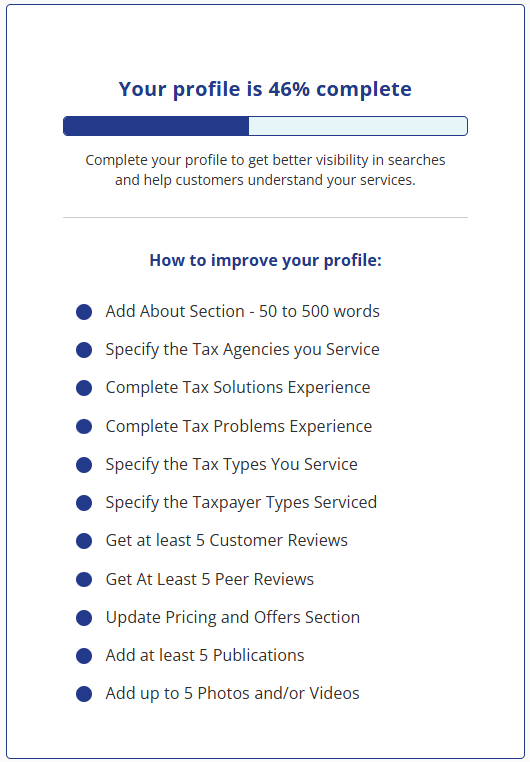
  • How to Avoid, Stop or Reduce South Carlina DOR Garnishments

    How to Stop Wage Garnishments for Unpaid Taxes in South Carolina

    SC tax garnishment

    If you don't pay state taxes, the South Carolina Department of Revenue (SCDOR) can attempt to take the money without your cooperation. The state can issue tax liens that attach to all of your assets. The DOR can also seize your bank or investment accounts. In most cases, however, the state starts involuntary collections by garnishing your wages. 

    The SCDOR can garnish 25% of your gross wages if you don't pay your state taxes. For example, if you earn $1,000 per week before taxes and other deductions, the DOR can take $250. The Department can also garnish your wages for unpaid hospital bills or state ethics commission penalties. 

    What to Expect With a Wage Garnishment

    If you don't pay your SC taxes, the SCDOR will send you multiple notices about the tax debt, interest, and penalties. If you continue to ignore the debt, the DOR may decide to garnish your wages. The state will send a notice to your last address on file, and they will also send a notice to your employer. 

    At that point, your employer will start to withhold payments from your paychecks, and they will send the payments to the state. The DOR will also seize state and IRS tax refunds and apply them to your debt. This will continue until you pay the tax debt in full. 

    Your boss cannot fire you for having a wage garnishment, but having your wages garnished is professionally embarrassing. If you leave your job, the DOR will send a garnishment notice to your new employer once you get one. 

    What If You Disagree With the Garnishment Notice

    If you disagree because you already paid the tax in full, find proof of your payment and contact the DOR immediately. If you disagree with the tax due for another reason, you may be able to appeal. File a protest as soon as possible or by the deadline shown on the notice. Then, work your way through the state's appeals process. 

    Note that you cannot appeal taxes on frivious grounds, such as arguing that the state doesn't have a right to tax citizens. You must have a valid argument. If you are unable to deal with the DOR through regular channels, contact a tax pro for help or reach out to the SCDOR Taxpayer Advocate. 


    How to Avoid Wage Garnishment

    To ensure the SCDOR doesn't garnish your wages, take care of your tax debt as soon as possible. You can pay your SC taxes in full online, through the mail, or over the phone. If you cannot afford to pay in full, consider applying for a payment plan, or look into SC's offer in compromise program. 

    What If You Receive a Garnishment Order for Your Employee

    If the SCDOR alerts you about a wage garnishment for one of your employees, you must respond. If you don't garnish your employee's wages as instructed, you may become personally liable for the debt. The levy notice should contain instructions about how to calculate the wage garnishment. 

    To make a payment, go to MyDORWAY. You need the Letter ID from the Levy Notice and the last four numbers of your employee's social security number. You can also use MyDORWAY to respond to a levy notice and to alert the DOR if your employee is no longer working for you or is on a leave of absence.

    How to Reduce Your Wage Garnishment in South Carolina

    Once a wage garnishment is in place, you can generally only remove it by paying your tax debt in full. However, you can ask the SCDOR to reduce the percentage of your wages being garnished. Normally, wage garnishments apply to 25% of your gross wages, but you can request a reduction to 15%. 

    To apply, make the request on the MyDORWAY homepage or email the DOR at ComplyToday@dor.sc.gov. You need to write a letter about why the garnishment is causing financial hardship. You should also include a copy of your pay stub, a list of monthly expenses, bank statements from the last two months, and contact info for your payroll department. 

    SC tax garnishment 2

    How to Make a Payment If Your Wages Are Being Garnished

    If your wages are being garnished, you can make a payment by credit card. Email the DOR with a copy of the payment receipt and your payroll department's contact info. Then, the DOR will ensure that the payment gets reflected on your account and that your employer adjusts the garnishment as relevant.

    What If I pay in full?

    Once the SCDOR processes your payment, they will notify your employer to stop the garnishment. This process usually takes about 30 days. If you mail a check, processing can take up to four weeks. Credit card payments take one to two weeks to process.

    What if the garnishment doesn't stop after I pay in full?

    If you've paid in full but your employer is still garnishing your wages, send a copy of your last pay stub plus the contact details for your payroll department to the DOR. As of 2024, you should email ComplyToday@dor.sc.gov.

    What if my employer garnishes too much from my paycheck?

    If your employer garnishes your pay after you have paid your tax debt in full, the SCDOR will send you a refund. Sometimes, this can happen if your employer doesn't receive the satisfaction letter until after they have processed payroll.

    Other Consequences of Unpaid State Taxes

    In addition to garnishing your wages, the SCDOR may seize your tax refunds. The DOR may also issue a tax lien and/or seize your other assets. The state may levy bank accounts, investment accounts, and contract or future payments. For example, if someone owes you rent, the DOR may levy that, or if you process credit card payments for your business, the state may be able to seize those funds before they hit your bank account. 

    The SCDOR can also revoke your business license. If this happens, the state typically sends you a notice and gives you 90 days to respond. If you don't contact the DOR or make payment arrangements, the state can shut down your business, and if you continue to operate, you can face penalties of $500 per day.

    Get Help With SC Wage Garnishments

    Are you facing a wage garnishment? Are you having other trouble with personal or business taxes in South Carolina? Then, you need help from a tax pro who's experienced in this state. 

    Don't call the big tax relief firms. Although the big companies may be the first to pop up when you do a search for the best tax relief firms, they lack state-specific experience and fill their staff with sales reps rather than experienced tax pros. Instead, use TaxCure to find a local professional who's experienced with your type of tax problem. 

    To get started, contact an SC tax pro today or check out the following links:

  • Texas Resturants: Handling Sales & Beverage Tax Audits

    Restaurant Sales and Mixed Beverage Tax Audits in Texas 

    Texas Tax Audit

    Restaurants are some of the most difficult businesses to operate. They have high closure rates, significant labor demands, and many other challenges. When you run a restaurant, it can also be complicated to keep track of all your tax obligations. In the Lone Star State, matters can get even more complicated if your restaurant sells and serves alcohol to customers.

    In addition to the sales tax on your food sales, your Texas restaurant may also have to collect and pay mixed beverage gross receipts and sales tax on alcohol sales. Because of how intertwined these taxes are, making a mistake with one can often lead to a problem with the other. If you’re not careful, you can find yourself subject to a tax audit from the Texas Comptroller of Public Accounts. These audits are not only a major headache but could lead to additional tax liability and penalties.

    The following guide is designed to provide a broad yet detailed look at the sales and mixed beverage tax audit process in Texas. However, to better understand this audit process, we need to first examine how restaurants should collect, file, and pay Texas sales and mixed beverage taxes.

    An Overview of the Texas Sales Tax for Restaurants 

    Restaurants in Texas have sales tax collection requirements similar to those of restaurants in many other states. As a general rule, the meals and drinks (non-alcoholic) served by restaurants for dine-in or take-out consumption are subject to the general state sales tax, which is 6.25%. Then, the local taxing authorities (like cities and counties) may impose up to a 2% sales tax on top of the 6.25% for a total of up to 8.25%.

    There is no sales tax on the non-reusable items that typically accompany a meal, such as straws, napkins, and disposable utensils. Restaurants can usually purchase these without paying a sales tax by having the appropriate resale certificate.

    No sales tax needs to be collected for complimentary drinks and meals. In a buy-one-get-one-free promotion, the sales tax only applies to the food the customer actually pays for, not the free food.

    Sales tax returns must be filed (and taxes paid) to the Texas Comptroller’s office by the 20th of the month following the applicable tax period (monthly or quarterly). For instance, if you're a monthly filer, your January sales tax is due February 20th. There is a $50 penalty for late filings, and a 5% penalty applies for taxes that are one to 30 days late. This rises to 10% if the sales tax is more than 30 days late. Interest begins to accrue starting 61 days after the due date. 

    Understanding Texas Mixed Beverage Taxes

    If your restaurant serves spiritous alcohol, you will have two additional sales-related taxes to collect. The first is the mixed beverage gross receipts tax, and the second is the mixed beverage sales tax. Despite their names, these taxes apply to practically any alcoholic beverage your restaurant might serve, including distilled spirits, beer, wine, and ale.

    You must also apply this tax to the price of any non-alcoholic drinks you mix with alcohol. For instance, say you charge $5 for a shot of vodka and $1 for a club soda. If someone orders a vodka soda, you would apply the mixed beverage tax to the $6 total. 

    Note that this tax only applies to restaurants that have a mixed beverage permit. If you only have a beer and wine permit, then, you are not required to collect the mixed beverage tax on your beer and wine sales. In this case, you only worry about sales tax on beer and wine sales.

    Mixed Beverage Gross Receipts Tax 

    This is a tax that you collect and pay; the customer does not pay it. The current rate is 6.7% of gross receipts on applicable alcoholic beverage sales. This tax must be reported and paid monthly, with a due date that’s the 20th of each month for the prior month’s sales.

    Late filings and tax payments result in the same penalties and interest charges as the general state sales tax. The exact reporting and payment method depends on the amount of taxes you paid in the prior fiscal year. 

    Mixed Beverage Sales Tax

    This is an 8.25% tax you collect for the sale of alcoholic beverages. Unlike the gross receipts tax, you may pass this sales tax to your customer by adding a line item to the customer bill or including it in the sales price. One thing to note about this sales tax is that it doesn’t combine with the regular sales tax. 

    In other words, a sale subject to the mixed beverage sales tax is exempt from the normal sales tax. You also file separate forms for these taxes. You will file one form for Texas sales tax, another form for your mixed beverage sales tax, and a third form for your mixed beverage gross receipts tax. 

    Another thing to remember is that your restaurant must collect the mixed beverage sales tax in addition to the mixed beverage gross receipts tax. So before calculating the mixed beverage gross receipts tax, you should deduct the mixed beverage sales tax from the amount received.

    For example, say that you sell $100 in mixed beverages. You should charge your customer $108.25. That covers your $100 sale plus the 8.25% sales tax. Then, when you file your gross receipts return, you will report $100 in mixed beverage sales, and you'll pay $6.70 in gross receipts tax. 

    The mixed beverage sales tax is also due on the 20th of each month following the end of the reporting period. If you're late, the penalties and interest are the same as the mixed beverage gross receipts tax. Reporting method and payment also depend on the amount of taxes you paid in the prior fiscal year. 


    The Reason for Sales Tax Audits in Texas 

    The Audit Division of the Texas Comptroller’s Office oversees the mixed beverage and sales tax audits that your restaurants might have to endure. They conduct these audits to ensure Texas’ tax laws are fairly applied, to deter tax evasion, to encourage taxpayers to pay their taxes, and to educate taxpayers about their tax filing and payment responsibilities. 

    The Tax Audit Process 

    The audit process in Texas has many similarities to the audit process in many other states, but it has two notable differences. One, there’s an option for a managed audit, where taxpayers essentially audit themselves under the supervision of the Comptroller’s office (this will be discussed later in this guide).

    Two, there are audits conducted not by the Comptroller’s office, but by third parties hired by the Comptroller’s office to perform tax compliance examinations. All that being said, no matter who conducts the audits, a Texas Comptroller tax audit may consist of up to 12 steps. 

    Step 1: Notice of Audit 

    The auditor will mail you an audit notice, along with Form 00-740, Audit Questionnaire. You have two weeks to fill this out and return it to the auditor so they can become more familiar with your business and tax situation. If you don’t return the questionnaire, the auditor will contact you after 30 days. After the auditor receives Form 00-740, they will schedule an entrance conference with you.

    If you ignore the questionnaire form and audit notice, the auditor will use the information available to estimate your tax liability for you. As you can imagine, you do not want this to happen as auditors are not going to create an estimate that does you any favors.

    Step 1 is when you should start preparing for the tax audit. If you’re confused about what’s happening and why, strongly think about hiring a tax pro. Audits are problems that can become worse if not handled carefully, especially if you overshare your financial information with the auditor.

    This is in no way an implication that you should lie or give misleading information during an audit. However, revealing more information than required can lead to an audit that is more invasive and requires more work for you. A tax professional will help you avoid providing information not requested. This can make the audit go faster and save you the hassle of digging up documents you don’t need. 

    Step 2: Pre-Audit Research and Review

    There’s nothing you need to do here, as this is when the auditor reviews your tax account and history with the Comptroller’s office. If you were audited before, the auditor will review notes and records to see what happened in the earlier audits. The auditor will then create a preliminary plan for the current audit’s objectives. 

    Step 3: Taxpayer Contact 

    This is the first substantive communication between you and the auditor. The earlier contact was to inform you of the audit and ask some basic questions about your restaurant business. Step 3 is where the auditor asks more probing and pointed questions so they may identify what documents they want you to produce. Types of documents you can expect to produce include:

    • Lists of sales made by your restaurant
    • Copies of resale and exemption certificates
    • Purchase invoices
    • Sales receipts
    • Federal income tax returns
    • General business ledgers
    • Bank statements
    • Accounting data and documents used to prepare your tax filings

    After the auditor decides what documents they want to review, they’ll schedule an appointment to start the audit. 

    Step 4: Entrance Conference 

    Here, you (or your tax representative) will talk to the auditor to finalize the audit plan and figure out what exactly your audit process will entail. 

    Step 5: Examination of Records 

    Also known as the fieldwork portion of the audit, this is the most substantive part of the audit and is where the auditor reviews the documents they requested from you. In some audits, the auditor will just review a sample of your available records to find any problems or errors.

    Assuming none are found, and you produce all requested documentation and information to substantiate the information on your tax return, then the document examination portion of the audit might conclude. However, if the auditor finds one or more errors or problems after this abbreviated review of records, they will continue the audit in three possible ways.

    First, if there are a lot of records to review, your auditor may use the sampling method. The sampling method involves a review of a portion of available documents, and then projecting out the results over a longer period of time. While this can work for some restaurants and bars, it's very inaccurate for businesses with a lot of seasonal variances.

    For instance, if the audit involves reviewing four years’ worth of alcohol sales, the auditor may just look at six months’ worth of sales and then multiply whatever deficiencies are found by eight. If the auditor finds that you underpaid your sales tax by $5,000 over six months, then the auditor will assume your total sales tax liability for the four years is $40,000 ($5,000 x 8). The assumption is that any tax deficiencies or mistakes will be relatively consistent so the auditor can save everyone time and effort by not reviewing all documents.

    Second, if your records are incomplete or you don’t provide them, your auditor will use the information available to estimate your tax liability. You want to avoid this as much as possible, given how auditors will likely fill in any missing information with upper-end estimates that increase your tax liability.

    Third, your auditor may complete a detailed audit and review every single record for the entire audit period. If you run a busy restaurant that serves alcohol, the amount of records you have over four years would be immense. Needless to say, your auditor probably won’t be using the detailed audit method.

    After completing the review of your tax documents and records, the auditor will prepare schedules that outline any taxes you still owe or refunds you are due. 

    Step 6: Exit Conference 

    During this meeting, the auditor explains what they found and what additional taxes you might owe, plus any applicable penalties and interest. If you disagree with the auditor, you can request a reconciliation conference and/or independent audit review conference. 

    Step 7: Reconciliation Conference 

    This is a meeting between you, the auditor, and the auditor’s manager or supervisor to discuss your disagreement with the audit. These meetings can be held at the audit office or your location. If the disagreement can’t be resolved during the reconciliation conference, an independent audit review conference can be held. 

    Step 8: Independent Audit Review (IAR) Conference 

    This is a conference between you, the auditor, and a third party to meet and discuss the audit dispute. This third party won’t be an independent, third-party reviewer, but they will be someone from outside the Audit Division of the Comptroller’s office. 

    Step 9: Finalization 

    Assuming a reconciliation and/or IAR conference takes place, the auditor will finalize their findings and organize them into audit schedules. 

    Step 10: Review 

    The auditor’s supervisor will review the auditor’s findings. Once approved, the results get mailed to you in an audit notification letter. 

    Step 11: Redetermination 

    If you disagree with the audit’s results, you can further challenge them by mailing a Statement of Grounds to the Comptroller to request a redetermination hearing. This document outlines your disagreements and the basis for those disagreements. The Comptroller must receive this document by the deadline located in the audit notification letter. 

    Step 12: Amendment 

    If the redetermination hearing results in any changes (and you agree with them), the Comptroller will prepare an in-house amendment reflecting those changes. If you disagree with the changes (or no changes follow the determination hearing), you can ask for an Administrative Hearing for another chance to review the audit. 

    What If You Fail the Restaurant Audit

    If the state determines that you didn't report and pay your restaurant sales tax, mixed beverage sales, or mixed beverage gross receipts tax, you may incur penalties. The state can assess a 10% penalty for filing late. Additionally, if fraud or evasion is involved, the Comptroller may assess a 50% penalty. 

    The penalty is based on the amount of unstated tax. For instance, if you get audited and the state discovers that you failed to pay $10,000 in mixed beverage tax, you may face a $5,000 penalty if the understatement was due to fraud or evasion. 

    Tax Audit Alternatives 

    In certain cases, you can avoid a traditional audit. If you’ve already been notified of the audit, you can ask for a managed audit. A managed audit is like a regular audit, except the fieldwork portion (Step 5) is completed by you, under the auditor’s supervision.

    You have 60 days after receiving the Audit Notification letter to request a managed audit. This request must be in writing and sent to the field office manager. A managed audit request will be considered if you had a prior audit that took more than 120 hours to complete or if you can show that a managed audit will save the Comptroller’s office time and effort and you can do a thorough job. Concerning this last point, you will need to show that you (or someone working on your behalf) have sufficient knowledge of Texas tax law to properly review your documents.

    If you haven’t been officially notified of an audit, but you think one is coming because you didn’t properly pay your sales taxes, you can consider the Voluntary Disclosure Program. If eligible, you can voluntarily pay any unpaid or underpaid taxes to the Comptroller’s office and avoid any penalties. In most cases, you can also avoid having to pay interest. 

    Common Problems Found During a Mixed Beverage Tax Audits 

    A mixed beverage and sales tax audit of your restaurant could result in any number of errors that result in an unexpected tax bill, plus penalties and interest. However, a common problem that comes up during audits is not having complete records.

    For example, you may have collected the mixed beverage sales tax when you sold a glass of wine to a customer, but your records of the transaction may not indicate that the mixed beverage sales tax was included in the price the customer paid. If you can’t produce documents to prove you did collect the mixed beverage sales tax, you should expect the auditor to conclude you did not collect the necessary alcohol sales tax. 

    How to Avoid a Mixed Beverage or Sales Tax Audit 

    The exact steps to avoid a tax audit are unknown. After all, if taxpayers knew exactly what triggered an audit, it would make it easier for them to engage in tax evasion. Despite the secrecy behind what the Texas Comptroller’s office looks for when deciding to audit a business, some factors can make it more likely that a tax return will get audited. Some of these characteristics include:

    • Being among the largest taxpayers in Texas.
    • Having been subject to a prior audit that found a tax liability of $25,000 or more.
    • Being a cash business.
    • Filing tax returns that are inconsistent with each other (such as sales tax returns representing gross sales that do not match up with a restaurant’s business income tax return).
    • Not filing necessary returns (sales and use tax returns must be filed, even if no tax is due).

    Even if none of these traits apply to your restaurant, you could still face a sales tax audit because of computer-based random selection. Therefore, the best strategy is to take a preventative approach, yet make sure you’re prepared for the audit you hope never comes. 

    Here are some tips that may not only reduce the chance of a sales tax audit but also help you get through one as quickly as possible if you do get audited:

    • Keep accurate and complete records of all transactions, not just sales to customers.
    • Have copies of all applicable resale or sales tax exemption certificates.
    • File all required tax returns on time.
    • Pay careful attention to cash transactions and keep good records of them.
    • Periodically reconcile cash registers.
    • Only take deductions and tax credits you’re confident you’re entitled to.
    • When in doubt, assume a transaction is taxable.
    • Don’t use round numbers on the sales tax return.

    In a situation where you believe you may have failed to pay taxes owed and feel an audit might be possible in the near future, you can consider taking advantage of the Voluntary Disclosure Program. This program lets you come forward voluntarily before the state contacts you, and in exchange, the state limits the penalties you face for the previous periods of noncompliance.

    Finally, if you haven’t already done so, consider hiring a tax professional. They can provide additional tips to avoid an audit and offer advice on changing tax laws and regulations that may affect your restaurant. 

    Texas Restaurant Sales and Mixed Beverage Tax Audit FAQs 

    How Far Back Will I Need to Produce Records for the Auditor?

    Most audits only look at the prior four years’ worth of records. This is because that’s the statute of limitations for the collection of unpaid taxes. In other words, if an unpaid tax bill is more than four years old, the state of Texas can’t collect it. 

    But before you get too excited, there are a few exceptions that allow the Comptroller’s office to assess a tax over any time period:

    • You filed a fraudulent return to evade a tax you had to pay;
    • There was a major mistake with a filed return that would increase the taxes you owe by 25% or more; or
    • You did not file a required tax return. 

    How Long Do Audits Last? 

    It’s hard to say for certain, as an audit’s length depends on how busy the auditor is, how quickly you comply with the auditor’s requests for information, and how complex your audit is. However, auditors are told to avoid any period of more than 30 days when nothing substantive occurs with your audit.

    This means that you’ll usually have at least 30 days to comply with any document request, although up to two 30-day extensions are possible. The first 30-day extension is usually granted upon request, but the second 30-day extension will only be granted if you have a hardship that’s beyond your control. If you take both extensions, you'll have a total of 90 days to prepare. 

    If there’s a major disagreement between you and the auditor, it can dramatically lengthen the amount of time it takes to complete the audit. If these disagreements have to be resolved by Administrative Hearings and/or court litigation, it can potentially take years for audits to complete. 

    How Do I Request an Audit Extension? 

    There’s no formal method of asking for an extension, but they should be made to the auditor and always in writing. Making your request by letter or email will help avoid any misunderstandings or confusion later. 

    What Are My Rights During the Tax Audit?

    The Texas Comptroller of Public Accounts has the “Texas Taxpayer Bill of Rights” which outlines your basic rights as a taxpayer. Some of the rights applicable during the audit process are:

    • Your taxpayer information is confidential.
    • You can have someone represent you during the audit process.
    • If you disagree with an audit’s findings, you have the right to contest them.
    • If the audit results in penalties, you have the right to ask for a penalty waiver (this is automatically done if your audit results in you having to pay penalties for unpaid taxes). 

    What If There’s a Major Disagreement in the Middle of the Audit? 

    If the disagreement with the auditor relates to a tax question, you have two options. First, you can wait until the audit is completed to ask for a reconciliation conference or an IAR conference. Second, you can ask the Tax Policy Division of the Comptroller’s office to issue tax guidance on the disagreement.

    To make this request, you and the auditor must consult with each other to prepare a document that identifies the issue and applicable facts. The Tax Policy Division will only accept guidance requests when you and the auditor can agree on the underlying facts.

    After preparing the document, your auditor will submit it to the Tax Policy Division through the Audit Headquarters. After a decision is made, it gets sent to the auditor who then explains the results to you during the audit. 

    Get Help With Texas Sales and Mixed Beverage Tax Audits 

    Texas sales tax and mixed beverage taxes can be confusing at times, especially when it comes to how sales tax exemptions apply. Then there’s the issue of doing the right thing by collecting and paying the appropriate sales taxes, but not having the records to prove you did what the law requires.

    If you receive notice from the Comptroller’s office informing you of an audit of your restaurant, you need to think about getting professional tax assistance. TaxCure can help you find the right Texas sales tax pros in your area. These tax professionals can help you prepare for an audit, as well as represent you during all steps in the audit process. They can also give you guidance on what to do to avoid an audit or apply for the Voluntary Disclosure Program. 

    Many of these professionals offer free consultations, so you have nothing to lose by getting in touch to ask questions about your sales and mixed beverage taxes.

  • How to Settle Your IRS Debt by Yourself: A Complete Guide

    Can You Negotiate with the IRS Yourself? How it Can Be Done

    Negotiate with IRS

    Many taxpayers around the U.S. struggle to pay off their tax debts. Millions of individuals owe the IRS money, resulting in around $316 billion in overdue taxes. Tax debt is one of the most common types of liabilities out there, aside from mortgages and loans.

    If you struggle to cover your tax obligation, the IRS offers various relief methods, including negotiating a payment plan or an offer in compromise. However, many people may not pursue these avenues because they aren’t aware of them or they don’t think they can negotiate with the IRS directly. 

    But there's good news – you can negotiate directly with the IRS. You don't need to pay a pro. In some cases, you should definitely get professional help, but that's always up to you. If you want to take a DIY approach to tax negotiation, you certainly can. In fact, you can even represent yourself in Tax Court if you are so inclined.

    Wondering where to start? This guide provides details on how to settle your tax debts with the IRS by yourself, your legal rights as a taxpayer, how to negotiate IRS tax debt, and the options available to you for resolving them. 

    Can you negotiate with the IRS yourself?

    Yes, you can negotiate with the IRS on your own. You don't have to hire someone to help you. However, before you start, you should make sure that you understand your tax problem and how to navigate the resolution options. You should also make sure that you know exactly how much you owe the IRS.

    As a taxpayer, you’re inundated with ads and messages from companies claiming they can help you negotiate with the IRS. However, depending on your unique situation, you can resolve many types of issues on your own, helping you avoid paying for those services, which can be costly. Some of these companies can create misleading advertisements about programs the IRS has to settle taxes. Most of the time, these are terms the IRS doesn’t use or programs they don’t actually have. Some of the most common are things about the fresh start program (which really isn’t a program and just a change in the law about basic resolutions offered by the IRS), or the IRS one-time forgiveness program (which is a fancy way of saying first-time penalty abatement that is catchy for marketing slogans). 

    Tax regulations can be confusing and intimidating. Ultimately, IRS representatives look out for the agency’s best interest, which is collecting the most taxes possible. Additionally, the agency struggles to put any of its letters and instructions in plain English. And those facts can lead to a challenging experience for many taxpayers.

    If you want to represent yourself, the first step is to get a sense of the options. 

    Options for settling or resolving tax debt

    The IRS is most concerned with collecting the money taxpayers owe the agency. Remember that you will typically face fewer consequences if you are open and honest about your situation from the start instead of trying to get away with late payments, failing to pay, or failing to file your return. 

    So, how do you negotiate a tax settlement with the IRS? You have a few options for getting your tax debt resolved or settled. You can then get back on good terms with the IRS and stay compliant, even if it means you pay smaller amounts over time. Here are relief options to research and consider for your situation:

    Payment plan

    You can request to set up a payment plan with the IRS on your own. Also known as installment agreements, these plans allow taxpayers to pay off their tax debt over a set period of time. The different types of installment agreements are as follows:

    • Guaranteed: This plan is usually the simplest option. To qualify, you can only owe $10,000 or less, and the debt must be paid off within three years or by the collection statute expiration date (CSED), whichever is first.
    • Simple: Set up payments online or over the phone. To qualify, you must owe $50,000 or less in individual tax debt (including interest and penalties) and be able to pay off the balance within 10 years or by the CSED if sooner.
    • Partial payment: A partial payment installment agreement (PPIA) is used when a taxpayer cannot make the minimum monthly payment in a regular installment agreement. If you get approved for a PPIA, you can instead make affordable payments, and you may end up paying a lower balance than you owe when all is said and done. With PPIAs, the IRS writes off any remaining debt once the collection statute expires.
    • Direct debit: With this plan, you make payments through direct debit from your bank account. The IRS requires businesses with over $10,000 in debt to pay by direct debit. The agency encourages individuals to pay by direct debit but only requires it for individuals who've defaulted on a payment plan in the recent past.
    • Streamlined: If you owe business taxes, you may qualify for a streamlined agreement. If still operating, you can take up to six years to pay up to $25,000 in non-payroll tax debt. If no longer operating, you can have up to six years to pay up to $25,000 in payroll or other business tax debt or up to $50,000 if you're a sole prop. Note that sole props without employees can apply as individuals.
    • Non-streamlined: These agreements can give you longer terms for repayment. The IRS previously required taxpayers with over $50,000 in taxes owed to have to provide a collection information statement, but that is typically no longer required unless your debt is seriously delinquent, you owe over $250,000, or a revenue officer requests one. The IRS may file a lien against you. 
    • Financially verified: For individuals and businesses owing $250,000 or above to the IRS, they would apply for a financially verified installment agreement and provide a collection information statement to disclose their financial information. 

    The amount of debt you have, whether you’re an individual or a business, and your income situation will all impact the type of installment agreement you apply and qualify for. The good news is that you have options, so carefully consider your biggest challenges and priorities when looking through eligibility requirements and the pros and cons of each plan.

    Offer in compromise

    Don't think you can afford monthly payments? Trying to figure out if you can pay your tax debt off for less than you owe? Then, you may want to look into an offer in compromise. 

    An offer in compromise essentially allows you to settle what you owe at a lower amount. In this way, you can settle IRS debt for less, which ends up being a big benefit if you’re dealing with financial difficulties. You send an initial payment amount, or offer, with the applicable tax form (433-A, 433-B, or 656), along with the $205 application fee.

    You may be eligible if your circumstances don’t allow you to pay your full tax bill because of a proven financial hardship. The IRS considers your ability to pay, income, expenses, and asset equity when deciding. If they believe that the offer you provide is the most they can expect to collect, they will likely approve it.

    You also must meet these requirements to qualify for an offer in compromise:

    • You have filed all required tax returns and made estimated tax payments.
    • You are not involved in an open bankruptcy proceeding.
    • You have a valid current-year return extension or have already filed for the year.
    • You are an employer that made tax deposits for the current and last two quarters.

    If the IRS finds that you don’t qualify, they’ll return the application fee you paid and apply the payment you sent to the balance you owe.

    You can apply for an offer in compromise on your own, but be aware that acceptance rates are low. By working with an experienced pro, you may increase your chances of getting your offer accepted.

    Currently not collectible

    You may be able to delay IRS collection when you’re unable to pay what you owe. If your financial situation doesn’t allow you to pay right now, the IRS may put your account into currently not collectible (CNC) status, which means they will temporarily cease trying to collect from you. 

    However, you will eventually have to pay your debt when your finances improve. Your balance will also accrue interest and potential penalties. If your finances don't improve, the IRS will no longer be able to collect the debt after the collection statute expiration date. Thus, the debt will effectively be forgiven.

    The IRS may require Form 433-F, Collection Information Statement, and evidence of your financial situation to mark your account CNC.

    First-time penalty abatement

    When you’re hit with penalties because of your failure to file, failure to pay, or failure to deposit, you can apply for first-time penalty abatement. This option waives fees related to these penalties, not the amount you may owe related to them. 

    You have to be in good standing with the IRS, meaning you have complied previously. The IRS defines good tax compliance as having filed the same type of return for the last three years, if required, and not receiving any penalties during those same three years.

    Applying for abatement is usually simple. Carefully review the IRS notice you received about the penalty, and contact the IRS at the phone number on the document. You shouldn’t have to provide any documentation to support your request if you are in good standing.

    Bankruptcy

    Another option when you’re unable to pay tax debts is bankruptcy. However, in many cases, you may still be required to pay what you owe the IRS unless you can show that the debts occurred because of tax fraud or mistakes.

    With a Chapter 7 bankruptcy, only federal or state income tax debt can be discharged, and in a Chapter 13 filing, you can set up a repayment plan to get your debts paid off. The IRS states that in Chapter 13 cases, you must file all required returns and pay taxes during the bankruptcy to avoid having your case dismissed.

    Waiting for the statute of limitations expiration

    The IRS will forgive tax debt after 10 years have passed. At that point, the agency will deem the outstanding debt as uncollectible. So, theoretically, you could wait out the IRS, but that's not simple. If you have a job, open a bank account, buy property, or take many other actions, the IRS will easily be able to find you.

    However, CNC status could allow you to keep the IRS from trying to collect until you reach the statute expiration date. Note that some situations, like filing for bankruptcy or applying for an offer in compromise, could extend the statute of limitations for a certain amount of time.


    When can you negotiate with the IRS on your own?

    Certain situations are easier to handle on your own than others. The more complicated your situation is, the greater the likelihood that you’ll need expert help. However, these common examples show situations where you can likely negotiate on your own:

    • Basic installment plan: If you’re struggling to pay your full tax bill by the deadline, you may qualify to apply for an installment plan online. This is usually a simple process that you can handle on your own. If you owe less than $50,000, you can apply online.
    • You have low balances owed: You may have just a couple of unfiled returns, and the balance you carry is pretty low. In this situation, you can file your late returns and then try to work out a payment plan with the remaining debt balance.
    • It’s your first tax issue: Remember that one way to get relief is to apply for first-time penalty abatement, which you may qualify for if you haven’t filed or paid late in the last three tax years. Abatement may allow you to be forgiven of penalties.
    • You are normally compliant but experienced a sudden life change: Applying for a CNC or offer in compromise is typically more effective with the help of a professional, but when your circumstances change suddenly, such as if your income drops, you can apply on your own. If you’re a strong candidate and you pay close attention to all guidelines, you could save thousands by handling it on your own.

    Navigating different debt scenarios and IRS options isn’t always easy, but these examples show common issues that you can tackle yourself. Do plenty of research, follow all laws and guidelines, and be communicative and open with the IRS through it all.

    When to hire a tax professional

    While you can handle many tax issues on your own and represent yourself, in certain situations, you need professional help. You never want to risk getting in deeper trouble with the IRS or taking a costly misstep. 

    Some IRS notices are straightforward, and you can contact the agency via the phone number provided to resolve the issue, or send in the documentation they requested. However, if you have received multiple notices or are facing serious fines or legal repercussions, always talk through the matter with an experienced professional.

    You may also want to hire outside help if you want to appeal a collection action. Using Form 9423, you can appeal a wide range of collection actions, and during the appeal, you can suggest alternatives. For instance, if the IRS wants to garnish your wages, you can appeal and request a payment plan. If you're comfortable, you can appeal on your own, but if you're at the last stage of the appeals process, you should definitely consider hiring a professional. 

    Also, hire a professional when you’re not sure about your options. They can help you file for relief options, and they know how to settle debt with the IRS. If you got hit with a tax penalty or you’re having trouble coming up with the funds to pay your bill, you may not fully understand which relief option is right for you. A tax expert can examine your situation and advise you on the best step forward. When you give them power of attorney, they can negotiate with the IRS on your behalf.

    How to Settle With the IRS by Yourself

    To settle with the IRS on your own, review the options. Then, decide on the best option based on how much you owe and how much you can afford to pay. 

    For example, if you owe less than $50,000 and can afford to pay off the debt in monthly installments over 10 years, you should get online and apply for an installment agreement. If you can only afford a small monthly payment, you may want to apply for a PPIA. If you can pay a lump sum but not the whole balance, you may want to look into an offer in compromise. 

    Once you've selected an option, review the paperwork carefully. If you're applying for a settlement, you will have to provide the IRS with detailed financial information. Gather details about your income, assets, debts, and expenses to complete the paperwork. 

    Keep in mind that the IRS wants to collect as much as you can possibly pay. The agency will only consider "essential" expenses when reviewing your application. For example, expensive car loans and private school tuition are not considered essential expenses by the IRS. Additionally, the agency has strict limits on how much it believes taxpayers should spend on housing, food, clothing, transportation, utilities, etc.

    If you have any expenses over the IRS's limits, be prepared to mount a defense. For example, say that your monthly energy bills are higher than the IRS's limits, but that's because you run critical medical equipment in your home. That's something you should be prepared to share with the IRS. 

    Finally, remember that you can appeal. If the IRS says no to your settlement offer, figure out why. Then, appeal the decision, but make sure you present new info to support your side of the story. Also, keep a close eye on deadlines. The IRS has strict timelines for the appeals process.

    FAQs

    Here are some FAQs about negotiating with the IRS on your own.

    Can I negotiate with the IRS myself?

    Yes, by law, you have a right to negotiate directly with the IRS and the state tax agencies. You are never obligated to hire a tax pro. However, you should take a DIY approach cautiously. With criminal tax issues, complicated tax issues, or high amounts of tax debt, you should work with a tax professional.

    How do you negotiate a tax settlement with the IRS?

    To settle your taxes for less than you owe, you must provide the IRS with detailed info about your tax return. You also need to explain extenuating circumstances. If you make a solid case, you may be able to convince the agency to settle your taxes for less than you owe.

    Can you settle IRS debt for less?

    If you meet certain requirements, you may be able to settle your tax debt for less than you owe. You must prove that you're paying the most possible. You also must be up to date on filing your tax returns and paying current taxes.

    How TaxCure can help

    Sometimes you may simply need more resources to research your tax situation. At TaxCure, we provide many detailed guides to help you research resolution options for a range of tax problems. You can read up and take a DIY approach, or you can do some preliminary research to ensure you're a well-informed consumer when you contact a professional.

    Want to find professional help now? Gain access to the largest network of tax resolution professionals in the country with TaxCure. We make the search process fast and easy so you can find guidance customized to your problem and location.

    To get help now, use TaxCure to search for a licensed tax pro in your area. Then, narrow down your search based on the problem you're having or the solution you want. Once you have a list of options, narrow it down even further by reading reviews and profiles. Then, contact a tax pro for a consultation.

  • Guide to Navigating a Florida Restaurant Sales Tax Audit

    Help! The Florida DOR Is Auditing My Restaurant!

    Fl Sales Tax Audit

    Restaurateurs Guide to Florida Restaurant Sales Tax Audits

    Owning and running a restaurant is a challenging and often rewarding way to earn a living. One of the challenges is keeping up with state tax requirements. One such example is Florida sales and use taxes.

    With so many transactions taking place in the front house and back house, it’s easy to see how you as a restaurant owner and/or operator could make a mistake or get confused with reporting and paying sales tax. If this happens, you could find yourself learning that the Florida Department of Revenue (DOR) wants to audit your business records to see if the prior sales tax filings for your restaurant are correct.

    Being audited can be a scary experience, but understanding the process can help. The purpose of this guide is to provide a comprehensive overview of sales tax audits in Florida. It starts with an overview of the Florida sales tax, and then shifts to the sales tax audit process. This includes what happens during a restaurant sales tax audit, how to prepare for the audit, what happens after the audit is complete, and when and why you might want the help of a tax professional. 

    Understanding the Florida Sales Tax 

    As a general rule, restaurants must collect and pay sales taxes on the sale of food products that are prepared, served, and sold on their premises. Similar businesses, such as caterers, cafeterias, hotels, and taverns must also collect and pay sales taxes on their eligible food sales. Note that food sold on a “to go” or “take out” basis will usually be subject to sales tax.

    The sales tax rate applicable to restaurants is the general Florida sales tax rate of 6%. However, there could be an applicable discretionary sales surtax charged by a local taxing authority (usually at the county level) that is applied on top of the 6% general sales tax rate.

    Keep in mind that Florida recently changed how it calculates sales tax and discretionary sales surtax in Florida. Instead of using a special bracket system, Florida businesses must now use a rounding algorithm.

    What about use tax?

    Florida sales tax is the tax paid on the sale of goods or services in Florida. In contrast, a use tax is a tax paid on a taxable good or service that wasn’t subject to a sales tax during its purchase. 

    Use tax issues often come up with restaurants when they give away free food.

    In many cases, no sales tax collection is required for free food to customers, as it’s usually part of a promotion, like free breadsticks with the purchase of a main course. Here, the main course would be subject to the sales tax, but the breadsticks would not. The breadsticks would also not be subject to a use tax in this situation.

    However, imagine if the breadsticks were given away for free with no purchase or other conditions required to receive them. In this second situation, the restaurant would have to pay a use tax on the cost of the breadsticks because they were not considered part of the taxable meal. 

    Here's why: When the restaurant buys food from its vendors, it does not pay sales tax. However, it charges sales tax to its customers when it sells the food. If the restaurant buys food and ends up giving it away, it must pay use tax on that food. Basically, someone needs to pay sales/use tax at some point for the purchase. Usually, that's the customer of the restaurant, but in some situations, it ends up being the restaurant. 

    An Overview of Florida Sales Tax Audits

    The Florida DOR will conduct a sales tax audit if it believes the information you provided in your restaurant’s sales tax returns is incorrect. The DOR uses an audit to confirm if its suspicions are correct by reviewing your business records.

    Florida sales tax audits are inherently limited to reviewing information related to sales tax. Yet the DOR can conduct a full audit to review all of your restaurant’s taxes. So in addition to filings and records relating to sales tax, the DOR may also audit your returns relating to local option taxes and the corporate income tax.

    After you file a sales tax return, the FL DOR has three years to audit the return. However, the DOR may ask for an audit involving older tax returns if you file a “substantially incorrect” return, substantially underpay any sales taxes owed, or don’t file a sales tax return. 

    Triggers for a Sales Tax Audit of a Restaurant in Florida 

    What exactly triggers the Florida DOR to conduct a sales tax audit is not publicly known, although an audit could be the result of a computer randomly choosing your restaurant’s sales tax return. What’s more likely is that a review of one or more of your Florida tax returns turns up a potential issue that the DOR wants to review further. Examples of possible red flags could include:

    • The sales tax collected and paid to the Florida DOR is higher or lower than the DOR expects given the restaurant’s reported income and expenses.
    • The restaurant’s sales figures are much higher or lower than similar restaurants in the area.
    • The state of Florida or the county where the restaurant is located has enacted new laws relating to sales tax.
    • The restaurant underwent a major business change, such as filing bankruptcy or closing a location.
    • The restaurant is consistently late when filing its sales tax returns.
    • The restaurant is part of another business, like a hotel or grocery store.
    • The restaurant receives a portion of its employees’ tips.
    • The restaurant offers free or discounted food to its employees.
    • A significant portion of business includes sales to tax-exempt organizations.
    • Part of the restaurant’s business includes food that’s delivered to customers away from the restaurant’s premises.
    • One of the restaurant’s vendors got audited and problems were found.

    Understand that many of the above “red flags” aren’t necessarily red flags in the traditional sense. In other words, a restaurant that offers free food as a perk to its employees won’t necessarily be automatically subject to a sales tax audit. Rather, the above list represents business operations and arrangements that are common with restaurants and often lead to taxpayers making mistakes on their sales tax returns.

    How to Prepare for a Florida Tax Audit

    The audit process begins when the FL DOR sends you a Notice of Intent to Audit Books and Records (Form DR-840). In the past, the DOR used to send Form DR-846, Notice of Intent to Conduct a Limited Scope Audit or Self-Audit to notify taxpayers of a sales tax audit. In recent years, Form DR-840 seems to be more common or used interchangeably with DR-846.

    After sending Form DR-840, the 60-day notice period begins. During these 60 days, you can:

    • Ask the Florida DOR any general questions about the audit.
    • Ask your assigned auditor listed on Form DR-840 for general information about the audit process.
    • Start gathering financial records that you can use during the audit or that were listed on the tax records guide attached to Form DR-840.
    • Look into hiring a tax professional to help you during the audit process.

    If you want to discuss specific details about the audit with the DOR, you may. But to do so, you must first waive this 60-day notice period by signing Form DR-840 and returning it to the auditor. If you plan on hiring a tax attorney, accountant, tax preparer, or other tax pro, it’s probably best not to waive this notice period until after you consult with them about your situation.


    The Florida Sales Tax Audit Process

    The sales tax audit process begins with an audit entrance interview. The auditor typically contacts you to set it up, but you can contact the auditor to schedule the interview if you’d like. 

    The Audit Entrance Interview 

    During this interview, you and/or your representative discuss the next steps in the audit process with the auditor. The auditor will also request documents and ask questions relating to your restaurant’s operations, accounting methods, business structure, and other applicable information. If you want the auditor to discuss your audit with your representative, you will need to complete Form DR-835, Power of Attorney.

    The interview is also your chance to ask specific questions about the audit and provide any information you feel is relevant to the audit. Because of the adversarial nature of audits (despite Florida’s claims that the audit process can be an educational experience), you should be careful as to what information you proactively disclose to the auditor without them first asking for it.

    A good strategy is to have a tax professional communicate directly with the auditor and have them decide what information or documents to share without being asked. The last thing you want to do is try to explain what you feel is a mistake or omission and have the auditor respond with something like, “Oh, I wasn’t aware of that. Now that you mention it, I’d like to see the following documents…”

    Types of Audits

     There are two main types of audits. First, there are desk audits where the auditor asks you for information and documents that you send them for review. Second, there are field audits where the auditor comes to your restaurant or business office to conduct the audit.

    In addition to where the audit occurs, another variable is how you produce the requested documents. The auditor or DOR might send you a questionnaire asking you questions to see if they can request documents in electronic form. Note that you must submit documents electronically if you maintain them in electronic form.

    The FL DOR prefers to conduct electronic audits (also known as eAuditing) where they receive the requested documentation electronically. This allows the auditor to use a computer to analyze your financial information in a more quick and effective manner. 

    Your Rights During a Restaurant Sales Tax Audit

    The Florida Department of Revenue has a “Florida Taxpayer’s Bill of Rights” which outlines your rights, including those relating to protecting your assets and privacy. Some of these include the right to:

    • Prompt and accurate responses to questions and requests for assistance.
    • Ask for help from a taxpayers’ rights advocate.
    • Hire a tax professional to represent you in a tax dispute with the DOR.
    • Be free from any penalty that’s the result of you relying on written advice from the DOR that was given in response to a question where you provided complete information.
    • Receive instructions and explanations that are written in a non-technical way.
    • Have your tax information kept confidential.
    • Have the DOR complete audits in a reasonable amount of time and place.
    • The right to have any adverse findings from the auditor subject to formal or informal review. 

    Audit Length 

    Florida law requires that the auditor complete the audit within 305 days of sending Form DR-840. You usually don’t need to worry about audits taking longer than necessary because auditors want to complete audits as quickly as possible. As nice as it is to have an auditor who wants to finish things quickly, this desire for expediency could potentially hurt you if it means not having enough time to prepare your responses and gather the necessary documents.

    For example, recall from earlier in this article that after the DOR sends you Form DR-840, you have 60 days to prepare for the audit. Many auditors will often try to persuade you to start the audit process sooner. If you have everything you need and are ready to go, there’s nothing wrong with starting before the 60 days is up.

    But if you feel like you need more time to get ready, you can politely decline the auditor’s attempts to get you to start the audit process sooner than you have to. If you begin before you’re ready, it could potentially lead to complications during the sales tax audit.

    Common Problems During a Restaurant Sales Tax Audit

    One of the more common problems found by auditors during a restaurant sales tax audit is when the restaurant doesn’t properly account for the free food given to customers. This causes issues because not all free food is subject to the same sales or use tax treatment.

    Refer back to the earlier breadstick example. Restaurants subject to a sales tax sometimes get into trouble for not paying the use tax when giving away free food that was purchased under a sales tax resale exemption.

    Another potential audit problem is when the auditor uses sampling or estimating methods to speed up the audit timeline. 

    Audit Sampling 

    Sales tax audits for restaurants often involve large amounts of financial information. Depending on the time period in question, if an auditor needed to review several months’ worth of sales and purchases, they could be looking at thousands of transactions. So a shortcut they try to use is to look at just a small sample of the transactions in question, then expand on that information to estimate the tax liability.

    For instance, let’s say you’re a restaurant next to a golf course and the auditor wants to review your sales tax records for an entire year. However, to avoid looking at 12 months’ worth of records, they only ask to look at a single month. The problem is that the month they choose to review is the month when the golf course holds a major tournament. In fact, it’s your busiest and most profitable month during the entire year.

    If the auditor were to use this busy month as a basis to form an estimate of the sales taxes you are expected to collect and send to the DOR for the entire year, the auditor would probably conclude you didn’t collect or remit enough in sales tax to the state. The auditor would then impose penalties on you.

    Sampling has its place to save everyone some time and effort (one month’s worth of records are easier for you to find and gather as opposed to a full year’s worth). However, this process can sometimes lead to unfair results.

    Additionally, remember that you may be sending these records electronically, and the auditor will likely have software to comb through the data quickly. In this situation, there’s little reason for the auditor to review such a small sample size. Then there’s the fact that the auditor is usually only allowed to use this sampling method if the documents you provide are inadequate (for example, some documents are missing due to a fire loss) or there are too many documents for the auditor to reasonably review.

    Finally, auditors should work with you (or your tax representative) to find a reasonable sampling method and time period to review. Using the earlier golf course restaurant example, perhaps it’s possible to reach an agreement with the auditor, so they review both your busiest and slowest months and then average the sales figures. 

    Audit Estimates 

    An auditor will estimate your restaurant’s sales tax liability if outside information is needed to complete your restaurant’s tax assessment. An auditor can only do this if you refuse to cooperate with the audit process. This means not providing the requested information when asked or not providing it in a timely fashion.

    As long as you’re cooperating with the auditor, this shouldn’t be an issue. But if you need additional time and the auditor refuses to provide it, this could be an issue best handled by a tax professional. They will know the best arguments to obtain additional time as well as create a proper paper trail supporting your contention that you’ve cooperated with the auditor as much as reasonably possible. Therefore, the auditor does not have the authority to use the audit estimating method to assess your tax liability. 

    What to Do After a Florida Restaurant Tax Audit 

    After the audit, the auditor will provide the findings and legal basis for any changes. In some cases, the auditor will tell you these things during an audit conference, which gives you a chance to ask for clarification.

    You should also receive a Notice of Intent to Make Audit Changes, Form DR-1215. This document summarizes the auditor’s findings and conclusions. If you disagree with these findings, you have 30 days from the date of this form to notify your auditor and request an audit conference with the auditor and/or the auditor’s supervisor.

    30 days after sending you Form DR-1215, the FL DOR will send you a Notice of Proposed Assessment. This will list your tax liability, if you haven’t paid it already, and inform you of your formal and informal protest rights to the auditor’s conclusions.

    If you want to file a formal protest, you have 120 days from the date of the Notice of Proposed Assessment to do so. If you want to file an informal protest, you’ll only have 60 days.

    If you agree with the auditor’s sales tax assessment, you can pay the amount owed. If you can’t afford to do it with a single payment, you can discuss the possibility of other payment options with the auditor. The FL DOR offers payment plans for qualifying taxpayers.

    Sales Tax Best Practices for Florida Restaurants

    The best way to deal with sales tax audits is to prevent them from occurring. Here are a few things you can do to prevent a sales tax audit.

    First, file and pay your sales taxes online and on time. It’s faster and reduces the chances of something getting lost in the mail. Electronic filing and payment also let you easily confirm that the FL DOR has received the money and/or filing.

    Second, file your sales tax return even if no tax is due. Your return will need to indicate that you didn’t have sales activity that resulted in sales or use taxes. If you’re filing by mail and have no deductions or credits, you can telefile by calling 1-800-550-6713 and following the prompts to indicate you have no tax obligation for the given reporting period.

    Third, if filing by mail with paper returns, use the correct returns from your coupon book. If you don’t have this book or need another copy, you can call Taxpayer Services at 1-850-488-6800.

    Because there’s only so much you can do to avoid a sales tax audit, there are things you can do to prepare for an audit to make it go more smoothly and result in no additional tax owed or a tax assessment you agree with.

    The single, most important thing you can do is create and maintain complete and accurate records of all purchases and sales. If some of your sales or purchases are tax-exempt, be sure to have easy access to your sales tax exemption certificates. You’ll also want to have your resale verification and authorization numbers and certificates available as well.

    You should keep these records for a minimum of three years. However, given the DOR’s ability to look back further, it helps to keep older records as long as they don’t become too burdensome.

    What If You Haven't Been Paying Sales Tax?

    Are you worried about an audit because you haven't been paying sales tax? Then, you should look into Florida's voluntary disclosure program. To qualify, you must contact the DOR before they contact you. If you receive an audit notice, it's too late. A tax professional can help you look into the program to figure out if it's right for your situation. Generally, when you make a voluntary disclosure, the state limits penalties on the account, but you will need to find a way to pay the delinquent tax.

    Find Help for a Florida Restaurant Sales Tax Audit 

    If you’ve gotten this far in the article, you probably can see why and how hiring a tax professional for a sales tax audit will often be a good idea. Another advantage of having a tax pro on your side during the audit is to decide if and when to submit a request to the DOR for a Technical Assistance Advisement (TAA).

    You can request a TAA any time during the audit and the goal of a TAA is to ask the FL DOR for clarification for situations where you and the auditor might agree on the facts, but disagree on how to apply the applicable tax law.

    For instance, you and the auditor might agree that $10,000 worth of food was sold to a charitable organization. But there could be a disagreement as to whether the food you sold to that organization was subject to a sales tax because the auditor believes the organization didn’t have tax-exempt status recognized by the state of Florida. It is very helpful to have a tax professional not only help you decide if you should request a TAA, but also when to do so during the audit.

    To get this assistance, you should find the right local Florida tax professional. TaxCure can help you find the best tax relief firms and pros in Florida. Start your search now to see a list of local Florida tax pros, including attorneys, enrolled agents, and tax accountants who have experience helping restaurants and other Florida businesses with sales tax audits.