Google Ads sounds great in theory.
Just show up when someone searches “IRS help near me,” get a few calls, sign a few cases, and grow from there.
Spend $500… land a few clients… repeat.
Hard to lose, right?
Wrong.
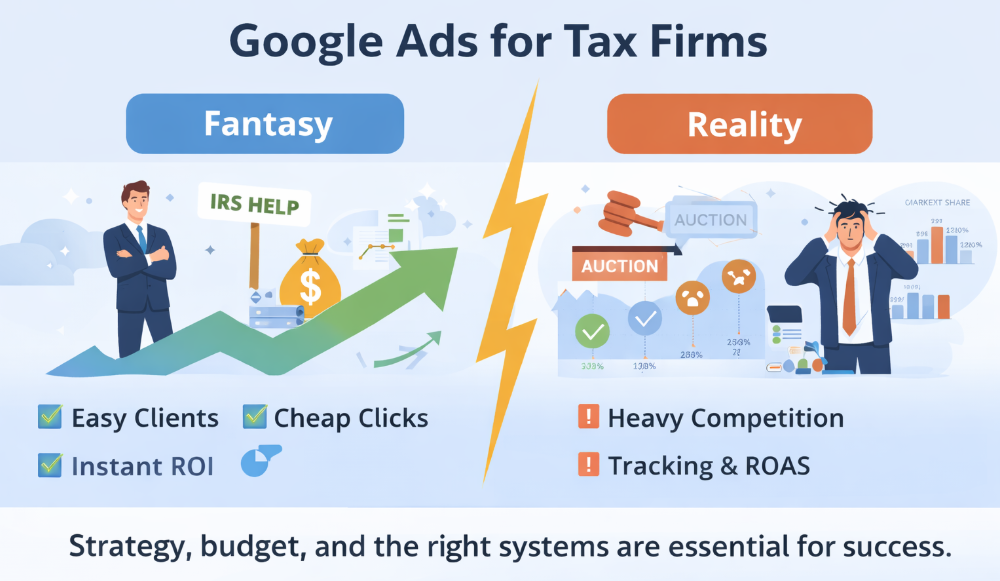
Google Ads can absolutely work for tax resolution firms. In fact, when done correctly, it can be one of the most consistent and scalable ways to bring in new cases. The leads are high intent. People are actively searching for help. And unlike SEO, you can appear in front of potential clients almost immediately.
But it is not as simple or as inexpensive as most people expect.
Over the years, we have spoken with hundreds of tax professionals who wanted to “try Google Ads” with the idea that a few hundred dollars a month would generate a steady flow of new clients. Some had tried running ads on their own. Others had hired agencies that promised quick results. Many were disappointed when the phone did not ring the way they expected or when the cost per lead did not make sense.
This article is meant to provide a realistic, behind-the-scenes look at how Google Ads actually works in the tax resolution space.
At TaxCure, our team has been managing Google Ads campaigns for tax professionals since 2007 and has overseen millions in ad spend in the tax resolution industry. Today, we continue to manage substantial monthly budgets across multiple markets. We have seen campaigns that generated incredible returns, and we have seen campaigns that struggled despite good intentions and solid effort.
The difference usually comes down to understanding the math, the competition, and the systems required to make paid search profitable.
Google Ads is not for every firm. It requires the right expectations, the right budget, and the right follow-up process. But for firms that understand how it works and approach it strategically, it can become a predictable and scalable source of new business.
Before you decide whether Google Ads makes sense for your firm, it is important to understand what you are stepping into and what it actually takes for campaigns in the tax resolution space to work.
Why Google Ads Is So Attractive for Tax Resolution Firms
It makes sense why so many tax resolution firms want to try Google Ads.
Few marketing channels allow you to appear in front of someone at the exact moment they are searching for help with a tax problem. When someone types “IRS levy help,” “tax attorney near me,” or “stop wage garnishment,” they are not casually browsing. They are usually stressed, looking for answers, and actively considering hiring someone.
That kind of intent is powerful.
Unlike SEO, which can take months to gain traction, Google Ads can place your firm in front of potential clients almost immediately. If someone searches today and your ad shows, you have the opportunity to generate a call or form submission today. For firms that want more consistent case flow or want to grow faster, that is very appealing.
There is also a scalability factor that makes paid search attractive. If a campaign is working and generating profitable cases, increasing the budget can often increase lead flow. This creates a more predictable growth engine compared to relying solely on referrals or waiting for organic search traffic to build.
For many firms, the thought process is straightforward:
If one new client from ads more than pays for the monthly ad spend, then the investment makes sense.
If the system works, it can be repeated and scaled.
That part is true.
Google Ads can become one of the most reliable ways to generate new cases when everything is aligned properly. The challenge is that many firms only see the upside. They do not always see the complexity behind making campaigns profitable or the level of competition in the tax resolution space.
Search Ads vs. Social Media Ads: Intent Matters
It also helps to understand how Google Ads differs from other types of advertising, especially Facebook and Instagram ads.
Social media ads are typically shown based on interests, behaviors, or demographics. Someone might see your ad because they follow financial content, own a business, or fit a certain income bracket. The platform is trying to predict who might need your services, but those people are not actively searching for help in that moment.
A simple way to think about social media advertising is like a billboard. Someone might see your message while scrolling and think, “That could be useful someday.” But they were not necessarily looking for a tax resolution firm at that exact time.
Search ads are completely different.
When someone searches on Google for “IRS final notice,” “revenue officer help,” or “tax attorney near me,” they are actively trying to solve a problem. In many cases, something has just happened. Maybe they received an LT11 notice. Maybe their wages are about to be garnished. Maybe they owe more than they can afford to pay.
There is urgency behind the search.
That is what makes Google Ads so powerful for tax resolution firms. You are not interrupting someone with a message they may or may not care about. You are showing up when they are already looking for help.
This higher level of intent is also why Google Ads leads tend to be more valuable than social media leads. They are closer to taking action. They are researching options. They are often ready to schedule a consultation if they feel confident in who they are contacting.
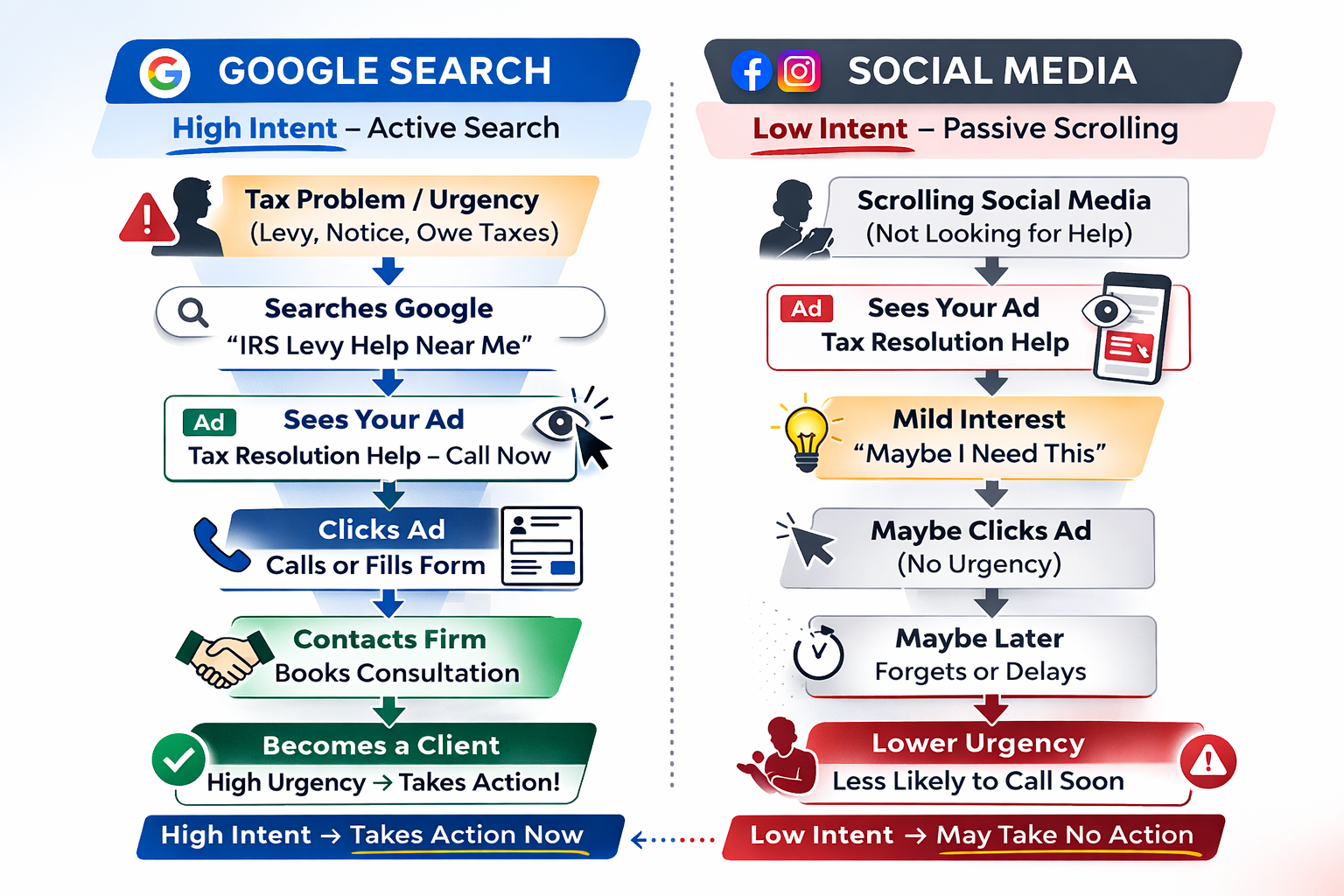
*Search intent vs social media intent: why Google Ads leads are typically higher urgency.
However, this same high intent is what makes search advertising more competitive and more expensive. Many firms want to appear in front of those same searches, and that competition directly affects costs and performance.
Before getting into budgets and expected returns, it is important to understand just how competitive the tax resolution advertising landscape has become and how that competition influences what it takes for campaigns to work.
The Competitive Reality of Google Ads in Tax Resolution
Once you understand why Google Ads is attractive, the next thing to understand is the competitive landscape.
Tax resolution is one of the most competitive service categories in Google Ads. You are not entering a quiet local market. You are stepping into an auction where some very large players are spending aggressively to dominate high-intent searches.
Several national tax resolution firms spend hundreds of thousands of dollars per month on Google Ads. On top of that, many mid-sized firms spend between $40,000 and $80,000 per month. Then below that tier are smaller firms testing budgets in the $1,500 to $15,000 range.
All of these advertisers are competing in the same auction.
Even if you only want local searches, you are still competing with firms that can target your area with much larger budgets. Someone searching “tax attorney near me” or “IRS help in [city]” will often see both local firms and national advertisers. That level of competition directly affects costs and performance.
How Click Costs Are Actually Determined
Clicks are not priced based on what Google thinks a lead is worth. They are driven by competition and bidding.
Every time someone searches for a term that triggers ads, Google runs a live auction. The more firms bidding on that keyword, the more competitive and expensive it becomes.
Lower-value searches like “tax preparation near me” typically cost less because the potential case value is lower. Fewer firms bid aggressively. Higher-value searches tied to serious tax problems tend to cost more because more firms are willing to compete for them.
In the tax resolution space, many clicks fall in the $5 to $30 range depending on the search and market, with some higher-value searches costing significantly more.
Why Optimization Matters More Than Just Bidding Higher
Bidding more does not automatically win.
Google favors ads that generate more engagement because that is how Google makes money. If an ad gets more clicks, Google earns more from showing it.
For example, if one firm bids $10 per click but gets a low click-through rate, and another firm bids $6 but gets a much higher click-through rate, Google may favor the $6 bidder. Even with the lower bid, Google can earn more overall if more users click that ad.
This is why optimization matters. Strong ad copy, relevant targeting, and well-designed landing pages can improve click-through rates and reduce your actual cost per click over time. Firms that actively monitor and optimize campaigns often outperform firms that simply bid higher and hope for results.
Google Ads in tax resolution is a competitive auction. Budget matters, but performance and optimization matter just as much.
What Leads Actually Cost (and What to Expect)
Now let’s talk about the numbers most firms care about.
One of the biggest questions we hear is:
“How many clients will I get if I spend X per month on Google Ads?”
The answer always comes back to the same core metrics:
cost per lead, close rate, and average case value.
Typical Cost Per Lead in Tax Resolution
In a well-structured, properly managed campaign, most tax resolution firms see leads fall somewhere in the range of:
$120 to $250 per lead
Some markets come in lower. Some higher. But this is a realistic range for many campaigns targeting high-intent tax resolution searches.
That means every phone call or form fill coming from ads has a real cost attached to it. The goal is not to make leads as cheap as possible. The goal is to generate leads that turn into profitable cases.
Expected Close Rates From Google Ads Leads
Google Ads leads are high intent, but they are not referral leads.
These individuals searched online, saw your ad, and reached out. Many are evaluating their options and deciding who they feel most comfortable hiring. They are looking for experience, professionalism, and confidence that you can actually help.
Because of that, most firms see close rates around:
1 in 10 leads as a healthy baseline
Some firms with strong intake and consultation processes close closer to 1 in 7. Others with weaker follow-up or slower response times may close fewer.
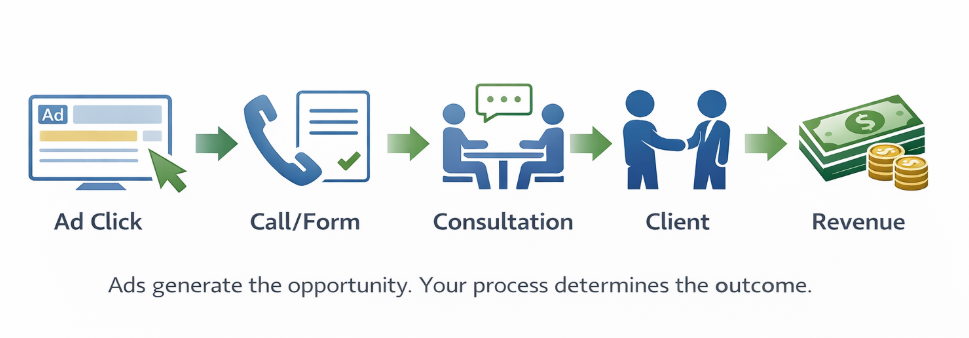
Speed matters. Professionalism matters. Your consultation process matters. Ads generate the opportunity, but your process determines how many of those opportunities turn into real clients.
If you are a TaxCure Pro member, we have a sample consultation and sales process available in the member section that can help improve close rates and consistency.
(Pro members can access it here: https://taxcure.com/member/professionals/member-content/sales/tax-consultation-services)
Understanding the Real Budget Math
Once you know average lead cost and close rate, the math becomes clearer.
If leads average around $150 each and you close 1 out of every 10 leads, you are spending roughly:
Budget-to-Client Reality (Typical Ranges)
| Monthly Ad Spend | Estimated New Clients/Month* |
|---|---|
| $1,200 – $1,500 | ~1 client |
| $3,600 – $4,500 | ~3 clients |
| $6,000 – $7,500 | ~5 clients |
| $9,600 – $12,000 | ~8 clients |
| $12,000 – $15,000 | ~10 clients |
These are not guarantees. They are realistic planning ranges based on how campaigns tend to perform in this industry.
The firms that succeed with Google Ads understand this math going in. They treat ad spend as an investment tied directly to revenue potential, not as a small experiment with unpredictable expectations.
Average Case Value and Why the Math Has to Work
When running Google Ads, everything comes back to the math.
Paid search is not just about generating leads. It is about generating leads at a cost that makes sense based on what your average case is worth. If the numbers do not work, even a steady flow of calls can feel frustrating instead of profitable.
Across the tax resolution industry, fees can vary widely depending on the complexity of the case. Some simpler matters may only bring in around $1,000. Larger or more complex business cases can reach $15,000 to $20,000 or more. When you average the lows and the highs across many firms and many case types, the typical average fee per new client tends to fall somewhere between:
$4,500 and $5,200 per client
This range is important because it helps determine whether your Google Ads investment will produce a healthy return.
Typical Case Value Ranges Across the Industry
| Case Type | Typical Fee Range |
|---|---|
| Simple individual issues | ~$1,000 – $2,500 |
| Standard resolution cases | ~$3,500 – $7,500 |
| Complex or business cases | $8,000 – $20,000+ |
| Industry-wide average | $4,500 – $5,200 |
Most firms see a mix of these case types. Some smaller matters come in that may or may not be a good fit. Some mid-range cases make up the bulk of retained work. Then there are larger, more complex cases that significantly increase overall revenue.
The goal is not to focus on any single case type. The goal is to maintain an average case value that supports your cost to acquire new clients.
Understanding Return on Ad Spend (ROAS)
A useful way to evaluate Google Ads performance is through return on ad spend, or ROAS. This measures how much revenue is generated for every dollar spent on advertising.
If you spend $1 and generate $3 in revenue, that is a 3x return.
If you spend $1 and generate $4, that is a 4x return.
Most successful tax resolution campaigns aim for a return on ad spend in the range of:
3x to 4x ROAS
That means for every $1 spent on ads, the goal is to generate about $3 to $4 in revenue from those leads. This range allows room for operating costs while still making paid advertising a strong growth channel.
ROAS Examples Based on Typical Case Values
| Ad Spend Per Client | Average Case Value | Return |
|---|---|---|
| $1,200 | $4,800 | 4x ROAS |
| $1,500 | $5,000 | 3.3x ROAS |
| $1,500 | $6,000 | 4x ROAS |
If it costs roughly $1,200 to $1,500 in ad spend to generate a new client and your average case value falls within the $4,500 to $5,200 range, the math typically supports a healthy return. If your average case value is significantly lower, it becomes much harder to achieve a strong return unless close rates are exceptionally high.
This does not mean every case needs to be large. Most firms see a mix of smaller and larger matters. The key is maintaining an overall average that justifies the investment required to generate consistent new opportunities.
Track Performance at a Detailed Level
Not all campaigns or leads perform equally. Some keywords may bring in higher-value cases. Others may generate more consultations but fewer retained clients. Looking only at total spend versus total revenue can hide these differences.
The most effective campaigns are tracked as granularly as possible. Firms that monitor which campaigns generate the best clients and strongest returns can shift budgets toward what is working and refine what is not. Over time, this leads to more predictable performance and better overall results.
When the numbers are understood and tracked properly, Google Ads becomes less of a guessing game and more of a measurable client acquisition system.
Why Most DIY Google Ads Campaigns Struggle
Many tax professionals assume they can open a Google Ads account, choose a few keywords, set a budget, and start generating cases. On the surface, the platform looks simple. In reality, there are a lot of moving parts that determine whether a campaign succeeds or quietly burns through budget.
Google Ads is not just about turning ads on. It is about building a system where targeting, messaging, landing pages, and tracking all work together.
When any of those pieces are missing, performance usually suffers.
Campaign Structure Matters More Than Most People Realize
A common mistake is grouping too many different search types into one campaign and sending all traffic to the same page. This makes it harder to control costs, messaging, and performance.
Strong campaigns are typically broken into very specific segments based on search intent. For example:
- Wage garnishment and levy searches
- Offer in compromise searches
- Revenue officer or enforcement searches
- Local “tax attorney near me” searches
- Business tax and payroll tax searches
Each of these groups represents a different type of client and a different level of urgency. When campaigns are structured around specific intent, ad messaging can match the search more closely and conversion rates tend to improve.
Landing Pages Play a Major Role
Where you send traffic matters just as much as the ad itself.
Many firms send paid traffic to their homepage and hope visitors will find what they need. While that can work in some cases, dedicated landing pages usually perform much better. A page built specifically for the search someone just performed is more likely to keep their attention and lead to a call or form submission.
High-performing landing pages typically include:
- Clear messaging that matches the search
- Strong trust signals (reviews, credentials, real photos)
- Simple layout with minimal distractions
- Fast load times, especially on mobile
- Clear calls to action
- Testimonials or short videos introducing the firm
These elements help reassure potential clients and improve conversion rates. Better conversion rates lead to lower cost per lead and better overall campaign performance.
Tracking and Data Are Critical
One of the biggest reasons campaigns fail is poor tracking.
If you do not know which calls and form submissions came from which campaigns, it becomes very difficult to improve results. Proper tracking allows you to see what is working, what is not, and where to adjust.
A solid setup should include:
- Call tracking tied to ad campaigns
- Form tracking with conversion attribution
- Visibility into which keywords generated leads
- Ability to measure cost per lead by campaign
- Ongoing monitoring of performance trends
Without this data, you are essentially guessing. With it, you can make informed decisions and steadily improve performance over time.
Ongoing Optimization Is Not Optional
Google Ads is not something you set once and forget. Search behavior changes. Competition changes. Costs fluctuate. Campaigns need ongoing monitoring and adjustment.
This includes:
- Reviewing search terms and adding negative keywords
- Testing new ad copy
- Adjusting bids and budgets
- Improving landing pages
- Monitoring conversion rates
- Refining targeting
Small improvements in these areas can have a significant impact on cost per lead and overall return. Firms that consistently optimize their campaigns tend to see far better long-term results than those that simply launch ads and hope for the best.
The First 60–90 Days: What to Expect After Launch
One of the biggest misconceptions about Google Ads is that results should be immediate and perfectly optimized from day one.
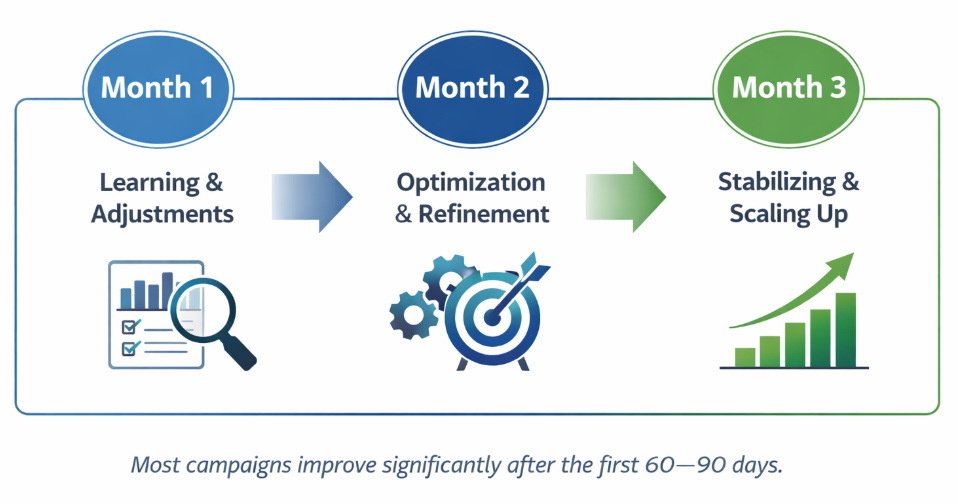
In reality, the first 60 to 90 days of a campaign are usually a learning and optimization period. Even well-structured campaigns need time to gather data, refine targeting, and improve performance.
It is important to go in with the right expectations.
Month One Is About Data and Adjustments
When a campaign first launches, Google is learning. Your campaigns are also learning. During this period, you may see:
- Higher click costs than expected
- Ads showing for some irrelevant searches
- Leads coming in that are not always a perfect fit
- Conversion rates that improve over time
This does not mean the campaign is failing. It means data is being collected and adjustments are being made.
Negative keywords need to be added to filter out irrelevant searches. Ads may need to be refined to improve click-through rates. Landing pages may need adjustments to improve conversions. All of this happens during the early phase of a campaign.
For many firms, simply breaking even in the first month is a positive sign. The goal early on is not always immediate profit. It is building a foundation that can be optimized and improved over time.
Performance Typically Improves With Optimization
As data accumulates, campaigns can be refined. Search terms that do not convert can be removed. Higher-performing keywords can receive more budget. Ads that generate stronger engagement can be prioritized. Landing pages can be adjusted to improve conversion rates.
Over time, these refinements often lead to:
- Lower cost per click
- Better conversion rates
- More consistent lead flow
- Stronger overall return on ad spend
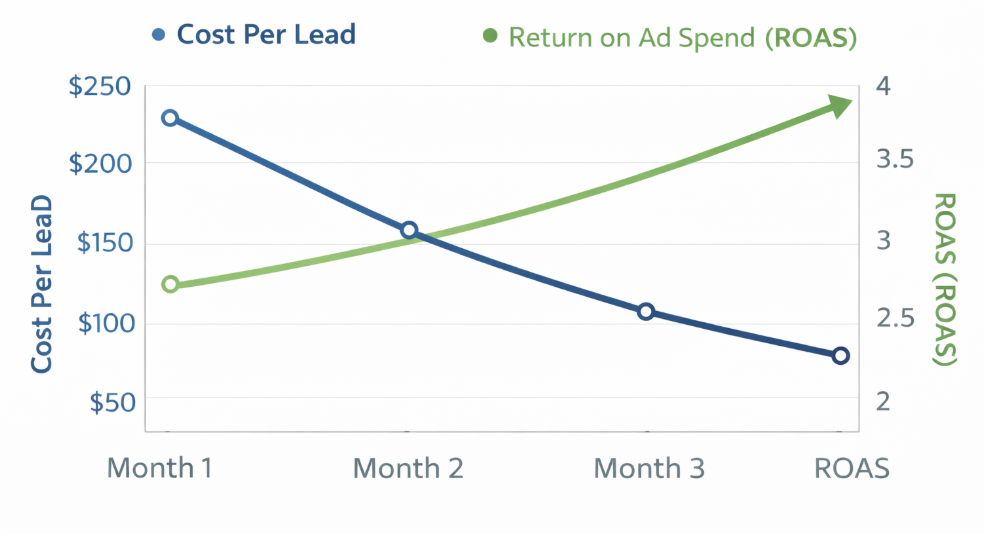
Campaigns that are actively monitored and optimized tend to stabilize and improve over the first few months.
Key Metrics to Watch Early On
During the first 60 to 90 days, it is important to monitor key performance indicators rather than focusing only on how many clients have signed.
Some of the most important metrics include:
- Click-through rate on ads
- Cost per click trends
- Conversion rate on landing pages
- Cost per lead
- Quality of incoming calls and inquiries
- Early return on ad spend trends
These metrics provide insight into whether the campaign is moving in the right direction. A campaign that shows improving conversion rates and stable cost per lead is usually on a good path, even if profitability takes a little time to fully develop.
Set Expectations Before You Start
The firms that tend to have the best experiences with Google Ads are the ones that understand this ramp-up period from the beginning. They approach the first few months as a build and optimization phase rather than expecting immediate perfection.
Once campaigns have enough data and refinements in place, performance often becomes far more predictable. At that point, scaling becomes a realistic option if the numbers support it.
The Sales Process Matters More Than Most Firms Expect
Generating leads is only part of the equation. What happens after the phone rings is just as important as the campaign itself.
Google Ads leads are high intent, but they are not referral leads. These individuals searched online, saw your ad, and reached out because they are exploring options. They are often comparing firms and deciding who they trust most to handle their situation.
That means your intake and consultation process plays a major role in overall return on ad spend.
Speed to Response Makes a Big Difference
When someone submits a form or calls from an ad, timing matters.
The firms that perform best with paid search typically respond quickly. A fast response signals professionalism and reassures the potential client that someone is available to help. Delayed follow-up often results in missed opportunities, especially if the person is contacting multiple firms to compare options.
Even a strong campaign can underperform if response times are slow or inconsistent.
Consistency in Consultations Improves Close Rates
Most firms see close rates around 1 in 10 leads from Google Ads. Some do better with a strong consultation process. Others close fewer when conversations feel unstructured or uncertain.
Consistency helps.
This includes:
- Asking the right questions early
- Clearly explaining the situation and options
- Setting realistic expectations
- Demonstrating experience and confidence
- Explaining next steps clearly
Potential clients are often nervous and unsure who to trust. A structured consultation process helps build confidence and improves retention rates.
Firms that use a consistent, well-structured consultation approach tend to see noticeably stronger close rates over time. Even small improvements in how calls are handled can significantly impact overall return on ad spend.
Not Every Lead Will Be a Fit
Some leads will be price shopping. Some may not qualify for the services you offer. Others may simply be gathering information.
That is normal.
The goal is not to convert every lead. The goal is to convert the right leads at a rate that supports a strong return on ad spend. Over time, patterns emerge around which campaigns and keywords bring in the best clients. When those patterns are understood, campaigns can be refined to focus more heavily on the highest-quality opportunities.
Ads Create Opportunity. Process Creates Revenue.
Google Ads can generate a steady stream of inquiries when managed properly. But turning those inquiries into revenue depends on what happens after the initial contact.
Firms that respond quickly, communicate clearly, and run consistent consultations typically see the strongest results from paid search. Those that treat intake casually or inconsistently often find it harder to achieve a strong return, even with solid campaigns.
Paid search and the sales process work together. When both are strong, Google Ads becomes a much more predictable and scalable growth channel.
Conversion Tracking and Data: What Must Be Measured
For Google Ads to work long term, tracking has to be set up properly from the start.
You need to know exactly where your leads are coming from and which parts of your campaigns are producing real clients. Without that visibility, it becomes very difficult to improve performance or make smart budget decisions.
At a minimum, campaigns should be set up to track:
- Phone calls from ads
- Form submissions from landing pages
- Which campaigns and ad groups generated those leads
- Which keywords led to actual consultations and new clients
This information allows you to see what is working and what is not. Over time, patterns emerge. Certain campaigns may generate higher-quality cases. Some keywords may consistently produce strong consultations. Others may bring in leads that rarely convert.
When tracking is set up correctly, you can measure cost per lead, cost per new client, and overall return on ad spend at a detailed level. That makes it much easier to adjust budgets, refine targeting, and improve performance month after month.
Without proper tracking, optimization becomes guesswork. With it, Google Ads becomes a measurable client acquisition system that can be refined and scaled over time.
When Google Ads Makes Sense — and When It Doesn’t
Google Ads can be one of the most effective ways to generate new tax resolution cases, but it is not the right fit for every firm.
The firms that see the best results usually go in with clear expectations, realistic budgets, and a willingness to treat paid search as a long-term client acquisition channel rather than a small experiment.
Google Ads Usually Makes Sense If:
- You want a more predictable flow of new consultations
- You are looking to grow or scale your practice
- You can respond quickly to new inquiries
- You have a structured consultation process
- Your average case value supports the cost of acquiring a client
- You are prepared to invest consistently each month
Firms that approach Google Ads with this mindset tend to see the strongest long-term results. When campaigns are measured and optimized properly, paid search can become a reliable source of new opportunities that scales alongside your firm.
Google Ads May Not Be the Best Fit If:
- You are only looking to spend a few hundred dollars per month
- You cannot consistently answer calls or follow up quickly
- You prefer only referral-based clients
- You are not looking to grow at the moment
- Your pricing structure does not support client acquisition costs
This does not mean Google Ads will never make sense. It simply means the timing may not be right yet. Many firms start with referrals and organic growth, then layer in paid search once they are ready to scale more predictably.
A Tool for Growth — Not a Quick Fix
Google Ads works best when viewed as a growth tool rather than a quick fix. When the numbers make sense and the systems are in place, it can become one of the most consistent ways to generate new opportunities. When expectations or infrastructure are not aligned, results tend to be inconsistent.
Understanding where your firm stands and what you want from paid search helps determine whether now is the right time to invest or whether it makes more sense to revisit later.
One simple way to evaluate whether your firm is ready is to think through a few key questions:
| Question | If Yes | If No |
|---|---|---|
| Want predictable growth? | Ads may make sense | May not need yet |
| Budget supports acquisition cost? | Good fit | Reconsider timing |
| Can respond to leads quickly? | Strong potential | Will struggle |
| Ready to scale? | Good time to test | Wait until ready |
When most of the answers fall into the “yes” column, Google Ads can become a strong and scalable growth channel. When several fall into the “not yet” column, it may simply be a matter of timing before paid search becomes a better fit.
Google Ads works best when your firm is ready to support and scale it.
If and When You Decide to Scale
When a Google Ads campaign starts producing consistent, profitable cases, the next natural question becomes whether to scale.
Scaling does not mean doubling your budget overnight. The firms that see the best long-term results usually scale gradually and carefully. The goal is to increase lead flow while maintaining a strong return on ad spend and manageable intake capacity.
Scaling Happens in Steps
When campaigns are performing well, budgets are typically increased in controlled increments. This allows performance to be monitored closely as volume grows.
As spend increases, a few things often happen:
- More data becomes available
- High-performing keywords and campaigns become clearer
- Lower-performing segments can be reduced or removed
- Lead flow becomes more predictable
Over time, campaigns can expand into additional service areas, geographic regions, or higher-value case types. Some firms remain at a modest spend level that consistently produces a few new clients each month. Others scale into much larger budgets once they see strong returns and have the infrastructure to support additional cases.
Capacity and Systems Matter
Scaling only works when the firm can handle the increased lead flow. More leads require:
- Faster response times
- Consistent consultations
- Strong intake processes
- Ability to manage new cases effectively
If those systems are not in place, increasing ad spend can create stress rather than growth. When they are in place, scaling becomes much smoother and more predictable.
A Long-Term Growth Channel
For firms that approach it strategically, Google Ads can become a long-term growth engine. Some firms use it to generate a steady baseline of new consultations each month. Others use it to aggressively scale and expand into new markets or service areas.
The key is understanding that successful campaigns are built and refined over time. Once the numbers work and the systems are aligned, increasing spend becomes a strategic decision rather than a gamble.
Google Ads is rarely a “quick win,” but when it is working properly, it can be one of the most controllable and scalable ways to grow a tax resolution practice.
Considering Google Ads for Your Firm?
At TaxCure, we have been managing Google Ads campaigns for tax companies since 2007 and have overseen millions in ad spend across the tax resolution industry. We work with firms across the country that are serious about building consistent lead flow, improving return on ad spend, and approaching paid search with the right expectations and systems in place.
Because Google Ads in this space is highly competitive and requires ongoing strategy and oversight, we are selective about the campaigns we take on and the firms we work with. Our focus is on helping firms build sustainable, measurable growth rather than short-term experiments that rarely produce meaningful results.
If you are considering launching Google Ads, increasing your current budget, or simply want an experienced perspective on whether paid search makes sense for your firm right now, you are welcome to request a high-level strategy review with our team. We will look at your market, your goals, and your current setup (if applicable), and share straightforward guidance based on what we are seeing work across the tax resolution industry today.
There is no obligation. This is simply an opportunity to get clear, practical insight into what it would take for Google Ads to work effectively for your firm and whether the timing and expectations make sense.