Most tax resolution professionals already know content matters.
You probably:
- Have a website
- Get some traffic
- Maybe paid someone for SEO at some point
- Maybe still do
- Maybe stopped because nothing happened
Here’s the reality we see across the industry:
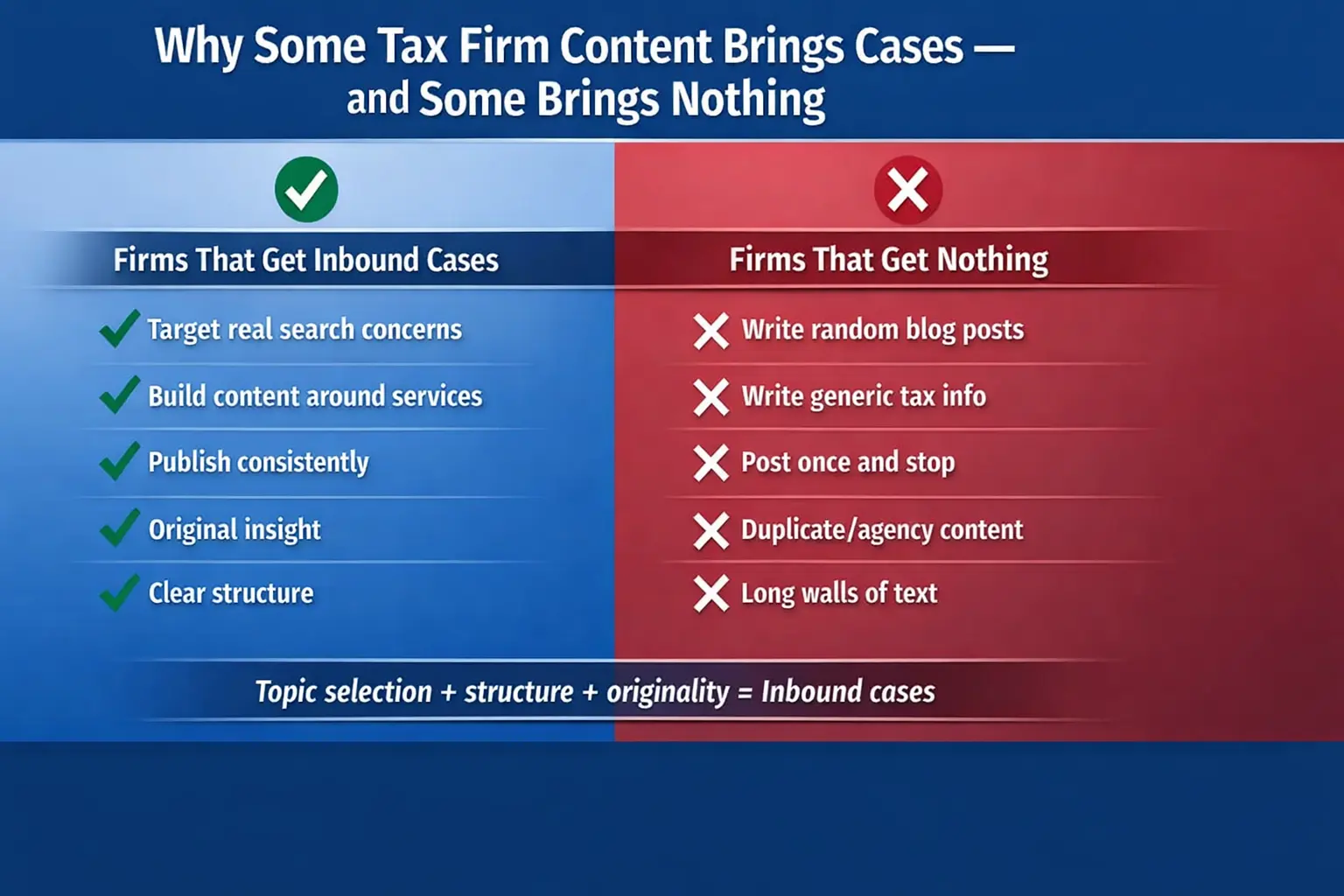
Some firms publish content and get steady inbound cases.
Others publish content for years and get nothing.
The difference is rarely effort.
It’s usually topic selection + structure + originality.
This guide focuses on blog topics that actually bring in cases — not random articles that just fill space on your site.
Why Blog Content Still Brings Some of the Best Cases
Most blog searches are informational.
That means the person is not always searching:
“tax attorney near me”, “tax debt relief”, “tax resolution services”, “offer in compromise.”
Instead, they are searching for things like:
- Can the IRS take my house
- Will the IRS garnish my wages
- What happens if I fail an audit
- Can I get a mortgage if I owe taxes
These are early-stage searches.
But here’s what matters:
Early-stage searches often come from people who already have serious tax problems.
They’re just trying to understand what’s happening before calling someone.
If your article:
- answers the question clearly
- shows real experience
- feels trustworthy
You often become the person they contact when they’re ready.
We have seen firms get cases from blog posts written years earlier that still bring in traffic every month.
What Makes a Blog Post Actually Generate Cases
Not every article works.
Some sit on your site forever and never get traffic.
Others bring in calls for years.
The difference usually comes down to a few things.
1. It answers the main question immediately
People don’t want long intros.
If they search:
“Can the IRS take my car”
Answer that in the first few sentences. Right away if possible.
Then expand.
2. It matches searcher intent
Someone searching about levies is usually scared.
Someone searching about an audit is usually stressed.
Someone searching about an offer in compromise is exploring options.
Write like you understand what they’re going through.
3. It shows real experience
This is huge.
Search engines and AI tools are increasingly looking for experience signals.
Add short real-world context:
- “We recently worked with a client who…”
- “In many cases we see…”
- “A common situation is…”
You don’t need to give confidential details.
Just show you’ve actually handled these problems.
4. Structure matters more than writing skill
Most readers skim.
Use:
- short sections
- clear headers
- simple language
- bullet points
- quick summaries
Consider adding:
- a short key takeaways box
- or table of contents
near the top of longer posts.
5. Add FAQs at the end (very important)
FAQ sections help with:
- search visibility
- AI-driven search
- long-tail traffic
Pro tip:
Add FAQ schema to these sections.
Search engines and LLMs pick this up very easily.
6. Original content wins. Always.
We’ve seen many tax marketing companies publish the same blog posts across dozens of client sites.
This hurts everyone using that content.
Duplicate or lightly rewritten content:
- rarely ranks well
- gets filtered out
- dilutes your authority
AI-assisted writing is fine.
But your final content should include:
- your perspective
- your structure
- your examples
- your tone
That’s what separates content that ranks from content that disappears.
| Element | Why It Matters |
|---|---|
| Answers the main question immediately | Readers decide in seconds if your content is useful. If the answer isn’t clear fast, they leave. |
| Written for real client concerns | People searching IRS issues are stressed. Content that speaks directly to their situation builds trust quickly. |
| Shows real experience | Mentioning real scenarios and outcomes signals authority to both readers and search engines. |
| Structured for skimmers | Short sections, headers, and bullet points keep readers engaged and improve time on page. |
| Internal links to services | Every blog post should guide readers toward the service that solves their problem. |
| FAQ section at the bottom | Helps capture long-tail searches and improves visibility in AI-driven results. |
| Original insight (not duplicate content) | Unique content builds authority and performs better in search and AI recommendations. |
One Important Reminder Before the Topic List
Blog posts work best when they connect to services.
If you want more:
- offer in compromise cases
- audit cases
- levy releases
- payroll tax cases
Your blog content should naturally guide readers toward those services.
Think of blog posts as the entry point.
Your service pages are where conversions happen.
Important: Use This Topic List for Inspiration (Not a Copy-Paste Plan)
This topic list is available to other tax pros too.
So here is the honest truth:
You probably should NOT write all of these exact blog posts in the same way everyone else will.
The goal is not to flood your site with the same “well-written” articles that already exist everywhere.
Google does not want 25 versions of the same post that all cover the same points in the same order.
Google wants the page that best matches what the searcher is actually trying to accomplish.
That usually means the best-performing page is the one that:
- matches the most likely intent behind the search
- answers the question quickly and clearly
- feels more helpful than the “standard” version of that topic
- adds real-world insight that the generic articles do not
TaxCure insight (from working with firms): the firms that win with SEO are usually not the ones writing “more” content. They are the ones writing content that serves a better angle for the same keyword.
Example #1: “Best Tax Relief Companies” vs “Worst Tax Relief Companies”
We assumed an article titled Worst Tax Relief Companies (and How to Avoid Rip-Offs) would mostly rank for “worst tax relief companies.” (which it did)
But something interesting happened:
That “worst” article started showing up for searches about “best tax relief companies.”
Why?
Because a lot of people searching “best tax relief companies” are not actually looking for a polished list.
Their real intent is fear-based: “How do I avoid getting scammed?”
They expect every “best” list to be biased, pay-to-play, or flat-out fake.
So the angle that truly matched intent was not “Here are the best.”
It was: “Here is how to avoid the worst, and what to watch for.”
This is exactly why copying the same “best of” style article is risky. You can target the same keyword by meeting the intent in a more compelling way.
Example #2: “IRS Wage Garnishment” Has Multiple Intents
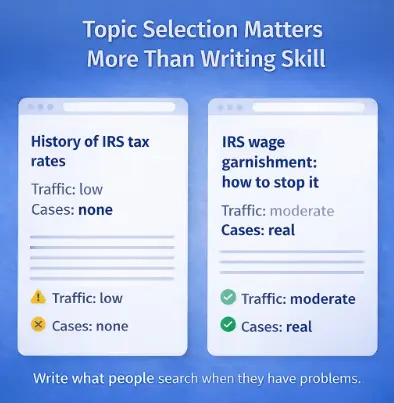
“IRS wage garnishment” is a huge keyword, but it can mean a lot of different things depending on the person searching.
A single mega-article like “What is IRS wage garnishment?” often tries to serve too many people at once:
- someone who is worried it might happen
- someone who just got a notice and wants a timeline
- someone already being garnished and wants it stopped
- someone trying to understand how much the IRS can take
When you try to cover all of that in one page, the article usually becomes bloated and unfocused.
A better strategy is to write separate articles that each serve one clear intent.
Intent angle: “I’m worried a garnishment is coming”
- When will the IRS garnish my wages?
- IRS wage garnishment timeline (what happens first)
- What happens after I get an LT11 notice?
- How much can the IRS garnish from my paycheck?
Intent angle: “My wages are already being garnished”
- How to stop an IRS wage garnishment
- Will a payment plan stop IRS wage garnishment?
- How to release a wage levy fast (what actually works)
- Can I appeal an IRS wage garnishment?
Sometimes these “long-tail” angles rank for the big head term too, because they do a better job matching what most searchers actually want.
How to Choose the Right Angle Before You Write
Before you pick a topic from this list and write it, do this first:
- Search the keyword in Google
- Open the top results
- Ask: What intent is Google rewarding right now?
- Then ask: Can we serve that intent better or serve a different intent more directly?
Pro tip: If every top result looks like the same article with the same headings, that is not a signal to copy it. It is a signal that Google may be waiting for a better angle.
Use the topic list below as a content bank and idea generator. If you like a topic, great. Just make sure your version has a clear angle, a clear intent, and something original that makes it feel more useful than the generic version.
High-Intent Blog Topics to Attract Future Tax Resolution Clients
These are informational searches people make before they hire a tax resolution professional.
They are often worried, researching options, or trying to understand what might happen next.
If your content shows experience, clarity, and real-world insight, many of these readers eventually become clients.
Enforcement and Immediate IRS Threat Topics
- IRS bank levy: what it means and how to stop it
- Can the IRS take my house for unpaid taxes?
- Can the IRS take my car or personal assets?
- IRS notice of intent to levy: what happens next
- How to stop an IRS levy before assets are seized
- IRS LT11 Notice: final notice of intent to levy and appeal rights
- How to stop an IRS wage garnishment quickly
- What happens after the IRS assigns a revenue officer
Payment Plans and Resolution Strategy Topics
- IRS payment plan options explained: which one is best?
- What happens if you miss an IRS installment agreement payment
- Can you negotiate with the IRS yourself or should you hire help?
- How long does the IRS give you to pay back taxes?
- What happens if you cannot afford your IRS payment plan
- Can you settle IRS debt for less than you owe?
- IRS partial payment installment agreements explained
- IRS currently not collectible status: who qualifies?
Offer in Compromise and Settlement Topics
- IRS offer in compromise requirements: who actually qualifies
- Why most people do not qualify for an offer in compromise
- IRS offer in compromise success stories and real outcomes
- How the IRS calculates your offer in compromise amount
- Offer in compromise vs payment plan: which is better?
- IRS reasonable collection potential explained
- IRS offer in compromise prequalifier tool: is it accurate?
- How to appeal a rejected offer in compromise
Business Tax and High-Value Case Topics
- Trust fund recovery penalty: who can be held responsible?
- IRS Form 4180 interview: what business owners should expect
- Can the IRS come after you personally for business taxes?
- Payroll tax debt: IRS resolution options for businesses
- Failure to deposit penalty: how businesses get into trouble
- What happens when the IRS assigns a revenue officer to your business
- Can the IRS shut down a business for unpaid taxes?
- Business tax debt settlement options with the IRS
Penalty Relief and Strategy Topics
- IRS penalty abatement: who qualifies and how to request it
- First-time penalty abatement: how it really works
- Reasonable cause penalty relief examples that work
- How much IRS penalties and interest add up over time
- Can IRS penalties be removed after you pay the tax?
- IRS failure to file vs failure to pay penalties explained
- How to write a penalty abatement letter to the IRS
- IRS interest on tax debt: how it grows over time
Hiring a Tax Resolution Professional Topics
- When should you hire a tax resolution professional?
- Can a tax attorney or enrolled agent negotiate with the IRS?
- What does a tax resolution consultation typically cost?
- How to choose the right tax resolution firm
- Warning signs of a bad tax relief company
- What happens after you hire a tax resolution professional
- Can the IRS contact you if you have representation?
- Do tax resolution companies really work?
- How long does it take to resolve IRS tax debt?
- What to expect when working with a tax resolution firm
How to Structure Blog Posts That Actually Bring Cases
Most blog posts written by tax professionals are technically accurate but poorly structured for real readers. Attention spans are short. People are stressed. They scan first and decide quickly if your content is worth reading.
A strong blog post does not need to be overly long, but it does need to be clear, well organized, and focused on the exact problem someone is searching.
Start by addressing the searcher’s concern immediately. Within the first few sentences, confirm they are in the right place and that you understand what they are dealing with. Avoid long intros about tax law or your firm. Get right to the issue.
Use a clean structure that is easy to scan:
- Strong headline that clearly states the topic
- Short introduction that hits the reader’s concern
- Subheadings that break the content into logical sections
- Simple explanations of what is happening and what options exist
- A clear next step or CTA for readers who need help
Add visuals where helpful. This can include simple timelines, process graphics, or screenshots of IRS notices. Visual elements help break up text and keep readers engaged.
End with a short FAQ section when appropriate. FAQs help answer common follow-up questions and also make it easier for search engines and AI systems to understand your content. Pro tip: adding FAQ schema to these sections can improve how your content is interpreted and displayed.
Do not overlook title tags and meta descriptions
Before anyone reads your article, they see your title in search results. Your title tag should clearly include the main keyword and reflect the exact problem being addressed. Avoid vague titles that do not mention the tax issue.
Meta descriptions should briefly confirm what the article covers and why it matters. Think of them as short ad copy that encourages the right person to click. Clear, relevant titles and descriptions help ensure your content attracts the right readers from search and AI results.
Why Unique Content Matters More Than Ever
One of the biggest issues we see in the tax resolution space is duplicate or recycled content.
Many tax marketing companies publish the same blog posts across dozens or even hundreds of client websites. The wording may change slightly, but the structure and substance are nearly identical. This approach does not build authority and it does not lead to strong rankings over time.
Search engines and AI systems prioritize original content and real insight. If your website has the same articles as many others, it becomes difficult to stand out. In some cases, duplicate-style content can dilute your site’s overall authority and limit long-term growth.
Your content does not have to be written from scratch without assistance, but it should reflect your firm’s real experience and perspective. AI can help with drafting and organization, but it should be guided by your knowledge and reviewed carefully before publishing. Adding your own explanations, examples, and practical insight makes a significant difference.
We have worked with firms ranging from solo practitioners to some of the largest tax resolution firms in the country. The sites that perform best over time consistently publish original content that reflects their actual services and experience.
If your goal is to build long-term visibility and attract better cases, originality matters. Unique content signals to search engines, AI platforms, and potential clients that your firm is active, experienced, and worth paying attention to.
How to Think About Blog Content Strategically
Not every blog post will bring in a call tomorrow, and that is not the goal.
Most blog searches are informational. Someone is trying to understand what is happening to them, what their options are, and how serious the situation may become. This is often the early phase of a case. If your content shows up during that phase, you position your firm as the one they already trust when they decide to get help.
Think of blog content as long-term visibility and positioning. Over time, a well-structured library of content builds authority around the types of cases you want. It also creates internal linking opportunities that strengthen your core service pages.
When planning blog topics, ask:
- What types of cases do I want more of?
- What are people searching before they hire someone?
- What worries or questions do they have early on?
Then build content around those concerns.
If you like handling wage garnishment cases, publish content around garnishment timelines, amounts, notices, and relief options.
If you prefer offer in compromise work, publish content around qualification concerns, downsides, timelines, and realistic expectations.
If you handle complex IRS or state issues, create content that speaks directly to those problems.
Over time, multiple articles on related subjects strengthen each other. Internal links between them signal to search engines and AI systems that your site has depth and authority on those topics. This often leads to stronger visibility across all related pages, not just one article.
The goal is not random posting. The goal is building a focused library of content around the types of cases you want more of.
Consistency Beats Perfection
The firms that benefit most from SEO are not the ones doing everything perfectly. They are the ones doing it consistently.
Search engines and AI systems reward sites that continue to grow and stay active. A website that publishes new content regularly and updates older pages signals that the firm is engaged and current. A site that has not changed in years often loses visibility over time.
Consistency does not mean publishing constantly. It means choosing a realistic pace and sticking with it.
For many small firms, this looks like:
- 1 to 3 new pieces of content per month
- Occasional updates to older high-traffic articles
- Continued expansion around core service areas
Over time, this builds momentum. Each new article strengthens your overall site authority and creates more internal linking opportunities. In many cases, adding more content around a topic increases visibility across all related pages, not just the new one.
We have seen articles that once brought in significant traffic slowly decline as they aged. After being updated with fresh information, improved structure, and better optimization, many regained strong visibility. Freshness signals matter more today than they did even a few years ago.
The key is routine. Decide what is realistic for your schedule or your budget and commit to it. Small, consistent efforts over time almost always outperform sporadic bursts of activity followed by long periods of inactivity.
Which Blog Topics Should You Start With First?
You don’t need to write all 50.
Use this list as your starting point or as inspiration for angles related to the types of cases you want more of.
Look through the topics and ask yourself:
What types of cases do I actually want landing on my desk?
If you want more offer in compromise work, focus there.
If you prefer business tax or payroll cases, start there.
If levy and garnishment cases are common in your practice, build around those topics first.
This list is not meant to be followed in order.
It is meant to help you identify:
- What people are already searching
- What concerns show up before someone hires a professional
- What topics position you as the obvious person to call later
You can use these topics directly or let them spark related ideas and variations.
Pro tip: Use keyword tools to guide decisions and expand on ideas from this list.
Tools like:
- SEMrush
- Ahrefs
- Google Keyword Planner
- Google Search Console (your own site data)
These tools help you see:
- What people are actually searching
- Variations of core topics
- Questions tied to real tax problems
- Lower-competition opportunities
You will often find dozens or even hundreds of search variations around one strong topic. Many lower-volume searches still bring excellent cases because intent is high and competition is lower.
Pick a few topics from this list or use it as inspiration.
Then start publishing consistently around the areas you want to be known for.
Where These Blog Posts Fit Into Your Website
Blog posts should not exist on their own.
Each one should support a core service you want more of.
For example:
- Offer in compromise blog posts → link to your Offer in Compromise service page
- Wage garnishment blog posts → link to your garnishment or levy help page
- Business tax articles → link to payroll tax or business tax resolution services
Think of blog posts as the entry point.
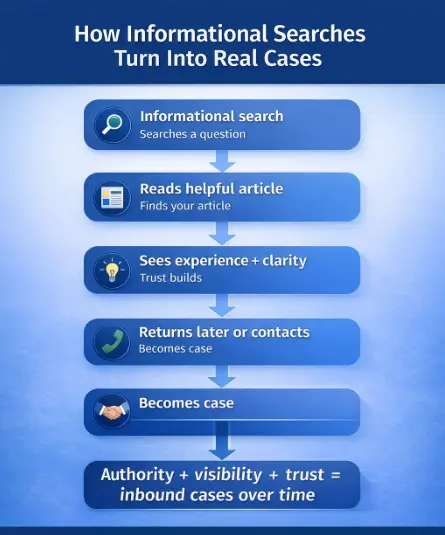
Someone searches a question.
They land on your article.
They see you clearly handle these cases.
Then they move toward contacting you.
This is how informational searches turn into real cases over time.
You don’t need a perfect site structure.
You just need clear connections between:
Blog topics → services you offer
That alone puts you ahead of most firms.
How Often Should You Publish?
Consistency beats volume.
You do not need to publish constantly to see results.
For most small firms, a realistic pace is:
- 1 to 2 new articles per month
- Or even 1 strong article per month
What matters more:
- Original content
- Good topic selection
- Staying consistent
Over time, articles build on each other.
Five strong posts on related topics often outperform fifty random ones.
If you already have older content on your site, updating it can also make a noticeable difference. Refreshing and improving existing posts often restores traffic that has declined over time.
Think long-term library, not quick wins.
Want Us To Build This For You?
If you read this list and thought, “This is exactly what we should be doing… but we’re not going to have time,” that’s normal.
TaxCure offers SEO support for tax resolution firms that want consistent visibility without guessing.
We can help with:
- Content strategy based on the cases you want more of
- Topic planning you can actually rank for (and variations you may not be thinking about)
- Writing and publishing original content (Led by licensed Enrolled Agent)
- Internal linking and content structure so your service pages actually benefit
- Ongoing updates to older posts that used to perform but have declined
- Website updates when needed to support growth
Closing: Pro Tip — Treat This as a Long-Term Content Bank
You do not need to write 50 blog posts this month.
Use this list as a long-term content bank and idea source — not a checklist to copy exactly.
If a topic stands out, think about how you can approach it differently or more effectively based on the types of cases you want and the clients you typically work with.
Pick 3 to 5 strong topics that match your core services, choose a clear angle for each, and build from there. Even one strong article per month adds up quickly when it is:
- focused on a specific search intent
- structured for real readers (and skimmers)
- tied to a service you want more of
- and written with real experience and perspective
This is how informational content builds real visibility over time.
As your library grows, your authority grows with it. Search engines and AI-driven results begin to recognize your site as a trusted source on the problems you handle most. That visibility compounds month after month and often leads to better, more informed prospects reaching out when they are ready for help.
Think long-term positioning, not volume. A focused, original content library built over time will outperform dozens of generic articles every time.