TaxCure WP

Search results for: “profiles”

  • How to Add Your Google Business Profile Reviews to Your TaxCure Profile

    How to Add Your Google Business Profile Reviews to Your TaxCure Profile

    What This Feature Does

    TaxCure Pro profiles already highlight TaxCure reviews that are specifically about tax resolution work. These are important because they show real, relevant experience in resolving tax problems and help our algorithm surface the right professionals to the right taxpayers.

    Now, you can also display your Google Business Profile (GBP) star rating and review count directly on your TaxCure profile.

    This does not replace your TaxCure reviews. It simply adds an extra layer of credibility:

    • TaxCure reviews = proof of real tax resolution experience
    • Google reviews = social proof and brand trust that many taxpayers already recognize

    Together, they make your profile stronger and more trustworthy at first glance.


    Why You Should Add Your Google Business Profile

    Even though TaxCure reviews focus on tax resolution (which is what really matters for quality and matching), many taxpayers:

    • Instantly recognize Google star ratings
    • Use them as a quick trust signal
    • Feel more comfortable when they see both platform reviews and Google reviews together

    Adding your Google Business Profile:

    • Makes your profile stand out in the directory
    • Increases perceived credibility
    • Helps convert more visitors into inquiries
    • Takes less than 2 minutes to set up

    Video Walkthrough (Recommended)

    This short video shows exactly how to find your Google Business Profile link and add it to your TaxCure profile.


    How To Add Your Google Business Profile to TaxCure

    Step 1: Go to Your Pro Dashboard

    Log in and go to your Pro dashboard:

    https://taxcure.com/member/professionals/dashboard

    Click Edit Profile.

    Step 2: Scroll Down to the Contact Information Section

    Click Edit on the contact information section

    You will see a field labeled:

    Google Business Profile URL

    This is where you will paste your Google Business Profile link.

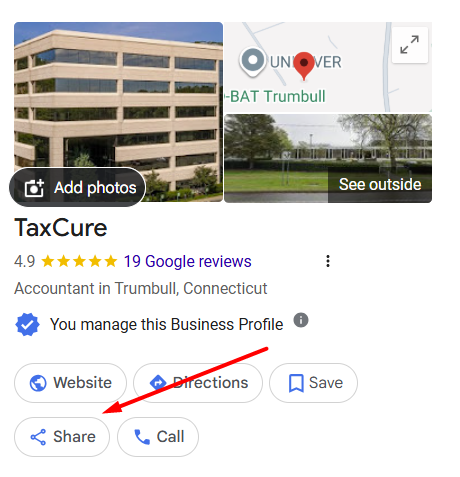
    Step 3: Get Your Google Business Profile Link

    1. Go to Google and search for your business name.
    2. Your Google Business Profile will appear (usually on the right side of the search results).
    3. Under your star rating and reviews, click the Share button.
    4. A panel will open with a link at the bottom.
    5. Click the link to copy it.

    Step 4: Paste the Link Into TaxCure

    1. Go back to your TaxCure profile edit page.
    2. Paste the link into the Google Business Profile URL field.
    3. Click Save.

    That’s it.


    What Happens After You Save

    Once saved:

    • Your Google star rating will appear on your TaxCure profile
    • Your review count will be displayed
    • Visitors will be able to see both your TaxCure reviews and your Google reviews

    Your TaxCure reviews will always remain the primary reviews used for rankings and matching. Google reviews are shown as an added trust and credibility layer.


    Important Notes

    • This only works if you paste a valid Google Business Profile share link
    • If your reviews don’t show up right away, try refreshing your profile or double-checking the link
    • If you don’t yet have a Google Business Profile, we strongly recommend creating one

    Summary

    • TaxCure reviews show real tax resolution experience
    • Google reviews add familiar social proof and trust
    • Now you can show both
    • Setup takes about 2 minutes

    If you have any issues getting this set up, contact support and we’ll help you get it added.

  • IRS to Automatically Abate First-Time Penalties in 2026

    IRS Offers Automatic First-Time Penalty Abatement

    Program Aims to Help About 1 Million Taxpayers Per Year

    The IRS plans to automatically apply first-time penalty abatement for qualifying taxpayers, starting in the 2026 filing season. The automatic abatement applies to tax returns from tax year 2025 on failure-to-file, failure-to-pay, and failure-to-deposit penalties. 

    About 1 million taxpayers will benefit from the program every year – the IRS expects to abate over $250 million in penalties annually, which should also free up about 100 to 150 IRS employees from focusing on penalty abatement to working on other tasks. 

    Taxpayers who don't qualify for automatic relief can still contact the IRS to request penalty abatement based on reasonable cause or other remedies offered under the tax code. 

    Key takeaways:

    • Automatic penalty relief starts in filing season 2026 for penalties incurred on tax year 2025 returns. 
    • Relief is available for late filing, late payment, and late deposit penalties. 
    • The IRS plans to provide automatic relief to taxpayers who have not had a penalty reversed in the previous three tax years. 
    • Approximately 1 million taxpayers will benefit from penalty relief each year, saving over $250 each on average.
    • Taxpayers who don't qualify for automatic relief can still request penalty abatement for reasonable cause.

    Who qualifies for automatic penalty relief in 2026?

    The IRS will provide automatic first-time penalty relief to taxpayers who:

    • incur failure to file, failure to pay, or failure to deposit penalties.
    • have no penalties over the three previous tax years – if not required to file all of the three previous years, have no penalties for the years they were required to file.

    Business taxpayers may also need to meet these requirements:

    • do not have four or more failure-to-deposit waiver codes in the last three years.
    • have not incurred a failure-to-deposit penalty for EFTPS avoidance. 

    If the penalty applies to a tax return that is filed as married filing jointly, both taxpayers must meet the above criteria. The IRS will typically not apply automatic relief if only one spouse has a history of good compliance. 

    How do you know if you qualify for automatic penalty relief?

    Review the criteria above to see if you qualify for automatic relief. If penalties are waived from your account, the IRS will send a letter explaining that you received an automatic penalty waiver. 

    At the time of writing, the IRS is still working on the letter for its automated FTA program. Most likely, the letter will be relatively short, and it will explain to the taxpayer that they incurred x penalties for x reasons, but the penalties were waived. 

    You can also check your online IRS account to see if any penalties have been assessed or waived.

    Which tax years qualify for automatic relief?

    Returns from tax year 2025 will qualify for automatic relief if the taxpayer meets the requirements. Tax returns from subsequent years will also qualify for automatic penalty relief if the IRS continues this program. Taxpayers can only get first-time penalty abatement on tax returns for a single year – not on returns from multiple tax years. 

    Erin Collins, the National Taxpayer Advocate, announced the automatic first-time relief at the AICPA National Tax Conference in November, 2025. Her comments suggest that this will be an ongoing program for the indefinite future, but to date, the IRS has not released a formal announcement. 

    Brief history of the IRS automatic first-time abatement program

    The IRS started offering first-time penalty abatement in 2001 for tax periods ending after December 31, 2000. However, taxpayers had to apply for this relief. It was not in the tax code. Instead, it was only in the Internal Revenue Manual (IRM), a training manual for IRS employees – as a result, tax prepapers and accountants often were not aware of this type of relief, unless they focused on tax resolution work

    To get a first-time abatement in the past, taxpayers had to apply by calling the IRS, writing a letter, or filing Form 843. Once taxpayers reached out, the IRS reviewed their file and applied relief if they met the requirements. Form 843 allowed taxpayers to explain if they were applying for relief based on reasonable cause, which is when events out of your control prevent you from being compliant with the tax filing or payment requirements. 

    However, even if a taxpayer qualified for reasonable cause relief, the IRS would process the abatement under the first-time rules. The IRS would also mark the taxpayer's file, noting that they'd received an abatement under the first-time rules. That effectively made taxpayers ineligible for first-time abatement for the next three years, regardless of whether they qualified for reasonable cause or not. 

    Starting in 2018 and potentially even further back, the IRS started talking about automating first-time penalty abatement. After several years of figuring out how to automate this process, the agency was ready to roll for the 2026 filing season. However, some analysts have doubts about the efficacy of this program and whether or not it'll really help some taxpayers as much as intended. 

    Possible problems with automatic first-time penalty abatement

    The Taxpayer Advocate Service says that automatic relief will help about 1 million taxpayers per year, particularly lower-income taxpayers. In the last 25 years, many taxpayers have unnecessarily incurred penalties because they didn't know that relief was an option. 

    However, tax professionals see potential problems for taxpayers, including:

    • Reduced opportunity for reasonable cause penalty abatement: If a taxpayer is eligible for first-time abatement and reasonable cause abatement in the same year, the automatic procedures will provide them with FTA instead of reasonable cause. Say the next year, they also incur penalties but don't qualify for reasonable cause – now, they cannot have these penalties abated as they've already used their first-time abatement during the previous three tax years.
    • Infringement of rights: The National Taxpayer Advocate has stated that taking away reasonable cause, which is a remedy offered under the law, and replacing it with first-time abatement, which is an internal IRS remedy, may infringe on taxpayers' right to only pay the correct amount of tax due, because of how it interacts with reasonable cause.
    • Reduced penalty abatement under small partnership exception: When partnerships with 10 or fewer partners, that also meet other criteria, file their 1065 partnership returns late, the IRS may abate penalties under the small partnership exception rules (Rev Proc 84-35). Historically, a partnership could use these rules for penalty abatement and still qualify for FTA in a future year. However, if the IRS automatically applies FTA, the partnership will not be able to use FTA in the next three years.
    • Mistakes with extended deadlines: Tax professionals worry that the IRS will not calculate penalties correctly in cases where filing or payment deadlines are moved in federally declared disaster areas. It's extremely common for the IRS to extend payment, filing, and deposit deadlines for individual and business taxpayers in these areas. 
    • Penalty relief when taxes are not fully paid: The failure-to-pay penalty continues to accrue until taxes are paid in full, and these penalties can often run for several years. If the IRS abates this penalty before it's fully assessed, the taxpayer may still qualify to have the remaining amount of the penalty abated. If this doesn't happen automatically, taxpayers will need to reach out to the agency. 
    • Worries about lack of IRS communication: Some tax professionals also worry that the IRS may not notify taxpayers that they've received automatic penalty abatement, but statements from the National Taxpayer Advocate indicate that the IRS already has a plan in place to notify taxpayers when penalties have been abated. 

    If you face any of these types of problems or any other issues with IRS penalties, reach out to a tax professional for help with penalty abatement. TaxCure makes it easy to find a professional – use the filters to narrow down your search to someone with penalty abatement experience. Then, check out profiles and read reviews until you find the right fit. 

    FAQs about automatic penalty abatement

    Does the IRS have a new penalty abatement program?

    No. In 2026, the IRS started automating its first-time penalty abatement program. The program uses the same rules and qualification criteria as it always has. However, now taxpayers don't have to apply. 

    What if I have penalties on a tax return prior to tax year 2025?

    Then, you must call the IRS to request penalty abatement. Alternatively, you can send in Form 843 or write a letter to the agency. 

    What if I don't get automatic penalty abatement on my late tax return or payment?

    Then, you may want to apply for relief based on reasonable cause. Taxpayers may qualify for reasonable cause abatement if events outside of their control – death, illness, natural disaster, loss of records, etc prevented them from paying, filing, or depositing taxes on time. Learn more about reasonable cause requirements.

    Can businesses qualify for automatic penalty relief?

    Yes, businesses may qualify for automatic first-time penalty relief if they incur a failure-to-deposit, failure-to-file, or failure-to-pay penalty. 

    What is one-time forgiveness?

    The IRS does not use the phrase "one-time forgiveness" – it does not apply to an official IRS program. However, sometimes people refer to first-time abatement as "one-time forgiveness" simply because it's available once after every three years of compliance. If you get first-time abatement, you cannot get penalties abated under this program for the next three tax years. However, if you incur another penalty four or five years later, you should qualify for another first-time abatement.

  • Best Florida Tax Relief Companies (Based on Real Reviews)

    Best Florida Tax Relief Companies (2026 Guide)

    best florida tax relief companies

    Dealing with IRS or Florida Department of Revenue tax problems? This guide cuts through the noise. Unlike most "best of" lists that feature the same national firms over and over — often because those firms paid for placement — this list is built entirely on verified reviews from real Florida taxpayers who hired these professionals to resolve actual tax problems. Every firm here has been vetted by TaxCure, is staffed by licensed tax professionals, and has demonstrated experience solving the specific types of problems Florida taxpayers face. Use the quick picks below to find the right fit for your situation, or read the full profiles to dig deeper.

    Quick Picks — Best Florida Tax Relief Firms by Situation

    These are the top-rated Florida tax resolution firms matched to specific tax problems, based on verified reviews from real taxpayers.

    Best for Multi-Year Back Taxes & IRS Cleanup

    Fairwinds Bookkeeping & Tax Solutions

    Jacksonville-based EAs with 200+ years of combined IRS experience. Strong fit for individuals and small businesses with multi-year compliance problems and long-term back tax issues.
    We came in with a very challenging tax situation with intermingled personal and construction business taxes that went back 7+ years… she was able to work with us and the IRS to resolve our tax issues. — Amanda H.
    Best for Florida DOR Issues & Sales Tax Problems

    Keith L. Jones, CPA

    Jacksonville CPA with 35+ years of experience and a strong track record with Florida DOR audits, sales tax problems, reemployment tax, and IRS collections.
    Despite a late hour, he stopped everything to review my sales tax problem and demand letter from the State of Florida… Feeling safe and protected in Keith's hands was invaluable. — Noah F.
    Best for High-Balance IRS Debt & Complex Negotiations

    MD Sullivan LLC

    Fort Lauderdale firm powered by 130+ years of direct IRS experience. Former Revenue Officers on staff — ideal for high-balance liabilities, revenue officer cases, and complex federal negotiations.
    After $11,000 of wasted money with another firm… Julie was able to get done in a couple of weeks what that incompetent firm could not do in over a year. — Anonymous
    Best for Multi-State Tax Problems & Unfiled Returns

    Nashville Tax Solutions

    West Palm Beach EA firm founded by Christopher Bennett. Specializes in multi-state compliance, unfiled returns, and structured long-term IRS resolution for individuals and small businesses.
    I was overwhelmed and didn't know how to proceed with taxes for multiple states… Chris was able to handle everything I didn't know I needed. My tax stress ended when I met Chris. — Anonymous
    Best for IRS Appeals, Revenue Officer Cases & Large Tax Debt

    Salinger Tax Consultants

    Fort Myers firm led by former IRS agent Peter Salinger with 33+ years of IRS experience. Has resolved over $100 million in tax liabilities — best for high-stakes collections and appeals.
    Peter handled all the back and forth with the IRS office of appeals and our local Revenue Officer… he kept the liens and levies at bay while we worked toward a solution. — Anonymous
    Best for Legal Tax Defense, Audits & International Issues

    Silver Tax Group

    West Palm Beach tax attorneys led by Chad Silver. Handles legal tax defense, criminal exposure, audit representation, and complex international issues including FBAR compliance.
    Silver Tax Group reduced the debt through filed tax returns and negotiated the remaining balance into affordable payment plans. The entire team is extremely easy to work with. — Anonymous
    Best for Amended Returns, IRS Error Corrections & Business Cleanup

    WesTax, Inc.

    Sarasota CPA/EA firm founded by Maurice West. Known for amended returns, IRS error correction, and business tax cleanup for individuals and small businesses across multiple states.
    He recently helped me amend my taxes… thanks to his meticulous attention to detail, I received a substantial reimbursement. His deep knowledge of tax laws has been invaluable. — Kate B.


    Florida tax relief companies — comparison snapshot

    Company Credentials Florida DOR Top Strengths
    EA
    IRS focus
    Multi-Year Back TaxesIRS ComplianceCleanup
    Jacksonville, FL

    CPA
    Sales Tax, Audits
    FL DOR AuditsSales TaxReemployment TaxIRS Collections
    Fort Lauderdale, FL

    EACPAFormer IRS
    Income & Payroll
    High-Balance DebtRevenue OfficersPayroll TaxComplex Negotiations
    West Palm Beach, FL

    EA
    IRS focus
    Multi-State IssuesUnfiled ReturnsPayment Plans
    Fort Myers, FL

    Former IRSCTRS
    Payment Agreements
    IRS AppealsRevenue OfficersLarge Tax Debt$100M+ Resolved
    West Palm Beach, FL

    Attorney (JD)
    Tax Defense
    Legal Tax DefenseAuditsCriminal ExposureFBAR / International
    Sarasota, FL

    CPAEA
    Unfiled Returns
    Amended ReturnsIRS Error CorrectionBusiness Cleanup

    How to Find Help for Your Tax Problems in Florida

    Tax problems are incredibly stressful, and if you don't get the right help, you'll continue to incur penalties and put your assets at risk. The IRS and the Florida Department of Revenue (DOR) have unparalleled power to collect unpaid taxes from individuals and businesses. Involuntary collections can ruin your personal finances and potentially shut down your business.

    To protect yourself, you need to work with an experienced tax resolution professional – and ideally, they should be local. If you're having tax problems in Florida, check out the top tax resolution firms in the Sunshine State for 2026.

    Why Local Florida Expertise Matters

    While some tax problems can be handled by licensed professionals anywhere in the country, working with a local Florida tax professional does provide important advantages. Florida has a unique state enforcement, especially for sales tax, reemployment tax, state tax warrants, and business audits. Professionals who regularly deal with the Florida Department of Revenue (FLDOR) understand these issues better than the national firms.

    Even if you are just dealing with the IRS, choosing local increases trust and communication and gives you the option to meet face-to-face if you ever want to. This is something many taxpayers value after a negative experience with large national companies. A local professional is also more likely to have a long-term reputation in their community and to be invested in delivering quality and personalized service. 

    Working with a Florida-based licensed EA, CPA, or tax attorney often results in better service, accountability, and outcomes for both IRS and Florida DOR tax problems. 

    How to Find Experienced Tax Help

    Traditionally, it's been very hard to find the right help when you have tax problems. Internet searches for the best tax relief companies in Florida often turn up the same old list of big nationwide firms over and over. Even respected publications tend to focus on the same handful of big tax relief firms anytime they publish an article on the best tax relief companies. 

    Why? You'll have to check each site's advertising disclaimer to see why it promotes these companies — but typically, it's one of two reasons: a) the companies paid for the placement, or b) the writer didn't have enough time to do quality research. 

    That's where TaxCure comes in – this site was created to address this hole in the marketplace and to help taxpayers find experienced, legitimate help for their tax problems. It's the only online directory that exclusively features tax resolution professionals. You can search for pros based on their area as well as their experience with specific tax problems. 

    To help you get started, we've put together a list of Florida's top tax relief companies in 2026.


    Florida's best tax resolution firms for 2026

    The TaxCure team has vetted all of these tax firms and professionals. All companies are staffed by licensed tax professionals bound by the ethical guidelines of Circular 230 and committed to giving clients customized solutions to their tax problems.

    How we selected Florida's best tax relief companies (2026 methodology)

    • Verified TaxCure reviews only — not general accounting or tax prep reviews as seen on Google or Yelp
    • Review recency, with reviews in the past 24 months weighted higher
    • Case types handled, including common IRS and state issues as well as complex payroll and sales tax matters
    • Depth of tax resolution experience, rather than general tax preparation or accounting experience
    • License requirements — all services must be performed by a licensed enrolled agent, CPA, or tax attorney
    • Complaint ratios and issue severity
    • Demonstrated expertise helping Florida taxpayers resolve tax problems

    Best fit forIndividuals and small businesses with multi-year IRS compliance problems, back tax filings, and ongoing accounting needs.
    Known forResolving long-term IRS back-tax issues and cleaning up multi-year filings. Also offers tax prep, tax planning, payroll, and bookkeeping.
    Agency coverageIRS, Florida Department of Revenue
    Review themesClients praise thoroughness, patience with complex situations, and ability to resolve cases others couldn't.

    We came in with a very challenging tax situation with intermingled personal and construction business taxes that went back 7+ years. We were very discouraged after having a bad experience trying to get help from other tax professionals. With Jennifer, she was so thorough and detailed… she was able to work with us and the IRS to resolve our tax issues. — Amanda H.

    Keith L. Jones, CPA

    Jacksonville, Florida
    CPA
    Best fit forTaxpayers facing Florida DOR audits, sales tax problems, reemployment tax issues, and IRS collection actions.
    Known for35+ years of experience with Florida DOR matters. Member of the American Society of Tax Problem Solvers (ASTPS). Strong track record stopping levies and negotiating settlements.
    Agency coverageIRS, Florida Department of Revenue, Georgia Department of Revenue
    Review themesPraised for deep knowledge of Florida DOR processes, responsiveness, and going above and beyond for clients.

    Despite a late hour, he stopped everything to review my sales tax problem and demand letter from the State of Florida… Feeling safe and protected in Keith's hands was invaluable. — Noah F.

    MD Sullivan LLC

    Fort Lauderdale, Florida
    EACPAFormer IRS
    Best fit forHigh-balance IRS liabilities, revenue officer cases, and complex federal and state business tax negotiations.
    Known for200+ years of combined tax experience including 130+ years of direct IRS experience. Former Revenue Officers on staff with deep insider knowledge of IRS collection processes.
    Agency coverageIRS, Florida Department of Revenue, and multiple state agencies nationwide
    Review themesClients highlight results that other firms couldn't achieve, speed of resolution, and former-IRS insider advantage.

    After $11,000 of wasted money with another firm… Julie was able to get done in a couple of weeks what that incompetent firm could not do in over a year. She is an ex-Revenue Officer of the IRS who knows what to look for and her credentials speak for themselves. — Anonymous

    Nashville Tax Solutions

    West Palm Beach, Florida
    EA
    Best fit forTaxpayers with multi-state compliance problems, unfiled returns, and individuals or small businesses needing structured long-term IRS resolution.
    Known forFounded by EA Christopher Bennett with a motto of "Tax Resolution Achieved!" Has helped clients save millions in tax liabilities across multiple states.
    Agency coverageIRS, Florida Department of Revenue, and multiple state agencies including Massachusetts, Colorado, and California
    Review themesPraised for handling complex multi-state situations, clear communication, and guiding overwhelmed clients through the entire process.

    I was overwhelmed and didn't know how to proceed with taxes for multiple states like Massachusetts. Chris was able to handle everything I didn't know I needed and was able to guide me when the other guys just could not. My tax stress ended when I met Chris. — Anonymous

    Salinger Tax Consultants

    Fort Myers, Florida
    Former IRSCTRS
    Best fit forHigh-stakes IRS collections, revenue officer cases, IRS appeals, and taxpayers with large tax debts requiring aggressive representation.
    Known forFounded by former IRS agent Peter Salinger with 33+ years of IRS experience. Has resolved over $100 million in tax liabilities. Multiple former IRS agents and CTRS professionals on staff.
    Agency coverageIRS, Florida Department of Revenue, and multiple state agencies nationwide
    Review themesClients consistently highlight Peter's former-IRS insider knowledge, responsiveness, and ability to handle revenue officers and appeals that others couldn't navigate.

    Peter handled all the back and forth with the IRS office of appeals and our local Revenue Officer. His help did wonders to reduce the fear and stress of dealing with the IRS directly, and he kept the liens and levies at bay while we worked toward a solution. — Anonymous

    Silver Tax Group

    West Palm Beach, Florida
    Attorney (JD)
    Best fit forTaxpayers needing legal tax defense, audit representation, criminal tax exposure, and complex international issues including FBAR compliance.
    Known forLed by attorney Chad Silver. All representation handled by licensed tax attorneys. Covers the full spectrum from basic tax debt to high-risk criminal exposure and offshore reporting.
    Agency coverageIRS, Florida Department of Revenue, Michigan Department of Treasury, and multiple state agencies
    Review themesClients highlight attorney-level expertise, personalized service, and relief from long-standing complex tax problems.

    Silver Tax Group reduced the debt through filed tax returns and negotiated the remaining balance into affordable payment plans. The entire team is extremely easy to work with and will go out of their way to accommodate. — Anonymous

    WesTax, Inc.

    Sarasota, Florida
    CPAEA
    Best fit forIndividuals and small businesses needing amended returns, IRS error correction, business tax cleanup, and compliance-based resolution.
    Known forFounded by Maurice West, CPA and EA. Motto: "Break free from IRS tax problems." Handles audits, amended returns, unfiled returns, tax debt, and IRS collections.
    Agency coverageIRS, Florida Department of Revenue, Georgia Department of Revenue, Louisiana Department of Revenue
    Review themesClients highlight meticulous attention to detail, strong results on amended returns, and deep knowledge of both personal and business tax law.

    He recently helped me amend my taxes… thanks to his meticulous attention to detail, I received a substantial reimbursement. His deep knowledge of tax laws has been invaluable in optimizing both my personal and business taxes. — Kate B.

    Find Other Licensed Florida Tax Professionals

    Want to keep exploring your options and see more Florida tax professionals? Then, learn more about how to use TaxCure or start your search right now. 

    TaxCure's innovative search feature lets you filter your search results so that you only see tax professionals who have experience with your specific concern, whether that's Florida sales tax, Florida business taxes, state tax warrants, etc. You can also filter your search results based on the solution you want – for example, Florida payment plans or settlements. 

     Or get started by looking at directories of specific Florida tax professionals, including:


    FAQs about Florida's best tax relief companies

    To find help for tax problems in Florida, talk with friends, colleagues, or tax professionals to get recommendations. Do online searches, but read the reviews carefully to ensure you understand the site's advertising practices and who can post reviews. Whenever possible, look for consumer-submitted reviews like you can see on TaxCure's profiles of Florida tax professionals.

    Florida allows the following professionals to represent taxpayers in front of the DOR: tax attorneys, CPAs, enrolled agents, former FL DOR employees, reemployment tax agents, or other qualified representatives with the training and experience to handle the tax matter. To have someone represent you in front of the DOR, you must file Form DR-835 (Florida Department of Revenue Power of Attorney and Declaration of Representative).

    Tax relief firms can help you set up payments or apply for an offer in compromise on your Florida taxes. They can represent you in audits, including industry-specific audits such as restaurant sales tax audits. They can also help you stop or avoid collection actions, such as Florida tax warrants, wage garnishment, bank levies, or asset seizures.

    The IRS has different rules about representation than the FL DOR. Only tax attorneys, CPAs, and enrolled agents may represent taxpayers in front of the IRS. However, there are a few exceptions where taxpayers may be represented by return preparers, family members, employees, or students.

    There are several reputable tax relief companies in Florida, but unfortunately there are also firms more focused on making sales than really helping clients. To find reputable help, only work with firms that connect you directly to licensed tax professionals. Ask about their experience with your concern and read customer testimonials to determine if they're a good fit. Learn more about how to avoid scams and spot the worst tax relief companies.

    Most cases run between $3,500 and $5,500. Business cases typically cost more, ranging from $5,000 to $7,000 due to the complexity of business and payroll returns. Costs vary based on the firm and the nature of your problem. Check out TaxCure's guide to tax resolution pricing for a full breakdown by service type.

    Most firms charge a flat fee, though some bill hourly ($200–$550/hr). Payment options vary — some require full payment upfront, others take a deposit with monthly payments until the case closes. Always make sure you understand the billing structure before signing anything.

    Hiring a tax resolution company is an investment in solving your tax problems. If you're confused about your options, stressed about dealing with the IRS, or unsure of the best strategy, you should reach out to a professional. Ignoring the problem or taking a DIY approach often makes things worse, putting you at risk of enforced collection actions or growing penalties.

    An Offer in Compromise typically runs $4,000–$7,500. A simple installment agreement is on the lower end at $2,500–$3,500. The more complex your case, the higher the cost. Business cases involving payroll tax or multiple years of unfiled returns will generally fall toward the higher end of the range.

  • Business Owner’s Guide to Surviving Missouri Tax Audits

    Missouri DOR Business Tax Return Audits

    MO Busines Tax Audit

    How to Prepare and What to Expect With MO DOR Audits

    The Missouri Department of Revenue has the right to audit any tax returns filed with the agency – and if you operate a business in this state, you need to be ready. To help you out, this post outlines what to expect if your business tax returns are selected for an audit. 

    Need help now? Use TaxCure to find a licensed tax professional who can provide audit representation in Missouri.

    Key takeaways

    • The MO DOR may audit sales and use tax returns, corporate income tax returns, or other other returns filed by your business. 
    • During an audit, you will need to provide records that back up the numbers reported on your tax return(s). 
    • If the auditor disagrees with your records, they may adjust your return and assess tax against you.
    • You have appeal rights after an audit, but they're subject to strict rules and deadlines. 
    • If you incur a tax liability due to an audit, you may be able to set up payments with the DOR.

    Types of Missouri business taxes subject to audit

    The DOR may select the following business returns for audit:

    • Corporate income tax returns
    • Partnership or S-Corp returns
    • Withholding returns (Missouri payroll tax)
    • Sales and use tax returns

    Any other taxes administered by the Department, including marijuana tax, tire and lead battery fees, cigarette tax, and motor fuel tax.

    Audit triggers: How the MO DOR selects returns to audit

    The DOR selects some returns for audit randomly, but often the Department takes a much more strategic approach to identify potentially problematic returns: 

    • Cross-matching – the DOR compares information on your returns to information submitted on other returns. For instance, revenue reported on a business income tax return to taxable sales reported on a sales tax return. 
    • Unusual discrepancies – unusual discrepancies between your reported information and industry norms can also lead to an audit. For instance, if the ratio between your business expenses and revenue is significantly out of line for your industry, your corporate income tax return may get flagged for an audit.
    • High-risk industries – the DOR often puts additional scrutiny on returns filed by businesses in cash-heavy industries such as restaurants or car dealerships. They also focus on industries where sales tax can be complicated, like car repair businesses that charge sales tax on parts but not labor.

    What to expect during a Missouri business audit

    The Department will mail you an audit notice, letting you know that you've been selected for a state audit and outlining the type and scope of the audit. The Department may handle your audit through the mail (correspondence audit), or they may request to meet with you at your place of business (field audit) or in the auditor's office (desk audit). Most business auditors will insist on coming to your place of business.

    The auditor will also let you know which returns, from which tax periods, are under audit. Typically, the Department only goes back up to three years, but if they discover fraud or significant income understatementse on those returns, they may go back further and look at older returns. 

    The documents you need to provide vary based on the return being audited, but may include:

    • POS reports
    • Invoices
    • Bank statements
    • Payroll records

    Often, the auditor may want to see multiple records. For instance, if the MO DOR is auditing your withholding tax returns, they may want to see time sheets, payroll records, and bank statements that show employees' payments being taken out of your bank account.

    After you provide the documents, the auditor will review them, and in many cases, they will ask for more documents. In most cases, state auditors will even come to your place of business and observe operations. That gives them a sense of whether your operations support the information reported in your returns – for instance, if they're auditing sales tax returns, they may want to see that you ring up sales, how you handle discounts, and what you do with cash payments.

    Finally, once all the details are in, the auditor will either accept your return as filed or make changes. Most changes lead to a tax liability, which will also include penalties and interest backdated to the filing deadline. A small number of audits may lead to a reduced tax liability, but that's rare. 

    If you agree with the changes, you can pay the tax due and put the audit behind you. If not, you have appeal rights. The appeal process can be confusing, and the deadlines are strict. Even if you've gone this far without representation, it's time to contact a tax professional now.

    Typically, you appeal through the Missouri Administrative Hearing Commission (AHC). During the appeal, you can present new information and explain why you disagree with the auditor's changes. If you miss the appeal deadline, you may be able to pay under protest and then seek a refund. 


    Nexus concerns during Missouri audits

    Auditors may also look for businesses with nexus that aren't filing the right returns in the state. For instance, if your corporation has a physical presence in the state – for instance, storing inventory or providing services along with product deliveries – the auditor may look into whether you have corporate nexus and need to file corporate returns.

    More commonly, however, nexus concerns are focused on sales tax filings. If you have a physical presence in the state, you have nexus and must register for a sales tax permit and collect sales tax. However, if you're not physically based in the state, you may have economic nexus if your sales exceed $100,000 over the last 12 months. 

    The state expects you to look at your sales at the end of every quarter, add up Missouri sales for the previous 12-month period, and if you're over the threshold, start collecting and paying Missouri vendor use tax within three months. Note that most states refer to sales tax collected by remote sellers as sales tax but Missouri calls it vendor's use tax.

    If you're a marketplace seller, the marketplace facilitator will collect and remit vendor's use tax on your sales, but if you have sales outside the marketplace, you must consider your total sales when determining your nexus. Say for example, you have $20,000 in Missouri sales through the marketplace but you have $80,000 through your personal business website. That triggers nexus. 

    To spot businesses that have nexus in the state but aren't paying sales tax, the MO DOR may:

    • Compare businesses registered to pay Missouri payroll tax to businesses registered for sales tax accounts.
    • Check state sales tax registrations against import/customs records.
    • Cross-reference payments from marketplace facilitators to sales tax registrations.

    The DOR has many ways to spot noncomliant business registrations and unfiled returns. If you're supposed to be paying tax in Missouri but haven't registered or filed, consider looking into the state's Voluntary Disclosure Program – but act quickly, you can only apply if you reach out to the state before an auditor contacts you.

    How to prepare for a MO business tax audit

    So, what should you do if you're selected for an audit. To prepare, keep these tips in mind:

    • Review the notice carefully – Look for documents required, deadlines and details about the audit.
    • Gather documents – get together all of the documents listed in the audit notice or any other documents that substantiate the details reported on your return. 
    • Understand sampling – if you have a high volume of sales, auditors may not want to see all your records; instead, they'll want to see a sample.
    • Get ready for unusual requests – if an auditor requests something that seems out of scope, ask to talk to their manager or reach out to an MO tax professional. However, in some cases, "unusual" documents are the norm – for example, an auditor may want sales details presented in a spreadsheet even though you only use the printed sales report from your POS documents. 
    • Work with the auditor – you must respond to the auditor promptly if you want the audit to go as smoothly as possible. 
    • Don't overshare – although you can't hold back requested documents, you should also avoid sharing more than necessary. 
    • Hire audit representation – the best way to get through an audit is with an experienced professional by your side. They'll handle the back and forth with the auditor, help when it's hard to find records, reconstruct records if necessary, make sure your rights are protected, and argue for the best outcome possible in your case.

    When you contact a professional, they'll let you know how they can help with the audit. You can bring on a pro at any point but the sooner, the better. 

    How to pay the tax due after an audit

    If you incur tax and penalties due to the audit and you can't pay in full, consider:

    • Payment plan – the DOR will generally let you make payments for up to two years, but you may be able to get longer if you provide financial details. If you wait too long to set up payments, the DOR may only give you up to 12 months to make payments and may require a 25% downpayment.
    • Offer in compromise – generally, you cannot get an offer in compromise on Missouri sales tax or withholding tax that was taken from your employees' paychecks, but you may be able to get an offer for corporate income tax in some situations.

    You may also want to request penalty relief. If you can't afford to pay anything, contact the state about hardship, but keep in mind that's not easy to establish if your business is still operating. Don't igore your tax liability – otherwise, you'll face tax liens, wage garnishments, and personal liability for the unpaid sales tax.

    FAQs about Missouri business tax audits

    How long do Missouri tax audits last?

    Audit timelines vary. The DOR says auditors usually spend a week looking at sales tax records for medium-sized companies and one day examining corporate returns, but big businesses may require longer audit times. Also, the length of the audit can vary based on whether you appeal.

    Where do most Missouri audits take place?

    Most auditors come to your place of business. However, some audits are conducted electronically (through email or uploading documents into the state's tax platform) or at the auditor's office.

    How do I find audit help in Missouri?

    Your tax preparer may be able to represent you in an audit – but only work with them if they have audit experience. Otherwise, you can use TaxCure to search for an experienced tax professional. Start your search by indicating that you need help with the MO DOR. Then, use the filters to narrow down the options so you only see pros with audit experience.

    Get help with Missouri tax audits

    Don't wait. If your business is being audited, you need to protect yourself by working with a tax pro. To get assistance, start your search on TaxCure now. Look at tax pros' profiles, read their reviews, and then reach out for a consultation to make sure you found the right fit for your needs. You can also explore these links to see a list of Missouri tax pros:

  • If I Owe Taxes, Can the IRS Seize Assets I Transfer?

    What Happens to Transferred Assets When You Owe Back Taxes?

    The IRS May Be Able to Seize Assets Transferred to Other Parties 

    Transferring assets to other people can be tempting when you owe back taxes – you might think that putting assets in your children's, spouse's, or a friend's name will prevent the IRS from seizing those assets. Or if you're dealing with a corporation, it might be tempting to make large payments to shareholders or to transfer everything to another corporation. 

    However, these transfers are often considered fraudulent, and the IRS and most state revenue agencies have a lot of legal authority to seize inappropriately transferred assets. The rules are complicated, but the bottom line is that the IRS can seize transferred assets regardless of whom you've transferred them to. This post outlines the basics – but to get help now, use TaxCure to search for an experienced tax professional today.

    Key takeaways

    • Transferring assets to other people or corporations when you owe back taxes is very risky. 
    • The IRS has the power to seize assets in other people's or entities' names if the transfer was made to avoid paying tax.
    • This can happen whether you transfer the assets before or after you incur the tax liability.
    • The IRS typically has the right to seize the transferred asset or get a judgment lien against the transferee for the value of the asset's equity.
    • If the IRS incorrectly targets a transferred asset, a licensed tax pro can help you appeal and avoid the levy.

    What to expect if you transfer assets to avoid paying taxes

    The IRS will only start looking at transferred assets if they are unable to collect the tax debt from you personally. If you have assets, bank accounts, or wages that can pay the tax debt, the IRS will seize those first. However, if you don't, the agency will start looking at transferred assets. 

    This may play out in a few different ways. If you apply for hardship relief (for example, currently not collectible status or an offer in compromise), you must note all assets transferred for less than fair market value during the last 10 years on Form 433-A (individuals) or Form 433-B (business). If you list assets in this section, the IRS may decide to do additional research before approving your request for relief. Note that if you deliberately don't list assets that should be included, that is, providing the IRS with fraudulent documents, which is generally considered to be tax fraud.

    Alternatively, if a revenue officer has been assigned to your case, they will do a search to look for your assets. They'll look for assets that you own right now, but they'll also look for assets that you recently transferred. Then, they'll look at the details of the transfer – and if you transferred the asset for nothing or for less than fair market value, they'll pursue that asset or its equity to collect the unpaid tax. 

    At that point, the agency will contact the transferee (the person or entity that received the asset), and they'll attempt to seize the asset or the value of its equity from the transferee.

    What is a transferee?

    According to the IRS, a transferee may be a donee, heir, legatee, devisee, or distributee. In plain language, this means anyone who received a gift or inherited an asset. 

    A gift does not necessarily mean that the transferee paid nothing – it just means that the transferee paid less than fair market value, and by extension, the value of the asset over what was paid is considered to be a gift.

    For example, say that you take $20,000 and you put it into a bank account in your child's name. Your child is the transferee, and the IRS may look at seizing those funds to cover your unpaid taxes. Or imagine that you know you're going to owe a tax bill, and you sell a boat worth $25,000 for $1000 to a family member – the family member is a transferee.

    That said, it's not illegal to give assets away or to sell assets for less than their fair market value. It's only a problem in situations where you've done so to evade the payment or collection of taxes or other debts. Note that other creditors may also go after recently transferred assets to collect unpaid debts – they use slightly different processes and are subject to different laws than the IRS, but they still have the right to do so.

    Is the transferee liable for your tax debt?

    No, the transferee is not liable for all of the tax debt. However, they are liable for the portion of the tax debt related to the equity they received in the asset you transferred to them. 

    Let's say you transferred an asset worth $100,000 to a friend who paid you $10,000. The IRS may determine that the friend is now liable for $90,000 of your tax debt. The IRS must go through the courts for this process – they can't just issue a lien against your friend or seize the asset as if it's in your name. 

    Based on the specifics of the situation and state law, the transfer may be set aside – that means that it's considered null and void, as if it never happened, and the asset is still owned by the transferor. Or the courts may issue a judgment lien against the transferee for the value of the asset's equity – this is not the same as a federal tax lien

    To continue with the example above, if the courts set aside the transfer, the IRS may be able to seize that asset, even if it's in someone else's name. Or if the courts issue a judgment lien against the friend, the IRS may be able to seize other assets to collect the $90,000. For instance, if the friend has $90,000 in their bank account, the IRS may go after that simply because it's a lot easier to seize cash in a bank account than to seize a physical asset like an RV.

    But before any of that can happen, the IRS must prove transferee liability.

    How does the IRS prove transferee liability?

    To establish that a transferee is liable, the IRS must establish that the transferor transferred property to the transferee and that the transferor is liable for a tax debt. The transferor must have been liable for the tax debt at the time of the transfer, or they must have made the transfer in the year that they incurred the liability. Finally, the transferee must have assumed liability for the tax in the transfer contract, or they must be liable under state or federal law. 

    For example, let's say that you own a property and there's a federal tax lien attached to the property. You sell or give the property to a friend, and the contract stipulates that they must pay off the lien. That is a situation where the contract makes the transferee liable for the tax. 

    Now, here's an example related to corporations, where legal statute determines the transferee's liability. Say that a corporation is dissolving, and instead of paying all of its debts, it makes big distributions to shareholders. Most states have laws that allow the IRS, the state revenue agency, or other creditors to sue the shareholders for the value of these distributions. Some states even have laws that allow a corporation's director to be deemed liable for the value of the distributions, even if the director is not a shareholder. 

    Types of transfers that may lead to transferee liability

    These transfers may fall into the following categories. The courts can use any of these categories to determine that a transferee is liable for the tax debt, up to the value of the transferred assets.

    • Fraudulent transfer – Includes actual fraud where property is transferred with the intent to delay or prevent the collection of a debt, and constructive fraud, which is when an asset is transferred for less than its value (aka inadequate consideration) and the transferor is insolvent or made insolvent by the transfer, regardless of the transferor's intent.
    • Trust fund doctrine – if someone transfers assets to someone else and it makes them insolvent or otherwise unable to pay their taxes, the trust fund doctrine says that the recipient is holding the assets in trust for the transferor. Typically, this applies in cases where a corporation has transferred money or assets to shareholders.
    • Successor liability – assigns liability to a successor corporation for another corporation's debts if that corporation survived a merger, consolidation, or reorganization, or if that corporation bought or received most or all of another corporation's assets. 
    • Transfer to shareholder or corporate distributee – applies if a corporation makes asset transfers or cash distributions to a shareholder. 

    These concepts may overlap. For example, a transferee may be liable based on both the fraudulent transfer and the trust fund doctrines. 

    What to do if the IRS is going after transferred assets

    First, be aware of the risks – putting assets into other people's names does not protect you from paying your tax debts, and in fact, it can often put you and your loved ones or associates at greater risk. 

    Second, reach out to an experienced tax professional for help. This is a very complex issue, and generally, you are not going to get the help you need from a big nationwide tax firm. Instead, use Taxcure to search for a tax professional who is experienced with these types of cases.

    Third, if you believe that the transfer was legitimate, you need to appeal. The steps you take vary based on whether you are the transferee or the transferor.

    How to avoid the seizure of transferred assets if you owe back taxes

    If you owe the tax debt, you may be able to stop the IRS from going after transferred assets by working with them to resolve the tax debt. In particular, you can often stop levies by setting up payment plans (typically referred to as installment agreements). If you've recently transferred assets, you generally will not get approved for an offer in compromise or currently not collectible status. 

    You can also appeal if you've received a Final Notice of Intent to Levy. The appeal options vary based on when you received the notice and where you are in the collection process- but typically, you get to explain why the seizure shouldn't move forward and talk with the IRS about payment options. 

    How to protect yourself if you're the transferee

    To prove that you're not liable, you'll need to establish that the transfer was legitimate. That may involve proving:

    • That the transfer was done before the transferor incurred the tax debt, but not in the same year they incurred the tax liability. 
    • That the transfer was legitimate – for example, you paid fair market value for the asset.
    • That the transfer didn't make the transferor insolvent.
    • The IRS should be going after the taxpayer's other assets. 

    Whether you're the transferee or the transferor, you should strongly consider reaching out to a tax professional for help. 

    FAQs about transferring assets when you owe tax debt

    Can the IRS seize property I transferred to my child?

    Yes. If the IRS determines that you transferred the property to your child to avoid paying tax, the IRS may be able to seize the property or cash. 

    Can the IRS seize property I put in my spouse's name for my tax debts?

    Yes, if the IRS determines that you transferred the property to your spouse to avoid paying your tax debt, they can seize the assets or hold your spouse liable for the value that was transferred. However, if you filed jointly, your spouse is also liable for the tax debt – learn more about liability for your spouse's tax debts.

    What if someone transfers an asset to me, and I wasn't aware of their tax debt?

    Unfortunately, you may still be liable whether or not you know about the tax debt. 

    What if I sold an asset that was given to me by someone who was trying to evade paying taxes?

    The new transferee is generally only liable if they knew that the asset was fraudulently transferred to you. If they did not know and if they purchased the item in good faith, they are generally not liable. However, you may still be held liable for the equity that you received, even if you have passed on the asset. 

    What is an alter ego tax lien?

    An alter ego tax lien is when the IRS files a tax lien for your tax debt against your alter ego. Limited liability companies (LLCS) or corporations owned by a single person, for example, are often considered to be alter ego of the taxpayer. 

    What is a nominee tax lien?

    A nominee tax lien is when the IRS files a lien against someone who has received assets from a taxpayer who transferred them to avoid paying a tax lien. For example, say that you title a boat in a friend's name so that the IRS will not seize the boat for your unpaid taxes. The IRS may file a nominee lien against the new owner of the boat. This is not a tax lien; rather, it's a judgment lien.

    Is transferring assets to avoid paying taxes a crime?

    Yes, transferring assets to avoid paying taxes can be considered a crime. The IRS may refer the case for criminal investigation and bring tax fraud or evasion charges against you. 

    Get Help Now

    If you're dealing with transferred assets, tax liens, IRS asset seizure, or similar issues, you need to reach out to a tax professional as soon as possible. TaxCure makes it easy to find a pro – start your search now, look at profiles from top tax pros, and reach out to the ones who feel like the best fit.

  • New York Tax Problems? Why Your CPA Can’t Always Help

    Why Your CPA May Not Be Able to Handle Your New York State Tax Problem

    The New York Department of Taxation and Finance has reached out to you about an audit, a tax assessment, a collection action, or another very specific New York state tax problem. Your first instinct is probably to call your CPA – after all, they help with your taxes. But before reaching out, be aware that they might not have the experience you need. 

    Here's why CPAs can't always help and why you may need to bring in a specialist if you need tax help in New York.

    Key takeaways

    • Problem resolution is a specific part of the tax industry – and not everyone who does tax returns has the right experience.
    • Reach out to your CPA to talk about your problem – but remember, you may need to reach out to a specialist for best results. 
    • A tax pro focused on resolution with experience in New York state can help you solve your tax problems.

    Let's take a look at the top five reasons that you may need a tax resolution specialist instead of your CPA.

    1. Your CPA focuses on a different niche.

    The tax and accounting field has a lot of different specializations, and they all require different types of knowledge and varying skill sets. If you have a CPA who works for themselves preparing tax returns, they likely have experience with clients like you. For instance, if you're a small business owner or high-net-worth individual, your CPA likely specializes in preparing returns and/or doing tax planning for those types of clients. 

    In contrast, if you employ a CPA for your business, they focus on small business or corporate accounting. That varies from tax prep and planning, although there can be a lot of overlap. But that skill set certainly doesn't overlap with tax problem resolution. 

    Bottom line – a CPA may have extensive experience with tax planning, tax prep, and accounting, but may have very limited knowledge of tax problem resolution. Read more about CPAs.

    2. Tax resolution services require the right knowledge.

    To provide tax resolution services, a pro needs to understand the options, and unfortunately, if your CPA isn't experienced in this field, they may not have that knowledge. Or even if they're aware of a certain program, they may have never helped a client navigate it. 

    Options vary based on the type of problem you're facing, but here are some of the most common solutions to New York State tax problems:

    • Installment agreements – setting up monthly payment plans on NYS tax debt.
    • Innocent spouse relief – relief from NYS tax liabilities for spouses who incur tax debt due to the actions of their spouses; special rules apply.
    • Offer in compromise – settle state taxes for less than owed, if you meet income/asset guidelines and other requirements.
    • Hardship status – if you can't afford to pay, the DTF may give you a 12-month hardship exemption.
    • Voluntary Disclosure – minimize penalties and lookback periods by filing a Voluntary Disclosure if you have unfiled taxes in New York; has very specific eligibility requirements.
    • Audit representation – get a tax professional to deal with the DTF if you're selected for an audit or need to appeal the results of an audit. Applies to residency audits, income tax return audits, sales tax audits, and any other DTF or state agency audits.
    • Help with tax warrants – find relief from tax warrants, through subordination, discharge, withdrawal, or release.
    • Stopping income execution – avoid or stop NYS from garnishing your wages with an income execution.
    • Levy appeals – appeal, dispute, or resolve tax levies before you lose your assets.
    • License reinstatement – get your driving license reinstated if you lost it due to not paying NY state taxes.

    When you contact a tax professional for your initial consultation, they'll learn about your situation, and they'll be able to give you an idea of the best resolution option for your situation. 

    3. Your CPA isn't familiar with the tax relief services that you need. 

    A lot of CPAs, especially if they're based in New York, may have experience with several of the programs listed above. It's very common, for example, for CPAs to provide audit representation on the returns they file for clients. If you use an unlicensed tax preparer, however, they may not have audit experience. 

    Similarly, CPAs may have experience with installment agreements – after all, they've most certainly filed returns for clients who couldn't afford to pay in full. But they may not have experience with hardship programs or offers in compromises. And they may not know the best way to respond to involuntary collection actions such as tax warrants, income executions, or asset levies.

    If you know the solution you need, you may want to just reach out to your CPA and see if they have experience with that. However, if you're not sure, you may want to consult with a New York-based tax professional who focuses on tax resolution so that they can review the options with you. Keep in mind that you may end up hiring a CPA (the other options are tax attorneys and enrolled agents) – but if so, it will be a CPA experienced with NYS tax problems.

    4. They don't have experience with New York tax problems. 

    Your CPA may not have experience with New York tax problems – especially if they are based in another state or if they focus on a different niche in the accounting industry. However, this point doesn't just apply to CPAs – it also applies to many nationwide firms that specialize in tax problem resolution. 

    These firms may be able to help with basic IRS tax problems like setting up payments or applying for offers in compromise, but they often lack experience for more complex problems. And unfortunately, even with the simplest solutions, these companies often mislead clients during the sales pitch and then fail to deliver when they actually start to negotiate a solution. 

    It's even worse when you're dealing with state tax problems. Most big tax relief firms don't have experience with state tax problems. That means they don't understand the options in New York State, don't know how collection processes work in this state, and don't know how to negotiate with the Department of Taxation and Finance.

    That's why it's critical to look beyond your CPA and the big firms to find someone who:

    • Focuses on tax resolution services.
    • Has experience with your specific resolution option. 
    • Knows how to represent clients in New York.

    Even when looking for a licensed tax professional, you need to ensure that they have state or solution-specific experience. TaxCure makes that process easy by letting you narrow down the search results to see pros with DTF experience. Additional filters let you focus on pros with experience with your specific problem or the solution you want. Learn more about how to use TaxCure.

    5. Inexperience might make the situation worse.

    You don't want to be a guinea pig for an inexperienced tax pro – especially when a significant amount of money is on the line. Applying for the wrong relief program, not filing forms correctly, missing deadlines, or not understanding the options can all make the situation worse. 

    When taxes and penalties are assessed against you, due to an audit or an adjustment to your return, you have a very limited amount of time to dispute or appeal. Missing the window can cause the assessment to become final, and then, the state will start adding penalties to your account.

    Proposed collection actions also have strict response deadlines. If you don't contact the state in time, they will move forward with garnishing wages, freezing bank accounts, or seizing assets. Once these actions are underway, they can be extremely difficult to stop – if you've been working with an inexperienced CPA up to this point, you may want to jump ship and look for a seasoned tax relief professional who can help you stop the collection action and protect your financial future. 

    Red flags you should call someone else

    You can ask your CPA to help you, and ideally, they should let you know if they have the right knowledge and experience to help. But in some cases, they may claim they can help simply because they're not aware of their own limitations. Even if your CPA has offered to help with your New York state tax problems, here are some red flags that you might want to reach out to a specialist:

    • They told you upfront that they don't have much experience, but they'll try.
    • You're receiving increasingly urgent collection notices.
    • Your CPA has missed one or more deadlines. 
    • You have a gut feeling they don't know all the options.
    • They've stopped communicating with you.

    If you're not sure, consider setting up an initial consultation with a tax relief pro to talk about the situation.

    FAQs about CPAs

    Can a CPA help with tax problems?

    Yes, CPAs can help with many tax problems, but sometimes, you need a specialist. Before committing to work with a CPA, talk with them to get a sense of their experience.

    Do CPAs handle state tax disputes?

    Yes, CPAs handle many state tax disputes, including audit representation, audit appeals, and dealing with unwanted tax assessments or collection actions. But again, you need to make sure the CPA has the right experience before you agree to work with them.

    What if my CPA gave me incorrect advice on NY taxes?

    Then, you may incur penalties or unexpected tax assessments or face unwanted collection actions. Unfortunately, you are responsible for the returns you file, even if they were prepared by someone else or you suffered a mistake due to incorrect advice from a tax professional. 

    The NY DTF may be willing to give you some relief if you relied on incorrect advice from a tax professional, but it's not guaranteed. The IRS takes the same approach. That's why it's critical to work with a seasoned professional.

    Who can handle state tax problems?

    CPAs, tax attorneys, and enrolled agents are all licensed to represent taxpayers, but they don't all have the same focus or experience. It's critical to look for a tax professional who has dedicated experience with your tax problem. TaxCure is the only online directory that lets you search for tax pros and narrow down the results based on their experience with specific tax problems.

    What makes New York tax laws complicated?

    The major complication is that these laws are unique to New York – they don't exist in any other state. That's why it's critical to look for a tax pro who has experience in New York. Taxes are also complicated in this state because, in addition to state taxes, you also have to deal with county, municipal, and special district taxes. Just like many other states, New York has individual income, corporate income, sales, withholding, and excise taxes, but its filing rules and requirements, as well as the consequences for failure to pay or file, vary based from other states.

    Can a tax attorney help with New York State tax problems?

    A tax attorney may be able to help with New York State tax problems, but only if they're experienced with the problem you're having. In short, they have the professional credentials to represent you, but the tax field is so broad that they may not have the right experience unless they specialize in New York tax problems.

    Should I hire a CPA or tax lawyer?

    Ultimately, the answer boils down to experience. However, you may want to focus on hiring a CPA if you're dealing with unfiled returns, forensic bookkeeping, or tax planning, and you may want to hire a tax attorney if you're facing legal issues or need representation in Tax Court. You can search for specific professionals on TaxCure when you use the site's advanced filters.

    Should I hire a local expert for NYS tax issues?

    Yes, you should hire a local expert if you're having state tax issues. And you're in the right place to do that. Start your search on TaxCure now and find licensed tax professionals based in New York. Don't wait, get the relief you need now. Check out the links to see NY tax pro's profiles:

  • Real Estate Agent Referral Letter Template

    How to Use the Real Estate Agent Referral Letter Template

    👉 Download the Real Estate Agent Referral Letter Template (Word)
    👉 Download the Agent Guide: Liens & Real Estate Closings (General Word Format, Professionally Designed White Labeled Version link below)
    👉 Open the Real Estate Agent Guide in Canva (need a Canva account, free version works). Simply replace with the standard logo with your logo and update the various sections to include your brand name, website, and contact information.

    Real estate professionals regularly run into tax liens — sometimes on the property being sold and other times on the buyer’s side of the deal. In both cases, liens can hold up closings, create frustration, and cost the agent their commission.

    This is where you, as a tax resolution professional, can become a powerful resource. By building referral relationships with real estate agents, you position yourself as the person who can step in, clear the lien issue, and help them close deals that otherwise might fall apart.

    To make this easier, we’ve created two tools for you to use:

    • A letter to send to real estate agents introducing yourself as a lien-resolution resource.
    • A guide you can attach to your letter that helps agents understand what liens are, how they affect closings, and why they need someone like you on their team.

    Why Real Estate Agents Make Great Referral Partners

    Agents’ commissions depend on closings. Every day a deal gets delayed is stressful for them — and when a lien threatens to cancel the deal entirely, they’re often desperate for a solution. Most agents don’t know how to handle tax liens themselves, but they know they need an expert.

    By positioning yourself as the “go-to” solution when liens appear, you not only help agents save deals, but you also build long-term referral relationships that can send you consistent clients.

    How to Use the Templates

    Here’s the recommended process for using the letter and guide together:

    1. Personalize the Letter
      • Address the agent by name.
      • Reference your firm’s name, contact details, and credentials.
      • Keep the tone collaborative — position yourself as a trusted partner who helps agents close deals smoothly when liens are involved.
    2. Attach the Guide
      • Include the “Liens & Real Estate Closings: What Every Agent Should Know” resource.
      • This gives agents real value up front and helps them understand why they should call you immediately when a lien comes up.
    3. Offer a Quick Call
      • Invite the agent to connect for a short consultation.
      • Keep it light — many will reach out the first time they hit a lien issue, but planting the seed now ensures they know who to call.
    4. Follow Up
      • If you don’t hear back, consider sending a quick email or making a call.
      • Building referral relationships often takes multiple touchpoints.
    5. Connect on LinkedIn
      • About a week after mailing the letter, send the agent a LinkedIn connection request.
      • Reference your letter in the connection note and mention that you’d be happy to help if they ever run into lien issues with a client.
      • This keeps you on their radar and gives them a quick way to reach out in the future.

    Tips for Success

    • Target active markets: Focus on counties or areas with high transaction volumes.
    • Build relationships with active agents: Any agent can run into tax liens, whether they’re working with individual homeowners, buyers, or larger property deals. Focus on agents who are busy in your market since they’re more likely to need your help.
    • Educate as you go: Use the guide not just as an attachment but as a talking point in conversations.
    • Be responsive: Agents need answers quickly when a deal is on the line. Fast response times will set you apart.

    How to Find Real Estate Agents to Contact

    Once you’re ready to use the referral letter and guide, you’ll need reliable contact information for agents in your area. Here are the best ways to find mailing addresses and other details:

    Source What You’ll Find Pros Cons
    State Real Estate Commission or Licensing Board Licensing info, sometimes mailing addresses Official and accurate Some states only list limited details
    Brokerage Websites Agent bios, office addresses, phone numbers Public, up-to-date, easy to search Time-consuming if you’re building a large list
    Real Estate Platforms (Zillow, Realtor.com, Redfin) Agent profiles, phone/email Quick way to identify active agents Often missing physical mailing addresses
    Local Realtor Associations / MLS Directories Member directories with contact details Agents are active in your market May require membership access
    LinkedIn Agent names, profiles, messaging option Perfect for digital follow-up Not a source for mailing addresses
    List Providers (with caution) Bulk contact lists Saves time if accurate Quality varies — confirm freshness and exclusivity


    Final Thoughts

    Tax liens don’t just create problems for taxpayers — they create real headaches for real estate agents and their clients. By offering solutions, you turn their challenges into opportunities for your practice.

    Use the provided letter and guide to introduce yourself, start conversations, and build relationships with agents in your area. Over time, these relationships can become steady referral pipelines that bring in new clients while helping agents protect their commissions.

    👉 Download the Real Estate Agent Referral Letter Template (Word)
    👉 Download the Agent Guide: Liens & Real Estate Closings


  • How to Resolve Tax Liens for Unpaid Tennessee Taxes

    TN Tax Liens

    TN Tax Liens: What to Expect and How to Resolve

    Behind on your Tennessee taxes? Then, the Department of Revenue can issue a tax lien that attaches to all of your assets. Liens make it very difficult to sell, transfer, or borrow against your assets – but there are resolution options. 

    The best solution is to work with the DOR and set up payment arrangements before they file a lien. But if that's not possible, a tax pro can help you explore other options. To get help now, use TaxCure to find a TN-based tax pro who can help you deal with tax liens and tax debt in the Volunteer State. 

    Key takeaways

    • TN tax lien – used to secure the state's interest in your assets if you have unpaid taxes.
    • When filed, if you owe TN state taxes. 
    • How it affects you – gives the state the right to the proceeds if you sell your assets.
    • Release – the DOR will release your obligation if you pay in full or qualify for and pay a settlement.
    • Discharge – the DOR removes the lien from a specific asset, typically so you can sell or transfer the asset.
    • Subordination – the DOR lets its lien fall in priority behind another lien, so you can take out a loan to pay the tax.

    What is a Tennessee tax lien?

    A tax lien is the state's legal claim to your assets for unpaid taxes. Say you owe $100,000, and the DOR files a tax lien against you. The lien gives the state the right to $100,000 worth of your assets – if you sell an asset, you don't get to pocket the funds. Instead, the sale proceeds up to $100,000 go directly to the state. 

    Why does the DOR file tax liens?

    The DOR files tax liens to ensure it gets paid when a taxpayer doesn't pay their taxes voluntarily. Tax liens may act as precursors to tax levies, which are when the DOR actually seizes your assets (ie, wage garnishment, bank levies, or asset seizure), but it doesn't always shake out that way. Often, the tax lien just stays in place until you sell or transfer your assets.

    Tennessee tax liens – what to expect

    The DOR may file tax liens for any unpaid state taxes, including:

    Businesses may incur a tax liability by filing a return and not paying, having the DOR adjust a return, having the DOR file a tax return on the business's behalf, or due to failing an audit and incurring a tax liability. The face value of the lien also includes penalties and interest that have accrued on the taxpayer's account. 

    Liability for tax liens

    Because Tennessee doesn't have a personal income tax, all tax liens arise from business tax debt and attach to business assets. But depending on the structure of the business and the type of tax, some liens may attach to personal assets as well. To determine if you're personally liable for Tennessee business taxes, consult with a tax professional. 

    Business Type Sales Tax Franchise Tax Excise Tax Business Tax Unemployment Insurance Tax
    Sole Proprietorship Yes N/A N/A Yes Yes
    General Partnership Yes N/A N/A Yes Yes
    Limited Partnership Yes No No No No
    LLC Yes No No No No
    Corporation Yes No No No No

    However, there are a couple of notable exceptions – if you co-mingle personal and business funds, the state may hold you personally liable for state taxes even if your business is a limited partnership, LLC, or corporation. Additionally, the state can hold you personally liable if fraud or evasion is involved.

    What if my business is an S-Corp?

    An S-corp is a tax election, not a legal business structure. To determine your potential liability for business taxes, you must consider the legal structure of your business, which is typically an LLC or a C-corp if you've elected to be taxed as an S-corp.

    How to resolve a TN tax lien

    The best resolution option depends on your objectives, your finances, and what the DOR is willing to accept on your account. An experienced tax professional can go over everything with you and steer you toward the best option. 

    Here are the main ways to deal with a tax lien in Tennessee.

    • Lien release due to error – The state will release the lien and withdraw it from the public record if you prove that it was issued in error. 
    • Pay in full – If you pay in full, the state will release the lien, meaning that you no longer owe the tax, but the record of the old lien may still be publicly available. After you pay in full, the DOR sends the release to the county clerk, and then, they typically release the lien within seven to 10 days.
    • Installment agreement – If you set up monthly payments, the lien will continue to exist, but the DOR will not move forward with wage garnishments or asset seizure. Once you complete all of the payments, the DOR will release the lien.
    • Offer in compromise – If you qualify for an offer in compromise (paying off your tax liability for less than owed), then the state will also release the lien. 
    • Discharge – The DOR may be willing to discharge (remove) the lien from a single piece of property. Typically, they will only do this if you're selling the property and putting the proceeds toward your tax liability or if you're transferring a property that has no equity to cover the tax liability.
    • Subordination – If you want to take out a loan against some of your property and use the proceeds to pay off or down your tax debt, the TN DOR may be willing to put their lien behind the lender's lien using a process called subordination.

    Sometimes, you may end up using multiple strategies. For instance, you may set up payments to stop the DOR from moving forward with asset seizure, but then, you may also want to request a lien discharge so that you can sell property either to put the proceeds toward the debt or because you're done using that property in your business and need to get rid of it.


    How to get help with TN tax liens

    Tax liens can put your business at risk, and potentially even threaten your personal finances. That's why it's critical to get skilled representation. Keep in mind that the big firms that advertise online and through traditional marketing avenues are often not equipped to deal with lien subordination, discharge, or release – and they tend to lack state-specific experience. 

    If you want a customized solution built around your specific needs, you should work with a small firm or tax pro who's focused exclusively on tax resolution. But with so many options, where do you start your search? Right here on TaxCure. 

    You can start your search now by selecting the TN DOR (and the IRS if you're also dealing with federal tax debt). Then, you can narrow down the search to find pros who have dedicated experience with TN tax liens, and finally, you can review profiles until you find the right match for your needs. 

    Don't wait – protect your business and your assets by getting help today. Learn more about how to use TaxCure.

    TN tax lien FAQs

    How long does a Tennessee tax lien last?

    TN tax liens last 10 years, but they can be renewed indefinitely. That means that a tax lien can last your whole life, and if you die, the lien may still be attached to your assets.

    Can a Tennessee tax lien be removed without paying in full?

    If you qualify for an offer in compromise, the TN DOR will release the tax lien once you pay the settlement on your offer. That lets you pay less than owed, while also getting rid of the tax lien.

    How do I find out if I have a tax lien in Tennessee?

    Tax liens are public records. Contact the county clerk in your area to see if a lien has been recorded against you. Otherwise, reach out to the DOR or contact a tax professional to help you.

    Does a Tennessee tax lien affect my personal credit?

    Typically, no, liens do not appear on credit reports. But they are public records, so they will impair your ability to get loans.

    Can I sell property with a Tennessee tax lien?

    Yes, but the process will be complicated, and the title will not transfer unless the closing company or a similar entity sends all of the proceeds of the sale to the DOR. However, if the proceeds aren't enough to satisfy the full payment, you will need to get a discharge before you can complete the sale. 

    How do you find a payoff amount for a TN tax lien?

    To find the payoff amount, contact the Special Procedures Section of the DOR at (615) 741-7074 or special.procedures@tn.gov. You may also be able to find a payoff amount through your TNTAP account. Keep in mind that the payoff amount includes your tax liability, penalties, and interest, as well as lien filing costs, which are added by the county recorder. A tax pro can also find the payoff amount for you.

    Where can I get a copy of a lien release?

    Once the lien has been released, you can get proof from the county register of deeds. You can also get a copy of the recorded lien before it's released, if needed.

  • Got IRS Notice LT36? What Federal Workers Must Know

    LT36: IRS Notice for Federal Employees With Unpaid Taxes

    Federal employee receiving IRS LT36 notices for taxes owed

    In the spring of 2025, the IRS began sending Notice LT36 to current and former federal employees. Like many other IRS collection notices, this one demands payment and threatens escalation if the taxpayer doesn't respond, but it also goes a step further and cites federal employees' legal responsibilities under the U.S. legal code. 

    Because this is a new notice, many tax professionals aren't sure what steps the IRS may take next, and the IRS has not yet published any guidance about this notice. But there are tax codes and legal precedents that can help predict what's likely to happen after you receive this notice. 

    The tone of the notice is somewhat alarming, and if you've received an LT36, you should either pay the balance in full immediately or reach out to a tax professional for help.

    What is IRS Notice LT36?

    This is a collection notice that the IRS sends to current and former federal employees. It states that they must pay their taxes or file unfiled returns. 

    What to do if you receive Notice LT36

    To avoid escalation, you should pay your taxes in full or contact the IRS to make arrangements for the tax debt. The IRS's main payment options include:

    • Installment agreements – Pay off tax debt in monthly installments for up to 10 years after the original due date or assessment date. 
    • Offer in compromise – Prove that you cannot afford to pay the full bill using your disposable income or assets, and qualify for a settlement for less than owed. Federal employees may face certain restrictions when applying for this program, which is why it's critical to work with a tax pro who has experience representing federal employees in particular. 
    • Currently non-collectible – Establish that you can't afford to pay anything and get the IRS to stop collection actions. This option may not be available to current federal employees, but it may be a possibility for former or retired employees. 

    If you believe that you have received this notice in error, you should call the IRS directly at the number on the notice – (800) 829-7650. Possible errors may include incorrect calculations, misapplied payments, notices sent to the wrong taxpayer, tax liabilities created through identity theft, and other IRS errors. 

    What if you ignore this notice?

    If you ignore this notice, the IRS will move forward with additional enforcement actions. That may include issuing a tax lien against your assets, garnishing your wages, and seizing your assets. The IRS may also be able to garnish your federal pension and/or Social Security payments if you are retired. 

    However, as a federal employee, you may face even more consequences – in particular, your job may be at risk. If you're worried about that, make payment arrangements as soon as possible to avoid adverse reactions. 

    Risks of having unpaid taxes when you're a federal employee

    Just like other taxpayers, federal employees risk facing wage garnishments, asset seizures, and other consequences of unpaid taxes. However, due to your job with the government, you may also face the following potential problems:

    • Loss of security clearance – Depending on your role, you may risk losing or damaging your security clearance if you don't pay your taxes or if you file incorrect returns or no returns at all. 
    • Termination – In some cases, not meeting your tax obligations can put your job at risk. 
    • Reputational harm — Liens are public record, which can hurt your reputation. Additionally, if you ever lose your job or security clearance due to your tax situation, that can follow you throughout the rest of your career.

    What is the QR code on Notice LT36?

    The QR code will take you to the IRS webpage where you can set up an online account. If you already have an ID.me account, you can use that to sign in. Once you're in, you can see which returns you've filed, how much you owe, and any tax documents that were filed in your name over the last 10 years – for example, W2s from employers or 1099s from payers. 

    If you owe less than $50,000, you can also create a simple payment plan from your online account. To do so, you must be current with all filing obligations and quarterly estimated tax payments if applicable. 

    FAQs about IRS Notice LT36

    Here are some other questions federal employees might have after receiving this notice. As of spring 2025, the IRS announced that it would be sending this notice to over half a million federal employees. If you are one of them, here's what you need to know.

    What is 5 CFR 2635?

    The Notice cites Title 5, Chapter 14, Subchapter B, Part 2635 of the US legal code, which covers the standards for ethical conduct for employees of the executive branch. The notice briefly touches on this part of the law by stating that federal employees have a legal obligation to pay their financial obligations to the government. The notice also says that federal employees should lead by example. 

    This part of the code outlines a list of ethical requirements for federal employees, including not using public offices for private gain, disclosing waste and fraud, and satisfying their obligations to pay federal, state, and local taxes. 

    Can I get fired if I don't pay my taxes?

    Possibly. Although the notice doesn't directly state that you will be fired if you don't pay your taxes, termination may be a risk. If you don't pay your taxes, you are not meeting the legal requirements of your duty as a federal employee, and theoretically, the government could use that as a justification to terminate your employment.

    The code states that employees are "on notice" with these statutes. That means that the code, itself, serves as notice of these requirements – you are bound to the terms, whether you're fully aware of them or not. 

    Did DOGE send LT36?

    At the time of writing, there is no indication that the Department of Government Efficiency (DOGE) is involved with the IRS LT36 letter. However, at the time of writing, DOGE is still analyzing federal departments for efficiency, and their efforts have led to job losses of tens of thousands of government workers. 

    Does LT36 mean I'm going to be arrested?

    No. LT36 does not mention anything about tax crimes or prosecution. However, you should still move forward carefully and talk with an attorney about the potential legal ramifications of this notice and your unpaid taxes. 

    According to a LinkedIn post from Gabaie & Associates, LLC, dated one year before the publication of this post, LT36 may indicate a risk of criminal prosecution.

    When will the IRS seize my assets?

    The IRS will not seize your assets immediately after sending you Notice LT36. However, the agency can seize your assets once it sends a Final Intent to Levy notice – that gives you 30 days to appeal or set up payments, and if you don't respond within that window, the agency can move forward with the seizure. 

    However, there are a few exceptions to the 30-day rule. Namely, if the IRS thinks that the tax collection is in jeopardy, the agency can move forward with a levy without warning. Additionally, the agency has the right to levy (seize) federal contractor payments without warning if you have unpaid taxes.

    I'm a federal employee with unpaid taxes – why haven't I received this notice?

    If you are a federal employee with unpaid taxes or unfiled returns and you haven't received this notice, it may be because the IRS has sent you other notices, or the agency's automated collection system may not have adequate information to determine that you both owe taxes and are employed by the federal government. Finally, you may have missed the notice because it was sent to your last known address, and you moved. 

    In all cases, it's critical to be aware that the government is focused on federal employees with outstanding tax liabilities, and even if you haven't been contacted, you should proactively make arrangements for your tax debt. 

    Find help now

    To get help now, use TaxCure to find a tax pro who has experience representing clients with unpaid taxes. This site lets you search for reputable tax pros and narrow down your search results to find someone with the right experience. Then, you can review their profiles and contact them to see if they have experience representing current or former federal employees. 

    Don't put your career, your assets, or your reputation at risk – use TaxCure to find a tax pro today. 

  • Why You Should Use TaxCure If You Need Tax Help

    Why Should You Use TaxCure to Find a Tax Pro?

    Choose TaxCure

    Getting into problems with your taxes is easy, but finding a trustworthy person to help can be surprisingly difficult. That's where TaxCure comes in – our site lets you connect directly with experienced, licensed tax professionals who specialize in your exact concern. 

    Our team has personally vetted all of the tax professionals featured on TaxCure. But more importantly, the site is set up so that you can easily review and assess tax pros until you find the right match for your needs. 

    Start your search by entering the IRS or state tax agency you're dealing with. Then, select the tax problem(s) you're having. TaxCure will generate a list of tax professionals with the experience you need.

    The Problem With Traditional Ways of Finding Tax Help

    TaxCure was created to address a specific problem in the tax resolution industry – the challenge of finding a trustworthy tax pro. 

    TV commercials, social media ads, and online review sites make it sound easy to get help. There are all kinds of companies promising to solve your tax problems and help you settle for pennies on the dollar. That sounds great – but it's just not that easy. 

    Unfortunately, the big firms that dominate the tax relief space lack hands-on experience, particularly with business and state tax problems. They get clients through massive marketing campaigns, paid placement on review sites, and aggressive sales teams.

    When you call a national tax relief company, your case gets randomly assigned to a tax professional — in most cases, you never know who's working your case, and you certainly don't speak with them directly. These companies have tax professionals on staff, but they're typically overworked and inexperienced. 

    With most big firms, the only person you'll talk with directly is a sales professional. They know very little about taxes or IRS processes. Despite that, they'll often make promises that you can qualify for certain types of tax relief — in particular, they're notorious for overpromising tax settlements. They're trained to get you to sign up for their services, and they'll say about anything to get you to pull out your credit card, regardless of the type of tax problem you're having.

    For more details on how these companies operate, check out Are Tax Relief Companies Legit?

    Aren't the big tax relief companies the best option?

    If you look at any major online review site, the national firms dominate the lists of "best tax relief firms". But if you look at user-submitted review sites like the Better Business Bureau, Google Business reviews, or Yelp, you'll see a different story with a lot of bad reviews and customer complaints about these same companies.

    How can sites with trusted brand names, like Forbes, say these companies are the best if they're not? Well, sometimes, it's because the big tax relief companies pay for placement. In other cases, it's due to the limited research done for these review articles – for instance, the writer might look at 10 companies and narrow it down to the top five, and of course, they don't look at any small firms during that process. 

    Don't take our word for it – all of these sites spell out their editorial process. To find out how a particular website works, look for its advertising disclosures or editorial notes. Check out this guide to the best tax relief companies for more insights on how this all works. 

    Can't my regular CPA help me?

    Sometimes, yes, your regular CPA can help you solve tax problems — but not always. It depends on the nature of the problem and your CPA's experience. For instance, say you're facing an income execution (garnishment) n New York State but your CPA has never represented anyone with that issue because they primarily focus on tax prep, not tax problem resolution. That's a great example of when you should use TaxCure — if your CPA can't help with New York State tax problems and you want to find a specialist who can.


    The TaxCure Difference – Why You Can Trust TaxCure

    How TaxCure Compares to Big Tax Relief Companies
     

    Feature TaxCure Big National Firms
    🔍 Find Licensed Pros Verified EAs, CPAs, and tax attorneys listed with credentials. You’re assigned a random pro — often without knowing who they are.
    🗂️ Filter by Tax Problem Search by issue or solution to find specialists in that area. Generic intake forms and catch-all promises.
    📞 Speak Directly to a Pro Contact the tax pro directly — no sales representatives  Calls are routed to sales staff, not the pro handling your case.
    👤 Transparent Profiles See the pro’s name, credentials, services, and verified reviews. Profiles are vague or hidden behind company branding.
    ⚖️ Ethical Standards All pros are licensed and bound by Circular 230 ethics rules. Sales-first approach — minimal accountability or oversight.
    📍 Local Experts Search by ZIP or state to find a pro near you. Typically operate from national call centers with no local focus.

    TaxCure is not a big tax relief company. It's a directory of small firms and independent tax professionals who focus on tax resolution. When you use TaxCure, you can filter the search results to find a pro in your area who has the exact experience you need. The professionals on TaxCure are focused on solving tax problems, not on sales and marketing. 

    TaxCure is also committed to transparency, both with our internal practices and in the tax relief industry as a whole. When you connect with a pro on TaxCure, you can see exactly who you're hiring and read reviews on the tax professional, not just their company. When you work with a small firm, you get to talk directly with the pro – there are no middlemen or sales people. Just message the pro, call them, or schedule a free consultation. 

    All of the tax professionals featured on TaxCure are licensed tax professionals (enrolled agents, tax attorneys, and CPAs). That means they had to go through training and testing to earn their credentials and complete continuing education to keep their credentials active. It also means that they're bound by Circular 230 ethical standards — in fact, without exception, licensed tax pros are required to take a certain number of ethics credits with their continuing education requirements. 

    Read more about the benefits of working with a Circular 230 tax professional

    Why TaxCure is the Best Place to Find Tax Help

    We can confidently say that TaxCure is the best place to find help for tax problems. This site lets you:

    • Find Local, Licensed Professionals – Search for tax attorneys, CPAs, or enrolled agents in your area. Each pro is validated based on their credentials to be able to represent you before the IRS or State tax agencies. Connect with pros who actually handle your case, and not call centers where you don’t know who will work your case. 
    • Search by Specific Tax Problems or Solutions – If you’re dealing with unfiled returns, garnishments, liens, or looking for help with an offer in compromise or installment agreement, you can filter by the issue you’re facing or the solution you are looking for to find the pros who have that particular experience.
    • See Real Profiles With Real Experience – Every listing includes the tax pro's credentials, background, and verified client reviews. You will know all about the professional's experience before contacting them.
    • Skip the Sales Pitch – Straight to the Expert – With TaxCure, there is no middlemen or sales reps. You contact the professional directly. You can contact them by message, phone call, going to their website, or using their booking link (if provided in their contact section)
    • Trust That You’re Hiring Ethically Licensed Pros – All professionals listed on TaxCure are licensed by the IRS or the State. Each professional is carefully verified to ensure they are in good standing. These professionals maintain continuing education and must follow the ethical standards that are outlined in Circular 230.

    To learn more about how to find help and avoid scams when you have a tax problem, check out this guide to the worst tax relief professionals.

    How to Get Started

    The process is easy. Here's how to find a tax pro on TaxCure:

    1. Select "Find a Local Tax Pro" or use the search widget embedded in the page.
    2. Choose IRS, your state tax agency, or both.
    3. Enter your zip code to find local experts or do a nationwide search
    4. Select your tax problem (liens, penalties, back taxes, audits, etc.) or the solution you want (payment plan, offer in compromise, etc)
    5. Get matched with licensed professionals in your area.
    6. Read real reviews and review the pro's experience.
    7. Contact the tax professional directly.

    Read more in our guide on how to use TaxCure.

    Find Quality Help Using TaxCure

    TaxCure is the go-to place for finding trusted local tax professionals. Nothing else like this site exists. Other online directories aren't curated, or they only list the company name, so you still don't see the pro working on your case. Unlike other platforms, TaxCure prioritizes expertise, transparency, and ethical standards to ensure you get the best help possible – there's no pay-to-play advertising on TaxCure.

    Take control of your tax situation today — use TaxCure to find an experienced, trustworthy tax professional.