You might be the best tax resolution professional in your state, but if your website doesn’t clearly say what you do, Google and AI will politely pretend you don’t exist.
At TaxCure, we have been working in the tax resolution industry and helping firms build their online presence and SEO strategies since 2007. We have worked with solo practitioners, small firms, and some of the largest tax resolution firms in the country, and we have seen how search visibility directly impacts growth.
Search engines and AI-driven search tools only understand what they can clearly find on your website. If someone searches for help with an IRS wage garnishment, payroll tax problem, or offer in compromise and your site does not clearly mention those services, you are very unlikely to show up, even if you handle those cases every day.
This now applies to traditional SEO and what many are starting to call AI search or generative engine optimization. AI tools pull information directly from websites and online content. If your site does not clearly explain what you do and who you help, these systems have very little reason to surface your firm when someone is looking for help.
| Reality | What it Means |
|---|---|
| If it’s not on your website, Google assumes you don’t do it | Every core service needs a page |
| SEO and AI search now work together | AI pulls from your website content |
| Fresh content signals an active firm | Update and expand regularly |
| Depth beats random blogging | Build around services you want more of |
| Consistency beats perfection | 2–4 pages/month adds up fast |
What SEO Actually Means Today
SEO today is not about tricks. It is about clarity and consistency. Your website should clearly reflect what you do and the types of cases you want more of. When it does, you are far more likely to appear when potential clients search for help.
SEO today is not about trying to outsmart Google or chase quick rankings. It is about clearly demonstrating what you do, who you help, and showing consistent activity on your website over time.
Search engines and AI tools are constantly crawling websites and looking for signals of expertise and relevance. They are trying to understand what services you offer, what problems you solve, and whether your website appears active and trustworthy. The clearer and more consistent your content is, the easier it is for them to connect your firm with the right searches.
One of the biggest shifts over the past few years has been the importance of depth and freshness. A basic five-page website that lists “tax resolution services” is rarely enough anymore. Search engines want to see that you regularly publish helpful information, update existing content, and cover the specific services and issues you handle in detail. When your website grows over time and continues to expand on relevant topics, it sends strong signals that you are active and experienced in those areas.
Freshness also matters more than many firms realize. We have seen instances where a blog post brings in thousands of visitors a year and then slowly declines as time passes and information becomes outdated. Simply updating that content with current information, expanding sections, and republishing it can bring it back to life and restore traffic. An active website signals an active firm.
Another important concept is topical depth. When your website has multiple pages related to the same subject, such as IRS wage garnishments or payroll tax issues, search engines begin to see your site as more authoritative on that topic. We have seen many situations where adding additional blog posts and pages around a specific service lifts traffic across all related pages. More content on a subject, when done correctly, often strengthens the visibility of everything connected to it.
SEO today is really about building a clear, consistent digital footprint that reflects your real-world experience. The more clearly your website communicates what you do and the more consistently you expand on those topics, the easier it becomes for search engines and AI tools to understand your expertise and connect you with potential clients searching for help.
Why SEO Is Worth the Investment of Time or Money
For most tax resolution professionals, SEO is not about whether it works. It is about whether you are willing to invest the time into doing it yourself or the money to have someone help you do it consistently.
Unlike paid advertising, SEO is a long-term asset. A well-written service page or blog post can bring in traffic and leads for years. Many firms we work with receive calls every month from content that was written one, two, or even five years ago. Once a page gains traction and authority, it can continue working for you without any additional ad spend.
That said, SEO does require consistency. Publishing one or two articles and then stopping will not move the needle much. Firms that see results are the ones that commit to expanding their website over time. Even a modest pace of one or two new pages per month can make a significant difference over the course of a year. Those pages build on each other, strengthen your overall authority, and create more opportunities to be found when someone searches for help.
Some firms prefer to handle this themselves. They write content between client work, update their service pages, and gradually expand their site. Others decide that their time is better spent serving clients and choose to have someone else manage strategy, writing, and updates. There is no single right approach, but there does need to be a decision to treat SEO as an investment rather than an afterthought.
One strong case can easily cover the cost of a year of SEO effort. More importantly, a consistent SEO strategy reduces dependence on referrals alone. Referrals will always be valuable, but having a website that regularly brings in new opportunities gives your firm more stability and control over its growth.
Whether the investment is your own time or hiring help, the key is to approach SEO with a long-term mindset. The firms that benefit most are the ones that stay consistent and continue building on what they have already created.
If It’s Not on Your Website, It Doesn’t Exist to Search Engines
One of the most common issues we see when reviewing tax resolution websites is simple. Firms handle a wide range of cases, but their websites only mention a small portion of what they actually do.
Search engines and AI tools do not assume you provide a service just because it falls under the general category of tax resolution. They rely on clear signals from your website. If a specific service or problem is not mentioned, there is very little connecting your firm to searches related to that issue.
For example, if someone searches for help stopping an IRS wage garnishment and your website never mentions wage garnishments, it becomes much harder for search engines to associate your firm with that search. The same applies to payroll tax issues, innocent spouse relief, offer in compromise cases, penalty abatement, state tax problems, or audit representation. Even if these are cases you handle regularly, they need to be clearly reflected on your site.
This is where many firms miss opportunities. They have the experience and the capability, but their websites do not fully represent the scope of their services. As a result, they are less likely to appear when someone searches for help with those specific problems.
There is also a second layer to this. Even when someone searches for a broader term like tax relief services and finds your website, they often look for confirmation that you handle their specific issue. If they do not see it mentioned anywhere on your site, they may assume it is not something you focus on and continue their search elsewhere.
Your website should clearly communicate the types of cases you want more of. If you handle wage garnishments, say so. If you work payroll tax cases, spell that out. If you help with state tax problems, make sure that is visible. The clearer your site is about what you do, the easier it becomes for search engines and AI tools to connect your firm with the right searches and the right potential clients.
Reviews and Reputation Signals Matter Too
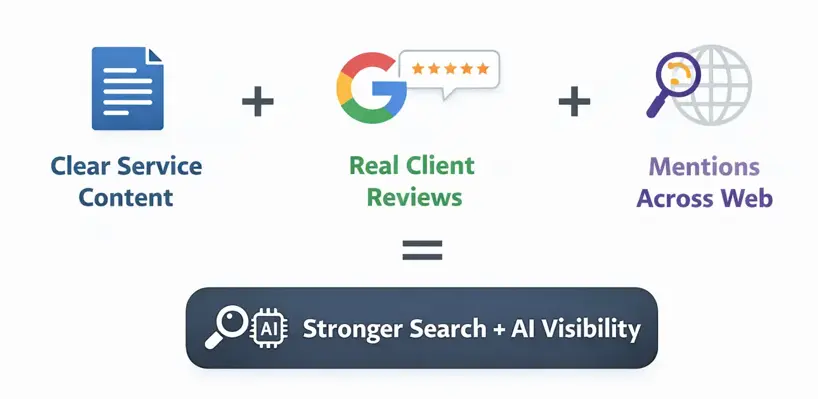
Content on your website is one of the strongest signals search engines use to understand what you do, but it is not the only one. Reviews and mentions of your firm across the web also play a role in how search engines and AI tools evaluate credibility and relevance.
When real clients leave reviews describing the type of help they received, it reinforces the services you provide and shows that real people are using your firm. These trust signals can support your visibility in search results and influence whether your firm is surfaced in AI-driven recommendations. Search engines and AI tools are constantly looking for consistent signals that a firm is legitimate, active, and experienced in specific areas.
Two of the most valuable places for tax resolution professionals to focus on reviews are Google Business Profile and TaxCure.
Google Business Profile reviews help strengthen your local visibility and overall online reputation. TaxCure reviews provide an additional layer of credibility within the tax resolution space and showcase feedback from real clients who received resolution services. Together, these help reinforce trust, support your digital presence, and provide confirmation to both search engines and potential clients that your firm is actively helping taxpayers resolve serious issues.
Encouraging satisfied clients to leave honest reviews over time is a simple but powerful way to strengthen your overall online presence and complement the content on your website.
Core Service Pages Most Tax Resolution Firms Should Consider
One of the easiest ways to strengthen your visibility in search is to make sure your website clearly lists and explains the services you actually provide. Many tax resolution websites stay very general, using phrases like “tax relief services” or “IRS help,” but they never break down the specific problems they solve. That makes it harder for search engines and AI tools to connect the firm with the right searches.
You do not need to create a page for every possible service if you do not offer it. However, for the services you regularly handle and want more of, it makes sense to have dedicated pages that clearly explain how you help.
Below are some of the most common service areas tax resolution firms may want to consider listing and expanding on if they handle these types of cases.
| IRS Services | Business Cases | State Issues |
|---|---|---|
| Offer in Compromise | Payroll Tax Problems | State Tax Debt |
| Installment Agreements | Trust Fund Penalties | State Garnishments |
| Innocent Spouse Relief | Revenue Officer Cases | State Liens |
| Penalty Abatement | Unfiled Business Returns | Sales Tax Issues |
| Wage Garnishment Help | Business Tax Debt | State Payment Plans |
| Bank Levies | ||
| Tax Liens | ||
| Audit Representation |
Not every firm handles all of these services, and that is fine. The goal is not to list everything possible. The goal is to clearly reflect the work you actually do and the cases you want more of.
If you regularly help clients with payroll tax issues but never mention payroll tax problems on your site, you are missing opportunities to appear in those searches. If you handle innocent spouse cases but have no page explaining that service, search engines have little reason to connect your firm with that topic.
Each core service you provide is an opportunity to create a dedicated page that explains the problem, how you help, and why someone should contact you. Over time, those pages build a stronger foundation for your website and make it easier for potential clients to find you when they search for help with those specific issues.
Understanding Content Types: Service Pages vs. Blog Posts
As you begin expanding your website, it helps to understand the different roles that service pages and blog posts play. Both are important, but they serve very different purposes and work best when they support each other.
Service pages are your core pages. These are the pages that explain the services you offer and the types of cases you handle. Their primary purpose is to convert visitors into inquiries by clearly showing how you help and why someone should contact you.
A strong service page should focus on the problem and your experience resolving it. It should explain who the service is for, what the process typically looks like, and how you help clients reach a resolution. These pages are not meant to be do-it-yourself guides. Instead, they should highlight your expertise and encourage someone to reach out for help. Clear calls to action and straightforward explanations go a long way here.
Blog posts serve a different role. They are designed to capture search traffic and answer specific questions people are typing into search engines. These are often more informational and can address concerns, timelines, notices, or common scenarios related to a service you provide.
For example, a service page might focus on helping clients stop IRS wage garnishments. Supporting blog posts could cover questions like when the IRS can garnish wages, how much they can take, or what notices are sent before garnishment begins. These blog posts attract people searching for answers and then guide them toward your service page when they realize they need help resolving the issue.
When service pages and blog posts are connected through internal links, they strengthen each other. Blog posts support and reinforce your service pages, and service pages provide a clear path for readers who are ready to seek professional help. Over time, this structure helps search engines and AI tools better understand your areas of expertise and improves your visibility across related searches.
Example Content Strategy: Building Authority Around One Service
One of the most effective ways to grow search visibility is to build depth around the services you most want cases in. Instead of creating random blog posts on unrelated topics, it is often more effective to focus on one core service and expand around it.
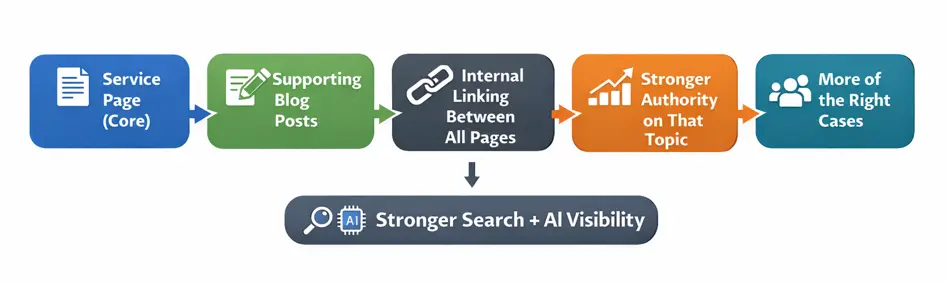
Take IRS wage garnishments as an example.
If stopping wage garnishments is a type of case you handle and want more of, it makes sense to have a dedicated service page focused on helping taxpayers resolve IRS garnishments. That page should clearly explain how you help, what options may be available, and why someone should contact you for assistance.
From there, you can build supporting blog posts around the questions and concerns people typically have when facing a garnishment. These might include:
- When will the IRS garnish my wages
- How much can the IRS garnish from my paycheck
- How to stop an IRS wage garnishment
- What notices the IRS sends before garnishing wages
- Will my employer find out I owe the IRS
Can the IRS garnish self-employed income
Each of these topics targets a specific search intent. Some people are trying to understand what might happen. Others are already being garnished and looking for ways to stop it. By creating content that addresses these different stages, you create multiple opportunities for people to find your website.
When these blog posts link back to your main service page and reference each other where appropriate, they begin to form a strong content cluster around that topic. Search engines start to see your website as more authoritative on IRS garnishment issues because you have multiple pages addressing different aspects of the problem. We have seen many instances where adding additional content around a single service lifts traffic across all related pages.
This same approach can be applied to other areas you want more cases in. Payroll tax issues, offers in compromise, audit representation, and state tax problems all have their own sets of questions and concerns that can support a core service page. Building depth around a topic over time helps strengthen your overall visibility and makes it easier for potential clients to find you when they search for help.
Consistency and Freshness Matter More Than Ever
If there is one factor that separates firms that see results from SEO and those that do not, it is consistency.
Publishing a few pages and then letting a website sit unchanged for years rarely produces meaningful results. Search engines and AI tools are constantly evaluating websites to see which ones appear active and up to date. Firms that continue adding content, updating existing pages, and expanding on their services tend to gain more visibility over time.
Consistency does not have to mean publishing large amounts of content every month. Even a steady pace of one or two new pages per month can make a noticeable difference over the course of a year. Firms that are more aggressive may publish two to four pages per month and build momentum more quickly. The key is choosing a pace that is realistic and sticking with it.
Updating existing content is just as important as creating new pages. We have seen many situations where an article performs well for years and then gradually loses visibility as information becomes outdated or competitors publish newer content. Simply revisiting that page, updating key sections, adding new information, and republishing it can restore traffic and improve performance. An active website signals an active firm.
Another benefit of consistency is that each new page strengthens the rest of your site. As you add more content around related topics and link those pages together, search engines begin to see greater depth and authority in those areas. Over time, this can lift visibility across multiple pages, not just the newest ones.
SEO works best when it becomes part of an ongoing routine rather than a one-time project. Firms that commit to regularly expanding and maintaining their websites are far more likely to build long-term visibility and attract the types of cases they want most.
Basic Writing Guidance for Tax Resolution Websites
Below are some of the most common SEO mistakes we see when firms try to handle this themselves.
| Mistake | What Happens | Why It Matters |
|---|---|---|
| Publishing random blog posts with no strategy | Firms write about whatever comes to mind instead of building around core services. | Random content rarely builds authority. SEO works best when content supports specific services and case types you want more of. |
| Not understanding searcher intent | Content is written from the firm’s perspective instead of what the taxpayer is actually searching. | Most clients search their problem, not your service. If content does not match real search intent, it will not attract the right traffic. |
| Trying to rank for overly broad keywords | Firms target terms like “tax relief” or “offer in compromise” and expect to rank quickly. | Many broad terms are dominated by government sites and large national firms. Better results often come from targeting more specific, realistic search angles. |
| Ignoring long-tail and smaller keyword opportunities | Firms focus only on a few big keywords and miss hundreds of related searches. | There are often hundreds of variations around each tax issue. Lower-volume searches can bring strong traffic because competition is lower and intent is high. |
| Not researching the competitive landscape | Content is created without reviewing what is already ranking. | If competing pages are detailed and comprehensive, very short or basic content may struggle to gain visibility. Understanding competition helps set realistic expectations. |
| Creating content that is too thin | Service pages or blog posts are only a few hundred words and lightly cover the topic. | Many top-ranking tax resolution pages are 1,200–2,000+ words and cover issues in depth. Thin content can make it harder to compete or be seen as authoritative. |
| Poor title tags and meta descriptions | Pages are published with generic or unappealing titles and descriptions. | Title tags and meta descriptions are the entry point into your content. They influence click-through rates and help search engines understand what the page is about. |
| Trying to be too broad about services | Websites list “tax relief” but do not clearly break down specific services. | Search engines and AI tools rely on clarity. If services are not clearly listed and explained, it is harder to appear for related searches. |
| Inconsistent publishing | Firms publish a few pages and then stop for long periods. | Consistency signals an active firm. Even 2–4 new pages per month can build momentum and long-term visibility. |
| Not updating older content | Existing articles and pages are left untouched for years. | Updating and expanding older content can restore rankings, improve traffic, and signal freshness to search engines and AI tools. |
You do not need to be a professional writer to create effective content for your website, but structure and clarity matter. Well-organized pages that quickly address what someone is looking for tend to perform better in search and keep readers engaged.
Service pages should be focused on the work you do and the types of cases you want more of. Start with a clear introduction that explains the problem and who the service is for. From there, outline how you help, what the process may look like, and why someone should contact your firm rather than trying to handle the issue on their own. These pages should highlight your experience and encourage someone to reach out, not provide a full do-it-yourself guide.
Clear calls to action are important. Make it easy for someone to contact you by including phone numbers, contact forms, or consultation requests in logical places throughout the page. Visual elements such as simple graphics, charts, or step-by-step outlines can also help break up text and keep readers engaged.
Blog posts serve a different purpose. They should focus on answering specific questions or addressing concerns someone may have about a tax problem. Try to address the main search intent within the first few paragraphs so readers immediately know they are in the right place. From there, expand on the topic with clear headings and short sections that are easy to scan.
Including a brief summary, key takeaways, or a table of contents near the top can help orient readers and improve engagement. Many firms also find value in adding a short FAQ section at the end of blog posts that addresses related questions. This can help search engines and AI tools better understand the content and connect it to relevant searches.
Each blog post should naturally guide readers toward a related service page when it makes sense. Someone reading about IRS garnishments, for example, may be looking for information, but they may also realize they need help stopping the garnishment. Providing a clear path to your service page helps convert that interest into an inquiry.
Well-structured content that clearly addresses problems and solutions not only performs better in search, it also creates a more professional experience for potential clients who visit your site.
The Reality: Most Firms Do Not Have Time to Do This Consistently
Most tax resolution professionals understand the value of SEO. The challenge is not knowing what to do. The challenge is finding the time to do it consistently.
Between client work, deadlines, and running a practice, writing service pages, planning blog topics, and updating older content often gets pushed aside. Many firms start strong but struggle to maintain momentum once things get busy.
Whether you decide to handle SEO yourself or eventually have someone help you, consistency and a clear strategy are what make the biggest difference. Firms that treat SEO as an ongoing investment and continue expanding their websites over time are far more likely to build lasting visibility and attract the types of cases they want most.
How TaxCure Supports Members With SEO Strategy
At TaxCure, we work with tax resolution firms of all sizes and regularly review websites to see how clearly they reflect the services a firm actually provides. Often, small adjustments and a more consistent content strategy can make a meaningful difference in long-term visibility.
For TaxCure Pro members, we offer a no-obligation website and strategy review. This is a high-level conversation where we look at how your site presents your services today and provide general feedback on positioning, visibility, and opportunities to strengthen your content over time. The goal is simply to give you practical direction based on what we see working across the tax resolution industry.
If you are a Pro member and would like us to take a look, you can request a strategy review here. We keep these fairly limited due to time, but we are always happy to connect when schedules allow.
Not a Pro member yet? Upgrade to TaxCure Pro to access strategy reviews and additional growth resources.
If you decide you would rather have a team handle the strategy and execution for you, TaxCure also offers SEO services specifically for tax resolution professionals. We work with firms across the country to plan content strategies, identify service and topic opportunities, and consistently expand their websites with high-quality content. Our team develops topic plans based on the types of cases you want more of, writes and publishes content, handles internal linking, and helps implement website updates that strengthen overall visibility. We use industry-specific tools to analyze rankings, identify realistic opportunities for growth, and build structured content strategies designed to improve long-term search and AI visibility.
Final Thoughts: Treat SEO as a Long-Term Asset
SEO is not a quick win or a one-time project. It is a long-term asset that builds over time and continues working for your firm long after a page is published.
The firms that benefit most are not always the ones doing the most at once. They are the ones that stay consistent, continue expanding their websites, and make sure their content clearly reflects the services and cases they want more of. Over time, that consistency builds authority, strengthens visibility, and creates more opportunities to be found when someone searches for help.
Referrals will always be valuable, but having a website that consistently attracts the right types of cases gives your firm more control over its growth. Whether you decide to handle SEO yourself or eventually have someone help you build and maintain a strategy, the key is to treat it as an ongoing investment rather than something to revisit once a year.
A well-built website that clearly communicates what you do and continues to grow over time can become one of the most reliable marketing assets your firm has.
Example: Simple 6-Month Content Plan (3 Pages Per Month)
If you are looking for a practical way to approach SEO without overcomplicating it, a steady plan of three new pages per month can build real momentum over time. The goal is to first create core service pages around the types of cases you want more of, then build supporting content that strengthens those pages and attracts search traffic.
Below is a simple example of how this could look.
| Month | Focus | Pages |
|---|---|---|
| Month 1 | Core service pages | OIC, Garnishment, Audit |
| Month 2 | Supporting blogs | OIC downsides, Garnishment timing, Audit penalties |
| Month 3 | More support content | Settle taxes truth, Stop garnishment, Audit dispute |
| Month 4 | New service pages | Liens, Unfiled returns, IRS notices |
| Month 5 | Supporting blogs | Appeal lien, Mortgage w/unfiled returns, LT11 notice |
| Month 6 | More support content | Discharge lien, Jail for unfiled?, CP14 notice |
By this point, you have created multiple service pages supported by several related blog posts. Each new article reinforces the others through internal linking and topical depth. Instead of publishing random content, you are building structured authority around the services you want more of, which helps search engines and AI tools better understand your expertise and connect you with potential clients.